Westminster Confession of Faith 3.1–3.2 (in Simple Language):
3.1
God has a wise and holy plan for everything that happens. He decided from the
very beginning how things would work out. This doesn’t mean God causes sin or
is responsible for evil. God’s decision doesn’t remove people’s freedom.
Instead, human choices can be truly significant, since God is making sure His
good and holy will always happens.
3.2
Although God decided from eternity what would happen, He didn’t do this
based on looking into the future or seeing what people would choose.
Introduction:
As Christians, we often say things like “God’s will be done” or “I hope what I’m
doing is God’s will.” WCF affirms that God’s will is like a plan that will unfold
with certainty. God knows what he wants, and it will surely happen. Let me
first explain why the writers of the Confession had to emphasize this. In their
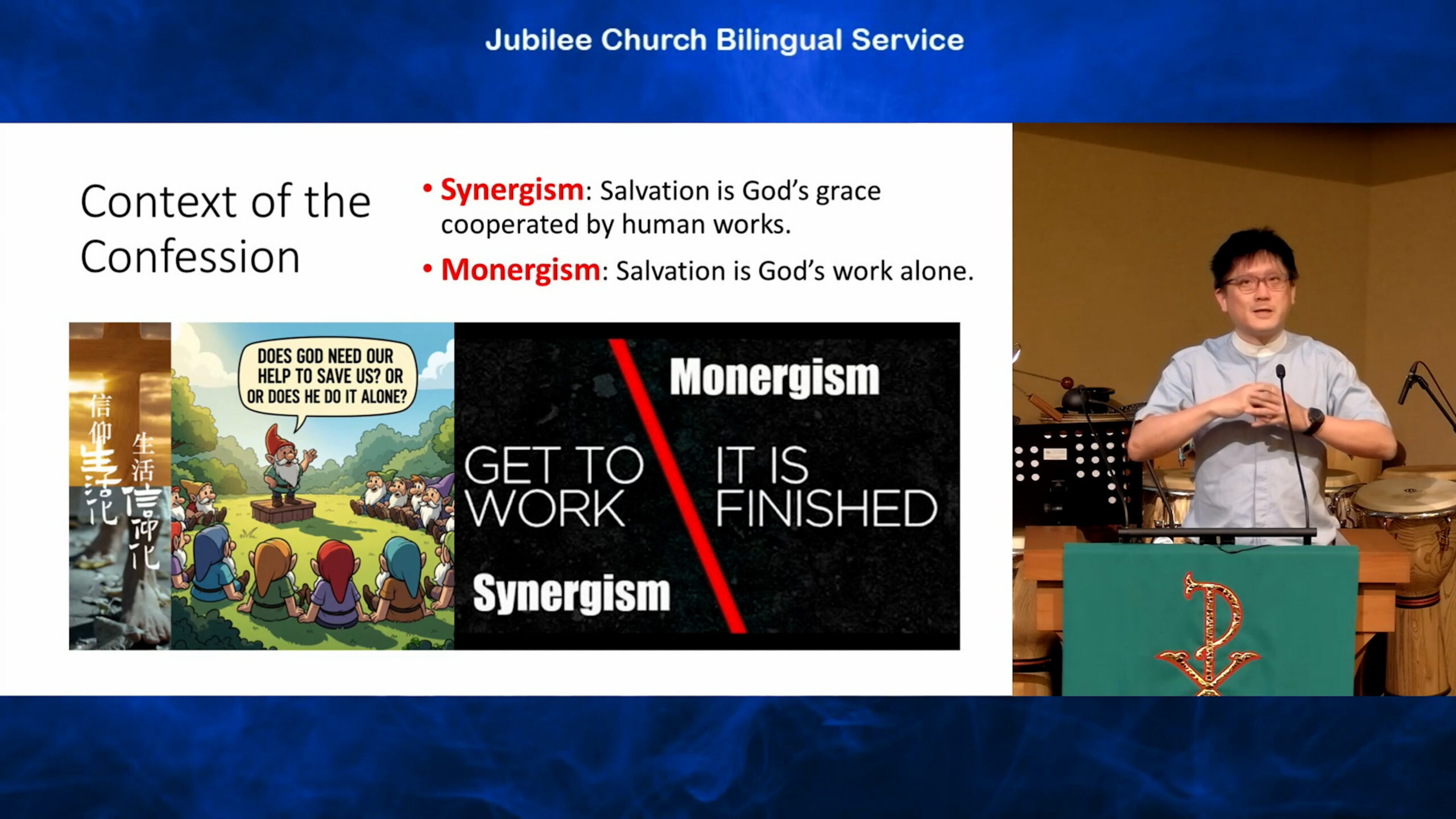
day, there were some who taught that we can “complete” God’s grace
ourselves — that salvation is a joint effort between God and man (this is called
Synergism). In that view, grace was “offered” by God, but the sinner had to
complete the work by aligning their will and works with God’s grace. The
Confession then responded sharply against this view, reminding the church that
grace belongs to God alone (this is called Monergism). Salvation is God’s work
from beginning to end. Righteousness cannot be attained through works but
solely by divine grace. Against a Catholic worldview where human merit can
“add” to God’s work, the Confession asserts that God is the sole author of our
salvation.
The Flaws of a Deterministic Reading
Although Westminster aims to ward off both synergism and righteousness from
works, its teaching on God’s will has such an absolute certainty on future
events, that it can be misunderstood as determinism. Here’s where things can
get tricky. When we think of the concept of “sole author,” God’s will is
sometimes explained like a giant clockwork mechanism, with every moment and
decision pre-determined down to the second. God is the first cause that starts
the ball rolling, and everything else that follows is just a domino effect from that
first cause. Is life like a script where every scene is already fixed? Such a view of
God’s will is also associated with Fatalism. Whatever must happen will happen
anyway. In that view, life can feel meaningless. Prayer can seem pointless.
Obedience can seem irrelevant.
I call this a misunderstanding because the theologians who drafted the
Confession believe in compatibilism. Compatibilism is the idea that God is
completely in control of everything (yes, He’s sovereign), and at the same time,
we are truly free to make real choices. Hence the name Compatibilism. So, this
is the challenge: Can God’s Will Be Sure Without becoming Determinism?
James O. Buswell: God of the Bible, not God of Philosophy
This might sound rather impossible, but here’s the good news. Fortunately, it
has been almost four centuries since the Confession is drafted, and we have
theologians, many of them Presbyterians who have offered solutions to improve
our understanding. Today, I will just introduce five.
The first I want to introduce is James Buswell. He was a Reformed theologian
who was concerned that some Christian thinking had become too influenced by
old philosophical ideas, especially from Plato and Aristotle. They made God
sound like a distant, unmoving being, called the first cause. This "static" view of
God, as he called it, came more from Greek philosophy than from the Bible.
He reminded the church that we must talk about God based on how the Bible
reveals Him—not on abstract logic or philosophy.
Daniel Migliore: The True Nature of God’s Will is in Christ
Building on this biblical vision, Daniel Migliore is another Presbyterian
theologian who teaches us to rethink God’s sovereignty. The bible reveals that
God’s power to rule is always being shaped by His character of love and
faithfulness to his people.
In Faith Seeking Understanding, he writes:
“The final meaning of God’s omnipotence is not sheer power to determine all
things in advance, but the power of God’s suffering and redeeming love to bring
life out of death, hope out of despair.”
Migliore affirms WCF’s conviction that salvation belongs to the Lord. But if
God's sovereign will is communicated in a way that leads people to
helplessness, it ceases to be good news. For Migliore, God’s will must ultimately
point us to Jesus Christ. Jesus shows us that God’s way is not to force
outcomes, but to transform people by love. He invites, He calls, He waits, and
He rejoices when we trust Him.
To sum up, Buswell and Migliore return us from a conceptual God of the
Philosophers to the God of Scripture—living, loving, and relational. We
understand God not only as the Alpha and the Omega, but also as the one who’s
ultimate will is for his dwelling place to be among the people, and he will dwell
with them (Revelation 21). In Jesus Christ we have the divine proof of that:
John 1: 14 The Word became flesh and made his dwelling among us.
Heeding Buswell and Migliore’s reminder, let’s look at the bible passage I have
chosen for today:
Isaiah 46: 8 “Remember this, keep it in mind,
take it to heart, you rebels.
9 Remember the former things, those of long ago;
I am God, and there is no other;
I am God, and there is none like me.
10 I make known the end from the beginning,
from ancient times, what is still to come.
I say, ‘My purpose will stand,
and I will do all that I please.’
11 From the east I summon a bird of prey;
from a far-off land, a man to fulfill my purpose.
What I have said, that I will bring about;
what I have planned, that I will do.
12 Listen to me, you stubborn-hearted,
you who are now far from my righteousness.
13 I am bringing my righteousness near,
it is not far away;
and my salvation will not be delayed.
I will grant salvation to Zion,
my splendor to Israel.
In Isaiah 46, Prophet Isaiah addresses a people suffering in exile. We can find
four truths about God that shed light on the mystery of His will. I am using the
HDMI acronym to help us remember them. HDMI stand for High-Definition
Multimedia Interface.
1. High: God’s will is above all other wills. God can and will accomplish His
future promises to his people.
2. Definition: God acts according to who he is: righteousness and rooted in
his faithful covenantal love with his people.
3. Multimedia: God gives His people the space and responsibility to respond
in obedience and trust, using words like “remember this” and “listen to
me.” God sends his prophets. God uses events. God relates to the state
of his people.
4. Interface: God’s interaction is at that present moment. God is present
with His people at that very moment.
On one hand, Isaiah 46 and WCF 3.1-3.2 seems to be in agreement. God has a
wise and holy plan for the salvation of his people. On the other hand, Isaiah 46
illustrates that there was a real-time interaction between God and his people.
God is not a detached watchmaker. The God who declares the end from the
beginning is deeply involved in every step. God’s will is HDMI. Not just in Isaiah
46, the biblical record is filled with moments when prayer, obedience, or
repentance seem to affect outcomes (Exodus 32:14, 2 Kings 20). If this is the
case, then God’s sovereign will is not like a king that dictates every single event
that happens. Yes, the entire domain falls under his rule, but he is governing in
a way that still allows for human involvement.
Back to the Challenge: How can God’s will be set from eternity (which is what
WCF3.1-3.2 wants to safeguard) without becoming a rigid blueprint
(Determinism or Fatalism)? If I stop at Buswell and Migliore, then the answer
will be “Look at the Bible, then focus on his ultimate revelation in Jesus. Jesus is
the proof that God’s will is not determinism.” If we stop here, we have a
perfectly biblical understanding of God’s will in time.
But for some of you who are more analytical, you might also want a theological
explanation that helps you makes sense of the God’s Will vs. Free Will
conundrum. So for those who want something that makes good logical sense of
the conundrum, I will now introduce another three theologians whose
suggestions sounds good to me.
The Questions We All Ask
Before, I proceed further, I want to state up front that today’s topic is not about
abstract or theoretical questions. I’m sure that there are times when you have
wondered why certain things happen? I am well aware that with all the “-isms” I
have mentioned so far, the entire sermon may sound like a bunch of irrelevant
jargons. But these theological reflections arise from moments of heartbreak,
struggle, or confusion — moments that matter deeply. I share this, believing
that if we have a clear perspective of God’s will in time, it should transform the
way we interact with God, and also how we think about what’s happening in the
world.
William Lane Craig: A God Eternal Yet Engaged
The first issue we need to solve is God and Time. How can God who is eternal
also be interacting in time with humanity? To deal with this, I turn to William
Lane Craig. In his essay “God, Time, and Eternity,” Craig argues that God is
eternal and unchanging in His being, but the moment He creates the world, the
moment when there is time-space, then God enters into time and becomes
responsive to history. According to Craig, the moment time is created by God,
then even God has to be subjected to the dimension of time.
Imagine a director of a play who also steps onto the stage as an actor. As the
director, he knows the ending. He wrote the story. But as an actor on stage, he
experiences each moment in real time. This stage production also happens to
be like an improv because the director likes his actors to have free will. So, the
actor-director also has to listen, react, and respond to the other actors in real
time.
If you think Craig’s proposal makes sense, don’t worry, God’s sovereign plan is
still secure. But the plan needs to unfold in time till time is no more. Meanwhile,
God is now in this very present moment. He listens, He waits, He acts within
time. This helps resolve the philosophical tension between foreordination
(God’s eternal will) and the biblical narratives of divine involvement.
Terrance Tiessen: Maybe God Knows What We Might Freely Do
Craig’s view of God and Time coincides with another theologian Terrance
Tiessen. In Providence and Prayer, Tiessen critiques the classical view of divine
timelessness by arguing that it ultimately renders God’s relationship to creation
unintelligible. He writes:
“To posit that God is outside of time—atemporal—is to assert that he has no
succession in his being, that there is no before or after in God. But this raises
severe difficulties for divine interaction with a temporal world. If God is
timeless, how can he respond to the prayers of his people or act within history
without already having determined all things eternally and immutably? It seems
impossible for a timeless God to have a real relationship with time-bound
creatures.”
Tiessen is in full agreement with Craig. God exists temporally in relation to
creation, thereby allowing for meaningful providence and interaction.
The next issue I want to solve is God and Foreknowledge. Foreknowledge is
God knowing future events like Judas’ betrayal and Peter’s three times denial of
Jesus. If the future has not existed yet, and if even God is in the present
moment right now with us, then how does God know the future? How can God
guarantee His sovereign will while giving real freedom to people? How can he
claim that his eternal will would surely happen?
Tiessen proposes a “Calvinistic model of middle knowledge.” Middle knowledge
is the idea that God knows not only what will happen, but what could happen
and what would happen under any set of circumstances. Think of it as God
seeing the entire multiverse that can sprout from this present moment. Having
middle knowledge allows God to sovereignly arrange the world in such a way
that His purposes are fulfilled through the free choices of individuals. God’s
vision of the future will happen for sure, but the future doesn’t need to “exist”
as a fixed script. Instead, it emerges from the interplay between God’s eternal
purpose and our decisions out of free will.
Imagine using a GPS. You set the destination, but you can take different roads.
Sometimes you make a wrong turn, but the GPS recalculates and gets you back
on track.
That’s like God’s wisdom. He doesn’t just know what will happen — He knows
what could happen. He knows all the roads and how to get there no matter
what. He guides us, even when we get off track. Our choices are real, but God is
always at work, weaving them into His plan.
I’m reminded of the story of Esther. There is a moment when Mordecai asked
for her help to save their fellow Jews. We see this dynamic of God-human
interplay beautifully in Mordecai’s words to Esther: “For if you remain silent at
this time, relief and deliverance for the Jews will arise from another place, but
you and your father’s family will perish. And who knows but that you have come
to your royal position for such a time as this?” (Esther 4:14). Mordecai affirms
that God’s saving purpose will not fail—even if Esther refuses to act. Yet at the
same time, he urges her to see that her current position as a part of God’s plan.
Still, her choices and her courage truly matter. She is not a puppet. Like the GPS
that recalculates toward the destination, God will fulfill His will—but He also
invites us to be part of the journey.
For anime lovers, you can think of it like Isagi in Blue Lock. Tiessen’s model does
not make human freedom ultimate; instead, it makes divine wisdom more
expansive and far-reaching. The future can twist and turn, but the destination is
certain. God, in His perfect knowledge, creates a world where His glory and
human response coalesce—not because He overrides the will, but because He
knows precisely how to orchestrate the story.
Sometimes, even when God is guiding us, life still goes sideways. There are
unexpected undesirable experiences. It’s not always because of sin—sometimes
it’s just part of living in a broken world.
G.C. Berkouwer, a Dutch Reformed theologian, called this God’s permissive
will. It means God may not always interfere with painful things that would
happen due to free will, even though He doesn’t desire them. In contrast, His
perfect will is what He delights in.
God’s permissive will and perfect will aren’t two separate plans—they’re two
ways God relates to a messy world. Even though we know everything is
technically God’s will, it matters that we acknowledge there is God’s perfect will
which follows God’s desire, and there is God’s permissive will which is not God’s
true desire.
G.C. Berkouwer: God’s Will Works Together With Ours
This brings me to the final issue I want to solve: the issue of free will. I want to
introduce another of Berkouwer’s key idea: double agency. Double agency
means that God is at work in everything, and so are we. It’s not either-or. It’s
not 50-50. It’s both at the same time. And both are real, meaningful actions.
In Taiji, a master doesn’t resist your force with brute force. Instead, they use
your movement to guide the outcome — 借力打力, or “borrowing force to
redirect force.”
This could be a way to understand double agency: God’s work with our will. We
move, and He moves with us. We act, and He uses our actions — even the
wrong ones — to bring about His good purpose.
So when we obey, it matters. When we resist, God still works. Our faith, our
choices, our prayers — they’re real. And they are being used by God in His plan.
This idea helps us avoid two common extremes. On one side is synergism,
which makes it sound like salvation is partly God’s work and partly ours, like a
combined team effort. On the other side is determinism, which treats our
choices as illusions. Berkouwer’s view matches what we see in the Bible—God
speaks, we respond. God leads, we follow. Some may say, since God’s will
happens anyway, does it matter whatever we do? I think it matters. Do you
want God to work through you (like Esther), to work around you (if Esther had
stayed silent), or worse, to work against you (like God using Haman against
himself)? Again, do you want God to work through you, to work around you, or
worse, to work against you? I think we agree that the double agency is most
fulfilling when God works through us, our will in tandem to his perfect will.
Allow me to sum up what three theologians have offered as a form of a
theological explanation for compatibilism. Being in the present moment allows
God to interact with us in real time. God can still have concrete foreknowledge
by knowing all the possibilities that can be routed to his final objective. And
through double agency, our will is not canceled but called—summoned into the
drama of God’s salvation plan.
Conclusion: Living with God’s Will in Real Life
So how do all these deep theological reflections help us when life gets
hard—when things go wrong, when we face disappointment, or when prayers
seem unanswered? How do we live out the truth that God’s will is sovereign,
yet our choices matter?
Together with Isaiah 46, I hope to demonstrate that when we let Scripture lead
(Buswell and Migliore) and use careful theological reasoning (Craig, Tiessen, and
Berkouwer), we can say with confidence: God’s will is sure, and our lives and
decisions can still matter. Faith and freedom can go together.
Let’s go back to the four truths from Isaiah 46, now seen in a fresh way through
the help of these theologians. God’s will is HDMI.
First is High, we can trust that God’s purpose will stand. His plans are not
thrown off by your mistakes or by the evil in the world. He is still working things
out, step by step, in time. So, when life feels uncertain, we don’t need to panic.
God’s plans are firm, and we are safe in His hands.
Second is Definition, knowing that God is love, we can respond with faith. Your
past doesn't disqualify you. There is always room for hope, change, and
restoration. Even when things go wrong, God can weave your story into
something beautiful. You’re not stuck—you’re being shaped by God’s salvation
plan.
Third is Multimedia, we can live with confidence that our decisions matter. God
works with us, not against us. That means your faith, your obedience, your small
acts of love—they all matter. When you choose to forgive, or serve someone in
need, or resist temptation, you are living out God’s will in real time. Your
choices are real. Your life has purpose.
Fourth is Interface, we can be comforted that God is not far away or unfeeling.
That means when you feel lost or confused, you’re not alone. God is with you in
the moment. He is not just watching from above—He is walking with you. You
can pray honestly, cry out to Him, and trust that He hears and cares.
So when you ask, Why did God let this happen? or Where is God in all this?,
remember:
When life feels off-course, think of the GPS. God knows how to recalculate.
When you feel unseen, remember the director who stepped on stage with you.
When you feel powerless, remember the Taiji master who redirects strength
into something good.
So today, take heart. The God who knows the end from the beginning also walks
with you in every step. It means we move forward with courage, knowing we
are not alone.
Amen.
Appendix
WCF Chapter 3.1-3.2
Of God’s Eternal Decree
1. God from all eternity did by the most wise and holy counsel of His own
will, freely and unchangeably ordain whatsoever comes to pass; yet so as
thereby neither is God the author of sin; nor is violence offered to the will
of the creatures, nor is the liberty or contingency of second causes taken
away, but rather established.
2. Although God knows whatsoever may or can come to pass, upon all
supposed conditions; yet hath He not decreed any thing because He
foresaw it as future, as that which would come to pass, upon such
conditions.