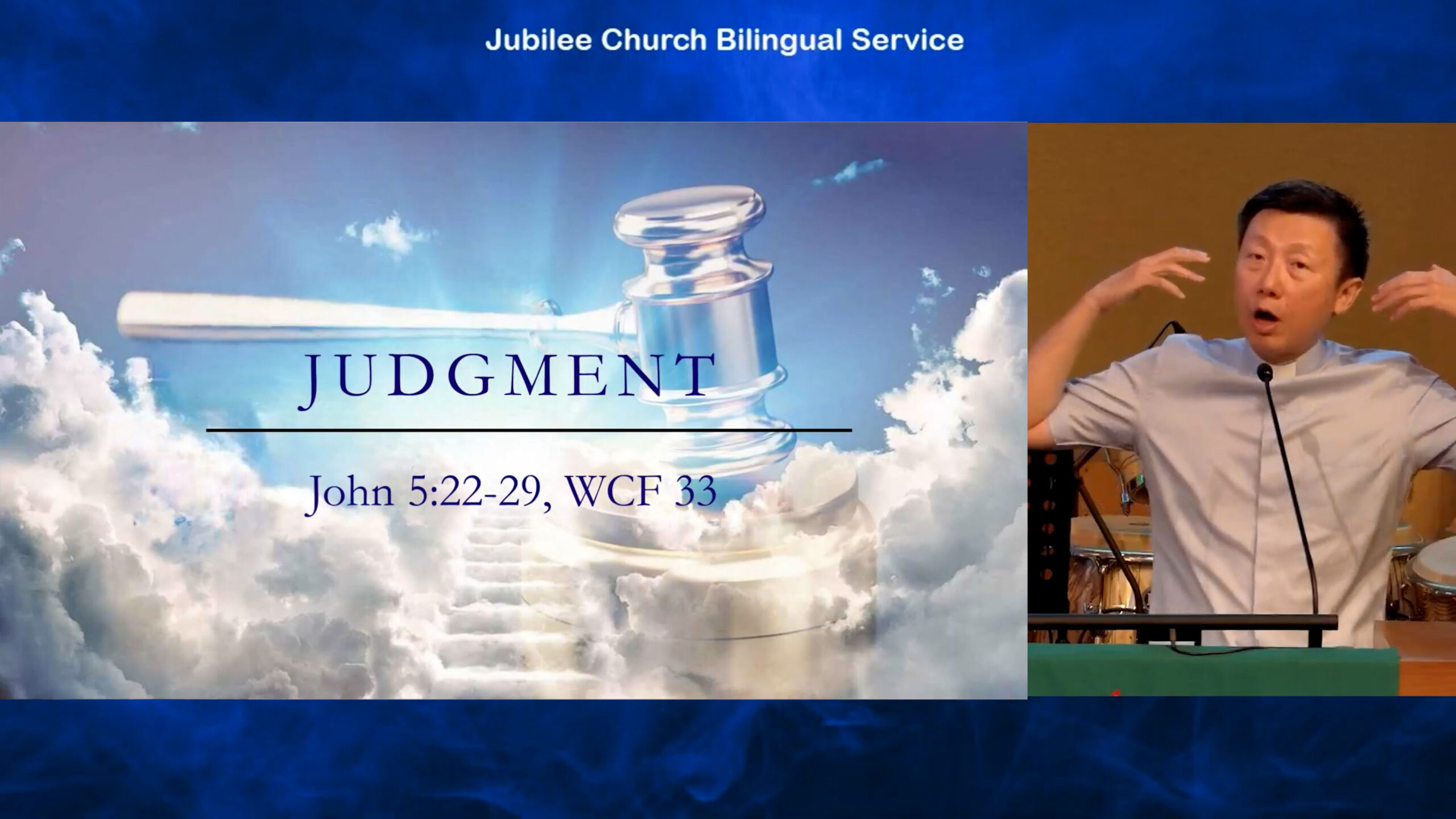
Introduction
This closing chapter of the Westminster Confession of Faith brings us to a serious topic: the Final Judgment. Jesus speaks of it multiple times in the gospels, and always as something certain—something every person will face. Yet it is also a doctrine that is easily misunderstood. Popular media turns it into a caricature of divine anger. Within the Christian circles, it is sometimes described in ways that miss the fuller biblical picture: that the Final Judgment is not only about justice, but also about hope and comfort for those in Christ.
So this morning, as we look at this final chapter, we want to ask: What does the Bible actually teach about the Final Judgment? Why does it matter? And how do we hold together both its seriousness and its hope as Scripture presents them?
Before looking at what the Confession says, let’s hear Jesus’ own words in John 5. These verses form the foundation for our understanding of the Final Judgment, and they will guide us as we consider WCF 33.
John 5:22-29
22 For the Father judges no one, but has given all judgment to the Son, 23 that all may honor the Son, just as they honor the Father. Whoever does not honor the Son does not honor the Father who sent him. 24 Truly, truly, I say to you, whoever hears my word and believes him who sent me has eternal life. He does not come into judgment, but has passed from death to life.
25 “Truly, truly, I say to you, an hour is coming, and is now here, when the dead will hear the voice of the Son of God, and those who hear will live. 26 For as the Father has life in himself, so he has granted the Son also to have life in himself. 27 And he has given him authority to execute judgment, because he is the Son of Man. 28 Do not marvel at this, for an hour is coming when all who are in the tombs will hear his voice 29 and come out, those who have done good to the resurrection of life, and those who have done evil to the resurrection of judgment.
These verses—especially verses 28 and 29—show us that two things will take place.
First, Scripture speaks of a day this is certain and unavoidable, called the Day of the Lord or the Day of God’s wrath, when the universal Judge shall take His seat.
Second, that day is not simply a day of condemnation. As N. T. Wright puts it, it is “the time when everything gets sorted out, when everything that needs putting right is put right.” [i]
- With these two points in mind, we come now to WCF 33.1. It tells us that at the appointed time, Christ will judge the thoughts, words, and deeds of every being who has ever lived — even the apostate angels.
We may feel quite neutral — or even relieved — to hear that the apostate angels will be judged. But when the same judgment is applied to humanity, we hesitate. It feels more natural to assume that a good God would never punish anyone. Yet Scripture says the opposite.
Romans 3 teaches that when God judges and inflicts wrath, He is being exactly who He is: faithful, righteous, and perfectly just (Rom 3:3-6). Judgment is not God setting aside His goodness — it is His goodness taking the form of justice.
We know this instinctively. When someone who steals is punished, we see fairness restored. When a murderer is held accountable, the value of human life is upheld. If this is what justice looks like among us, how much more in God’s perfect judgment.
And justice, if it is justice at all, cannot be selective. It must be applied fairly and universally. This means that believers, too, will stand before the judgment seat of Christ. The difference — as Jesus teaches in John 5:29 and as Paul explains in 1 Corinthians 3:14–15 — is not whether we are saved, for our salvation in Christ is secure. Rather, our thoughts, words, and deeds will be examined and evaluated.
Paul goes on to say that if a believer has built his life on things that do not belong to the kingdom — works shaped more by worldly wisdom than by the gospel — those works will be burned up. The person himself will be saved, Paul says, “but only as through fire.” In other words, it is possible to enter the kingdom with very little to show for one’s life — saved, but empty-handed.
Scripture also warns about another group entirely. Paul warns us against merely claiming to belong to Christ while living lives that prove otherwise. In Galatians 5:18–21, he makes it plain that a life consistently marked by the works of the flesh shows that a person is not being “led by the Spirit,” and such a person “will not inherit the kingdom of God.”
Here is where the Confession helps us. It moves from the reality of judgment to the purpose of judgment, which brings us to WCF 33.3, a paragraph worth hearing in full:
As Christ would have us to be certainly persuaded that there shall be a day of judgment, both to deter all men from sin; and for the greater consolation of the godly in their adversity: so will he have that day unknown to men, that they may shake off all carnal security, and be always watchful, because they know not at what hour the Lord will come; and may be ever prepared to say, Come Lord Jesus, come quickly, Amen.
This section of the Confession lays out two purposes, let’s consider them one at a time.
We begin with the top half, which — after reaffirming that the day of wrath will surely come — explains why Scripture speaks so directly about it: to “deter all men from sin,” and to comfort the godly who suffer, assuring them that the perfect Judge will one day set everything right.
Let me illustrate what this top half is getting at with a recent piece of news from CNA.
Some of us might have seen this report from CAN on traffic cameras.[ii] New traffic cameras have been installed across the island to catch offences such as illegal U-turns, and to date they have recorded over 6,000 incidents. But once you read beyond the headline, the purpose of the report becomes clear: it is signalling to the public that a trial is underway — and that everyone should start getting ready for the cameras’ full deployment
And here comes the “oh, how fortunate” part — because it is still only a trial, no action will be taken against those offences. The article even lists the current camera locations and notes that more units will be deployed. It also informs readers that the cameras will not be fully operational until sometime in the first quarter of 2026 — though without stating the exact timing.
Is this bad news? Yes — because once fully operational, offenders will be penalized. Is it good news? Also yes — because announcing the trial serves as a warning. It prepares drivers to obey now, before enforcement begins.
I find this a helpful parallel to what Scripture and WCF 33 are doing. Declaring the certainty of judgment is not meant to scare us, but to motivate us: to choose to live godly lives, to let Jesus and His gospel flow through our thoughts, words, and deeds, and to persevere in adversity — for the perfect Judge will come in His timing to set everything right.
The second half of WCF 33.3 emphasises the uncertainty surrounding the day of God’s wrath. Jesus Himself once said that even He did not know when that day would come. Yet this very unknown has a purpose: to cultivate readiness in us.
This is a timely reminder, especially when we consider how people often come to Christ today. In sharing the gospel, Christians — not wanting to be pushy — often invite pre-believers to “receive Jesus.” There is nothing wrong with gentleness. But framing the gospel only as an invitation carries certain problems.
For one, Scripture teaches that on the day of judgment God will not issue invitations; He will summon all who have ever lived before His judgment seat. Seen in this light, that language can be misleading.
And more than that: starting the Christian life on the basis of an invitation can subtly shape how people think about discipleship. Obedience can begin to feel like a personal option rather than the command of the Lord. What begins gently can, over time, blur the seriousness of Christ’s call to follow Him.
Before saying more about this tendency, perhaps a brief word about how we share the gospel. Instead of asking, “Do you want Jesus?”, we can simply present what Scripture says: what Jesus has done, what He teaches, what He desires for His world, and how He is already at work to renew it. And let our hearers raise their questions and responses.
This suggestion not work, but one thing it does is to let the gospel speak for itself, and the Holy Spirit to work in our hearers. This doesn’t mean we should never invite someone to come to Christ; invitations have their place. But our aim should be to proclaim the gospel in its fullness — and that fullness includes the truth that Jesus saves us not only from sin, but also from the day of judgment.
Returning to our point: obedience is not optional. Yet it is often hard for us to think this way — especially if our spiritual journey began with us choosing to “want Jesus.” Even Saint Augustine once prayed, “Give me chastity and continence, but not yet.” We long to be transformed, yet part of us hesitates.
Still, transformation is both our calling and a real possibility. Countless saints, ancient and modern, show us that change is possible when God works in us. And God, in His wisdom, helps us along this journey. He leaves some things unknown so that we stay watchful. He gives us His Spirit to guide us as we plod faithfully on our heavenward path. And He gives us the Church — its practices, teachings, and shared life — to help us grow in grace.
Very soon we will enter Advent, a season when the Church remembers that Christ once came and that He will come again — at any time, like a thief in the night. So may our reflection on WCF 33 stirs us toward greater intentionality in obeying God and in being ready for His return.
II.
Having considered WCF 33.1 and 33.3, we now turn to WCF 33.2 to cover the chapter
This section focuses on the declaration of God’s glory. As one writer puts it, “Heaven declares the glory of God’s grace; hell declares the glory of God’s justice.”[iii] Yet we must still wrestle honestly with the reality of hell, or “eternal torments,” as the Confession describes it.
The New Testament gives us several images of hell.[iv] These descriptions may be symbolic rather than literal. Jude, for instance, speaks of hell as both fire and darkness—a combination physically not possible, yet together, these descriptions vividly portraying utter and final anguish.
But why are we given these descriptions? Packer explains: “ “New Testament teaching about hell is meant to appall us and strike us dumb with horror, assuring us that, as heaven will be better than we could dream, so hell will be worse than we can conceive. Such are the issues of eternity, which need now to be realistically faced.”[v]
In simpler terms, Scripture warns us about hell to deter us from it, and to encourages us to choose grace, the saving grace of Jesus Christ.
To picture what WCF 33.2 is doing, imagine an Escape Room. The clock is ticking, the doors are locked, and the only way out is to find the clues and follow the correct path. You may ignore the clues or try to break the rules, but you remain stuck—and when time runs out, you lose. In the same way, the biblical teaching on hell function like the locked room: it points us to Jesus as the only way out. He is the path from sin and death into life everlasting. Choosing His grace is the positive message of WCF 33.2.
One clarification is needed. Some Christian traditions have taught that God sends people to hell simply for refusing to believe the gospel. But this view does not align with Scripture. God, who is unchanging, has made clear in the book of Amos that His judgment is based on what people do. Persistent evil, rebellion, and injustice—not mere disbelief—bring about downfall.
III.
So — hell is real, and judgment is certain — but fear is not where the Bible leaves us.
The Judge whom every created being will one day face is the very same One who became the Saviour of humankind.
We who gather here this morning know ourselves to be saved — saved from sin and unrighteousness, saved from being lost, and even saved from the emptiness and meaninglessness of life. And though we may not enjoy being reminded of it, salvation also means deliverance from the coming day of wrath.
Whether or not we have reflected on it today, we cannot fully shake off our feelings of hesitation and uncertainty about that day. Yet Scripture declares clearly and confidently that Christ will deliver us from the wrath to come” (1 Thess 1:10) .
And who will this Judge be on that day? He will be the One who is wholly just — the One before whom all evil will finally be “named, shamed, and dealt with.” [vi]
He will also be the One who is incomparably merciful — the One who walked among us, who knows our frailty, and who does not demand perfect obedience before welcoming us into His kingdom.
With this biblical portrait of the Judge and of the judgment, we are not invited into fear but into hope. And so we can join Goldingay and Wright, who remind us that God’s coming judgment gives us “reason for a shout of praise,” and that His future judgment is “a good thing, something to be celebrated, longed for, yearned over.” [vii]
So may we, in sum, choose to look toward it with a deep sense of hope.
Call now, O sinner, on your coming Judge
To be here even now as your Savior
Fall now, O sinner, on the mercy and grace
Of Jesus, our Judge and our Savior
Who is He we shall meet at the end of life’s road?
The One who will judge every heart, every soul?
Who is He who will one day sift the tares from the wheat?
Jesus, our Judge and our Savior
Call now, O sinner, on your coming Judge
To be here even now as your Savior
Fall now, O sinner, on the mercy and grace
Of Jesus, our Judge and our Savior
Who is He who will end all the sin and the pain?
The One who was dead yet who rose up again?
Who is He heaven praises as the Lamb who was slain?
Jesus, our Judge and our Savior
Call now, O sinner, on your coming Judge
To be here even now as your Savior
Fall now, O sinner, on the mercy and grace
Of Jesus, our Judge and our Savior
For the Lord will come down and the trumpet will sound
At the mighty command of the Lord
And the saints will arise, meet the Lord in the skies
To be joyful in Jesus forever
Call now, O sinner, on your coming Judge
To be here even now as your Savior
Fall now, O sinner, on the mercy and grace
Of Jesus, our Judge and our Savior
Of Jesus, our Judge and our Savior