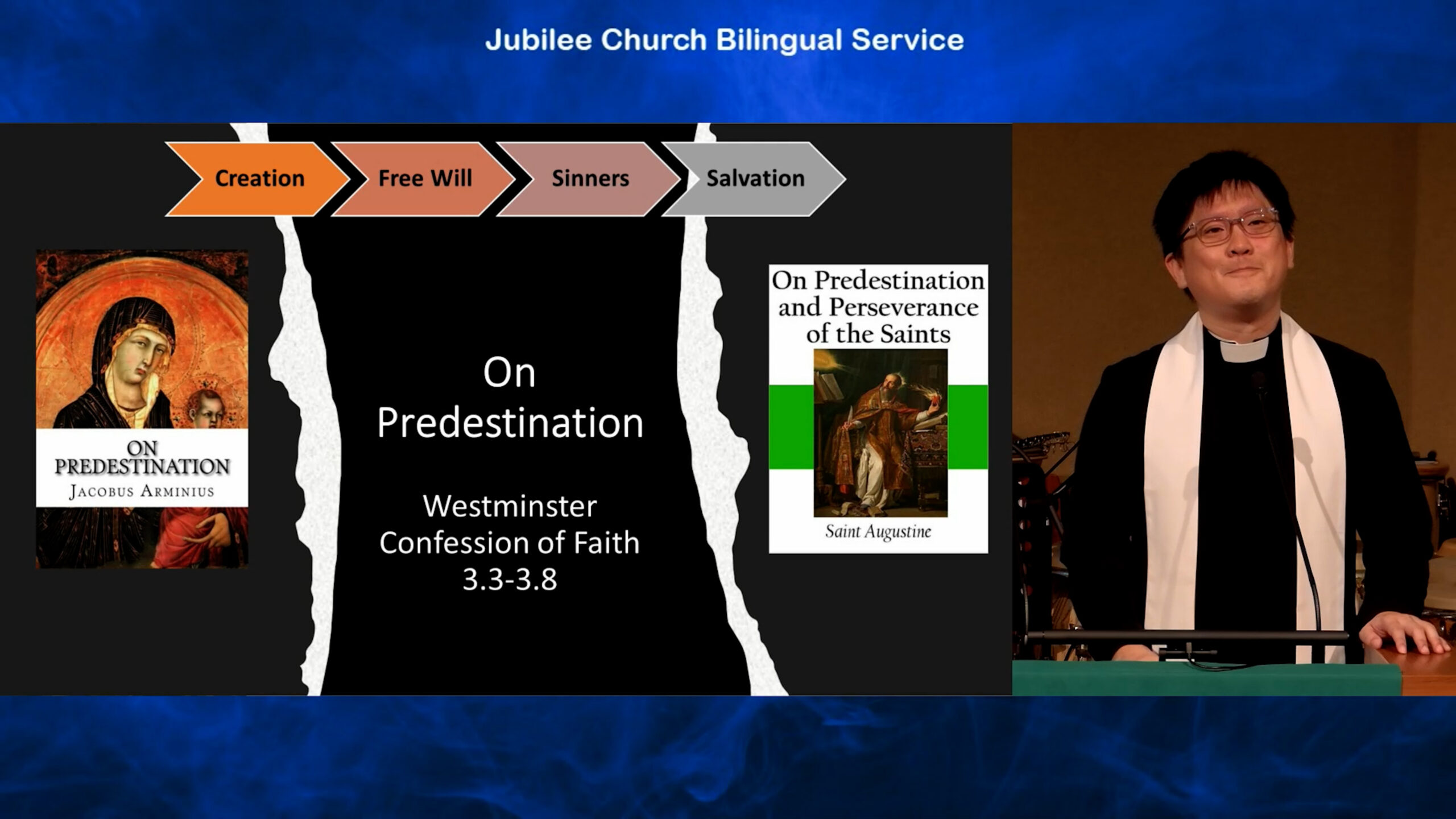
Last Sunday, I spent an entire sermon dissecting the implications of God’s
eternal will because today, we will be dealing with the most important and also
the most controversial portion of God’s will: his salvation plan. Before there is
even time, when God wanted to create the world, he wanted a world where
humans have free will. Logically speaking, this world will therefore have sin and
sinners. So, in God’s creation plan, based on God’s loving nature, there must
also be a salvation plan. So far, every Christian agrees with this. What
differentiates the Christian world is their interpretation of God’s salvation plan.
There are three possible stands adopted by Christians. This differentiation is
intentionally simplified so I apologize to members of other churches if I have
misrepresented their doctrines.
The first stand is the Roman Catholic stand: The Catholics believe that God has
offered prevenient grace to all mankind. This is a form of grace that allows all to
respond to God despite our sinful nature. Due to prevenient grace, there will be
those that would cooperate with the grace with good works. God can foresee
those who would live their lives in this way. Based on this foreknowledge, God
then elects the cooperative ones for predestination. Predestination means God
chose these persons for salvation. This is a form of conditional election. Hence,
the Catholic stand is salvation by divine grace with human good works in
cooperation. This is known as Synergism (which we mentioned last week).
The second stand is the Arminian stand. This is preferred by the Methodists,
Baptists, and most of the later denominations. Today, you can say they
represent the majority of the Protestants, and especially the evangelicals. Their
stand is quite similar to the Roman Catholics but with one key difference. The
prevenient grace is only for faith, not works. You can think of it as a reduced
form of Synergism. God’s predestination is still based on his foreknowledge, but
his main criterion is for those who respond in faith alone. Cooperation by works
is not part of the criteria.
The third stand is the Calvinist stand. This is mainly preferred by the
Presbyterians, but not all subscribe to it. The Anglicans and Lutherans are
intentionally vague in their official stand, so some could be Calvinist, but they
can also be Arminian as well.
Allow me to articulate the Calvinist stand by rephrasing WCF 3.3-3.7 in simple
language.
Before the world began, God chose to save some people. He didn’t choose them
based on his foreknowledge, whether it is by predicting that they would do
good works (aka the Catholic stand) or by their response of faith (aka the
Arminian stand). His choice was entirely based on His own purpose and will.
There is an exact list of his choices. Hence, we call this an unconditional
election.
Only those whom God has chosen will eventually be called by the Holy Spirit.
Their hearts will be changed, they will believe in Christ. (So, this is beyond
prevenient grace, this is irresistible grace.) They will be made right with God,
adopted into His family, and continue growing in grace until they are finally
glorified into everlasting life. This is Monergism. God does all the work. Not
only that, those that God chose will be saved for sure. This is Predestination
based on God’s will alone.
Others, God chose not to save. He passed over them and allowed them to
continue in their sin and eventually be judged into everlasting death. Again,
those that God chose not to save will surely die since no man can save
themselves. We call this portion: double predestination.
So, which of these three salvation plans is the right one? Is salvation by our
works, or salvation by our response of faith, or is salvation purely the work of
God alone? The solution is very simple. When we did WCF chapter 1 on the
authority of the Bible, we declared that on the matter of salvation, the Bible
alone is the answer. So, I researched on all the various passages that supported
the three stands. They are quite convincing! Darn! All three stands are correct!
Then I read the counter arguments. Equally convincing! Darn! All the three
stands are wrong! Then I read the counter arguments of these counter
arguments. I almost gave up on this sermon.
Long story short: ultimately, I concluded that there is no overwhelming winner.
Which arguments you find convincing is entirely subjective to personal
preferences. If your top priority is fairness, what you reap is what you sow,
then your bias will tilt towards the Catholic stand. If you care most about God’s
grace, then you will favour the arguments for the Arminian stand. And lastly, if
God’s sovereignty is your indisputable criteria, God’s will cannot be
compromised, then the Calvinist stand is the most logical conclusion. I don’t
think I should allow my personal bias to pick a winner for you, and if your bias if
different from mine, you won’t favour my preferences anyway.
Instead, I hope to address another concern today: Why does the Bible sound
like it’s saying three different things on such an important matter as God’s will
for salvation?
Here’s the simple truth: the Bible was written for real people facing real
struggles. And depending on who they were and what they were going through,
God used different voices to speak the truth they needed to hear. Let’s take a
closer look.
1. The Jews in Jesus’ Time: Confident but Closed
When Jesus was born, he entered into a world where the Jews were God’s
presumed chosen people. They had the Law of Moses. They were circumcised.
They traced their family line back to Abraham. Basically, they were confident of
their covenant with God, and also because their law observances speak for
themselves.
But here’s the twist: many of them didn’t accept Jesus as the promised Messiah.
In fact, the Gospels show us that Jesus was rejected by many of his own people.
John 1:11 says, “He came to that which was his own, but his own did not receive
him.” This rejection was painful and confusing to early Christians—especially to
those who were also Jews.
Paul wrestled with this in Romans 9–11. He loved his fellow Jews and was
heartbroken that many didn’t believe in Jesus. But he pointed to a bigger truth:
salvation has always been God’s decision. God chose Isaac over Ishmael. Jacob
over Esau. And now, God is bringing in Gentiles to show that His grace can’t be
controlled or claimed by human effort. As Romans 9:16 says, “It does not,
therefore, depend on human desire or effort, but on God’s mercy.”
This leads to the first doctrinal development: double predestination—that God,
in His wisdom, chooses some for salvation and passes over others. It’s not
because one group is better than another, but simply because salvation is
entirely by grace. When people are proud or feel like they “deserve” salvation,
the Bible reminds us: no one earns it. It’s all grace. God chooses. We certainly
don’t get to boast. And salvation is always a gift, even our decision of faith.
Things got even harder when Jewish Christians were kicked out of their
synagogues (see John 9:22 and 16:2). The Johannine community (the one
behind the Gospel of John) felt deeply the pain of being expulsion. That’s why
John’s Gospel uses strong language about people who are “not of God” or “not
of the truth.” In John, Jesus talked about sheep from the Father that belong to
him, and sheep that are rejected. Calvin repeated quoted Jesus’ words in
Matthew: “Every plant which my heavenly Father has not planted shall be
rooted up” (Mt. 15:13).
This brings us to the second doctrinal development to complement double
predestination: the perseverance of the saints. When people are persecuted
and wonder about their salvation, they need this reminder: if salvation is God’s
work from beginning to end, then He will not abandon what He started.
Philippians 1:6 offers this assurance: “He who began a good work in you will
carry it on to completion until the day of Christ Jesus.”
2. The Problem of Taking Grace for Granted
But what if people who were once on fire for Jesus are getting complacent.
Some start thinking, “If God forgives everything, and he will do all the salvation
work anyway, then what’s the point of trying hard?” Others say they believe,
but nothing in their life reflect Christlikeness.
That’s when writers like James and Hebrews step in. They give wake-up calls
about falling from grace:
“Faith without works is dead.” (James 2:17)
“It is impossible… if they fall away, to be brought back to repentance.”
(Hebrews 6:4–6)
These verses sound more Arminian and Catholic, right? They’re not denying the
sovereignty of God’s grace. But they’re saying: “Hey, if you’ve really been saved,
it should change how you live. And if you’re not living it, then you’re in danger.”
Don’t treat grace like a free pass.
3. Why the Bible Sounds Different in Different Places
So… is the Bible confused?
No. God knows that different people need different truths:
To the proud: “It’s all grace. You didn’t earn this.” (Romans 9, Ephesians 1)
To the worried: “God will never leave you.” (Romans 8:38–39)
To the careless: “If your faith is real, then live like it.” (James, Hebrews)
You see, each side—Calvinist, Arminian, Catholic—is trying to protect
something:
Calvinists want to protect God’s sovereignty.
Arminians want to protect our need to respond to grace.
Catholics want to protect the link between faith and works.
And guess what? The Bible cares about all of these. The key is knowing when to
emphasize what.
Some of you might think: How can you be a Presbyterian pastor and yet have
sympathies for teachings of other denominations? Don’t worry, I have not
become a renegade Presbyterian. You don’t have to report me to the Synod.
By respecting the different voices of the Bible, I am following the advice at the
conclusion of Chapter 3 of WCF: section 3.8.
(In simplified language) The teaching about predestination is a deep and
mysterious truth. So, we should talk about it carefully and wisely. When we
focus on what God has shown us in the Bible and live in obedience to Him, we
can find confidence in knowing that God has chosen us and called us to Himself.
This truth should lead us to praise and honor God, be humble before Him, live
faithfully, and find great comfort—especially for those who truly follow Jesus.
So, what the Bible reveals matters more than static theological stands, and how
we live matters as much as God’s eternal will.
In the first half of the sermon, I explain the three stands on Predestination in
the Christian world. In the second half, I will take the most important advice in
the Confession and just focus on the Bible and how we should live.
Last week, I used Isaiah 46 to explain God’s will in time. Today, I will continue
with Isaiah 48, and make my reflection specific to predestination.
Isaiah 48: 3 I foretold the former things long ago,
my mouth announced them and I made them known;
then suddenly I acted, and they came to pass.
4 For I knew how stubborn you were;
your neck muscles were iron,
your forehead was bronze.
5 Therefore I told you these things long ago;
before they happened I announced them to you
so that you could not say,
‘My images brought them about;
my wooden image and metal god ordained them.’
6 You have heard these things; look at them all.
Will you not admit them?
“From now on I will tell you of new things,
of hidden things unknown to you.
7 They are created now, and not long ago;
you have not heard of them before today.
So you cannot say,
‘Yes, I knew of them.’
12 “Listen to me, Jacob,
Israel, whom I have called:
I am he;
I am the first and I am the last.
17 This is what the Lord says—
your Redeemer, the Holy One of Israel:
“I am the Lord your God,
who teaches you what is best for you,
who directs you in the way you should go.
18 If only you had paid attention to my commands,
your peace would have been like a river,
your well-being like the waves of the sea.
I have chosen Isaiah 48 as my main bible passage because it neither fits neatly
into strict Calvinist double predestination nor into classic Arminian conditional
election. It contains elements that both camps emphasize. Isaiah 48 presents
us with a God who decrees history. Yet in real-time, He longs for obedience,
delays his judgment, and invites the listeners to walk in His ways.
Surprisingly, it even moves beyond Calvinist and Arminian. Though we see a
God who declares “things long ago” and brings them to pass (v.3), but he also
introduces “new things” that we have not heard before (v.6) in that very
moment in history. God is not locked into a script—he is dynamic, responsive,
creative.
This fits well with my conclusion last week about God’s will being HDMI.
High: God’s will supersedes everything.
Definition: Because of who God is, this is surely a wise and holy will.
Multimedia: Yet God continually reaches out to us.
Interface: And that interaction is in the present right now.
I want to support the Confession objective to safeguard the belief that God’s
will is sure—but we must never forget that his will is not deterministic. It is
HDMI. He can do new unimaginable things as he interacts with us. His love
abides with his people day by day till this very day. He speaks about the future
from the beginning, but also walks with us through the highs and lows, in our
worship and even in our rejections. It is important for us to speak intelligibly
about God, and knowing the theological stand matters. But we must not let
these stands limit what God can do or who he is.
Finally, our main attention should be how should we live. I first must address
our concern about our own salvation. That is primarily why the Bible is even
talking about Predestination in the first place.
Question 1: How can I know if I am predestined for salvation?
Herman Bavinck, a Dutch Calvinist theologian, offers this pastoral advice. We
are not called to figure out whether we are elected before we believe. Rather,
we come to know our election through our relationship with Christ.
Bavinck writes: “Election is the fountain of all the benefits of salvation, but it is
not the starting point of our experience. Christ is.”
So, we do not begin with election—we begin with Christ. And in him, we find
that we have been known, loved, and chosen from the very beginning.
This is exactly how the apostle Paul puts it in Ephesians 1:4–5:
“For he chose us in him before the creation of the world… In love he predestined
us for adoption to sonship through Jesus Christ.”
Notice Paul doesn’t say we are chosen apart from Christ, but in Christ. That’s
the key. Election is never something abstract or cold. It’s always connected to
the person of Jesus.
Donald Bloesch, an evangelical linked to the Reformed tradition, also points to
Christ as the center of election. He argued that predestination is about a God
who suffers with us and for us. The decisive moment of election is not in a
hidden decree, but at the cross. That is where God chooses to love us despite
our sin.
In short: if you want to know if you are predestined, then feel it in your heart in
response to what Christ has done for us on the Cross.
Question 2: How does predestination fit with evangelism?
Francis Turretin and F. A. Lampe, both Reformed theologians, explained the
distinction between the general call and the effectual call. The General Call is
the external proclamation of the gospel that goes out to all people. The
Effectual Call is the internal working of the Holy Spirit in the hearts of the elect,
causing them to respond in genuine faith and repentance. The general call in
evangelism is the means by which God reaches the elect with the effectual call.
We preach to all because we do not know who the elect are, but we trust that
through faithful proclamation, God will awaken faith in those he has chosen.
Question 3: How can God be loving and still so many who are unsaved?
I must admit that this is the hardest question I have to answer in my research.
In the end, I have decided that there are only two roads to take. The first is the
road taken by John Calvin. Calvin frequently emphasizes that God's will and
decisions—especially regarding predestination—are not subject to human
questioning. He sees this as a vital act of reverence and humility before divine
majesty.
“We should not investigate what the Lord has left hidden in secret. We should
adore with fear and reverence the judgment of God which is too deep to be
fathomed.” (from Institutes of the Christian Religion 3.21.4)
“For the will of God is the highest rule of justice, so that what he wills must be
considered just for the very reason that he wills it.” (3.23.2)
Besides accepting God’s will for his predestination by faith, there is another
possibility. James Daane (1914–1983) was a Reformed theologian and professor
at Fuller Theological Seminary. Though rooted in the Reformed tradition, he was
critical of its rigid formulations of predestination. He argued that this view
comes not from Scripture but from philosophical ideas of a static, unchanging
God.
For Daane, God’s predestining love is always tied to Christ and offered as good
news. Predestination should be understood as God’s sovereign initiative to save,
not to condemn. He insisted that theology must serve the gospel:
“Predestination must be preachable—and it can be only if it is good news.”
Daane’s advice to rethink Predestination makes sense to me. If you think about
it, the Bible only uses the word predestined in only two places—Romans
8:29–30 and Ephesians 1:11—and both talk about how God’s plan is centered in
Jesus Christ. This is why within the Presbyterian and Reformed tradition,
theologians have responded to these verses in three different ways. Some
Reformed thinkers like James Daane and F.A. Lampe believe Predestination is
mostly about God choosing Jesus to carry out his plan, not about picking
individual people to be saved or not. Others like Daniel Migliore and G.C.
Berkouwer are more in the middle—they say God leads, but we still respond,
and we shouldn’t think of everything as fixed like a machine. Then there are
people like James Buswell and Herman Bavinck, who do believe God chooses
individuals, but they also remind us this truth should be shared with love and
care, not fear or pride.
Final Word:
Isaiah 48: 12 “Listen to me, Jacob,
Israel, whom I have called:
I am he;
I am the first and I am the last.
We often emphasize that God is the first in his predestination. We must not
forget that he is also the last. He is constantly supporting us even right now, till
we can be with him in the last.
Brothers and sisters, predestination is not a doctrine to frighten us. It simply
declares that God's salvation plan will succeed.
We are pilgrims, called to walk in faith, trusting that the God who began a good
work in us will bring it to completion.
Amen.
Appendix on actual WCF 3.3-3.8
3. By the decree of God, for the manifestation of His glory, some men and
angels are predestinated unto everlasting life, and others foreordained to
everlasting death.
4. These angels and men, thus predestinated and foreordained, are
particularly and unchangeably designed; and their number is so certain
and definite that it cannot be either increased or diminished.
5. Those of mankind that are predestinated unto life, God, before the
foundation of the world was laid, according to His eternal and immutable
purpose, and the secret counsel and good pleasure of His will, hath chosen
in Christ, unto everlasting glory, out of His free grace and love alone,
without any foresight of faith or good works, or perseverance in either of
them, or any other thing in the creature, as conditions, or causes moving
Him thereunto; and all to the praise of His glorious grace.
6. As God hath appointed the elect unto glory, so hath He, by the eternal and
most free purpose of His will, foreordained all the means thereunto.
Wherefore they who are elected being fallen in Adam are redeemed by
Christ, are effectually called unto faith in Christ by His Spirit working in due
season; are justified, adopted, sanctified, and kept by His power through
faith unto salvation. Neither are any other redeemed by Christ, effectually
called, justified, adopted, sanctified, and saved, but the elect only.
7. The rest of mankind, God was pleased, according to the unsearchable
counsel of His own will, whereby He extendeth or withholdeth mercy as
He pleaseth, for the glory of His sovereign power over His creatures, to
pass by, and to ordain them to dishonor and wrath for their sin, to the
praise of His glorious justice.
8. The doctrine of this high mystery of predestination is to be handled with
special prudence and care, that men attending to the will of God revealed
in His Word, and yielding obedience thereunto, may, from the certainty of
their effectual vocation, be assured of their eternal election. So shall this
doctrine afford matter of praise, reverence, and admiration of God; and of
humility, diligence, and abundant consolation to all that sincerely obey the
gospel.
Appendix on passages not used
Verses for:
“Who has called us with a holy calling, not according to our works, but
according to his own purpose and grace, which was given us in Christ Jesus
before the world began,” (2 Tim. 1:9).
“as many as were ordained to eternal life believed,” (Acts 13:48).
2 Timothy 2: 25 Opponents must be gently instructed, in the hope that God will
grant them repentance leading them to a knowledge of the truth, 26 and that
they will come to their senses and escape from the trap of the devil, who has
taken them captive to do his will.
Verses against
God wants to save everyone 1 Tim 2:4; 2 Pet 3:9