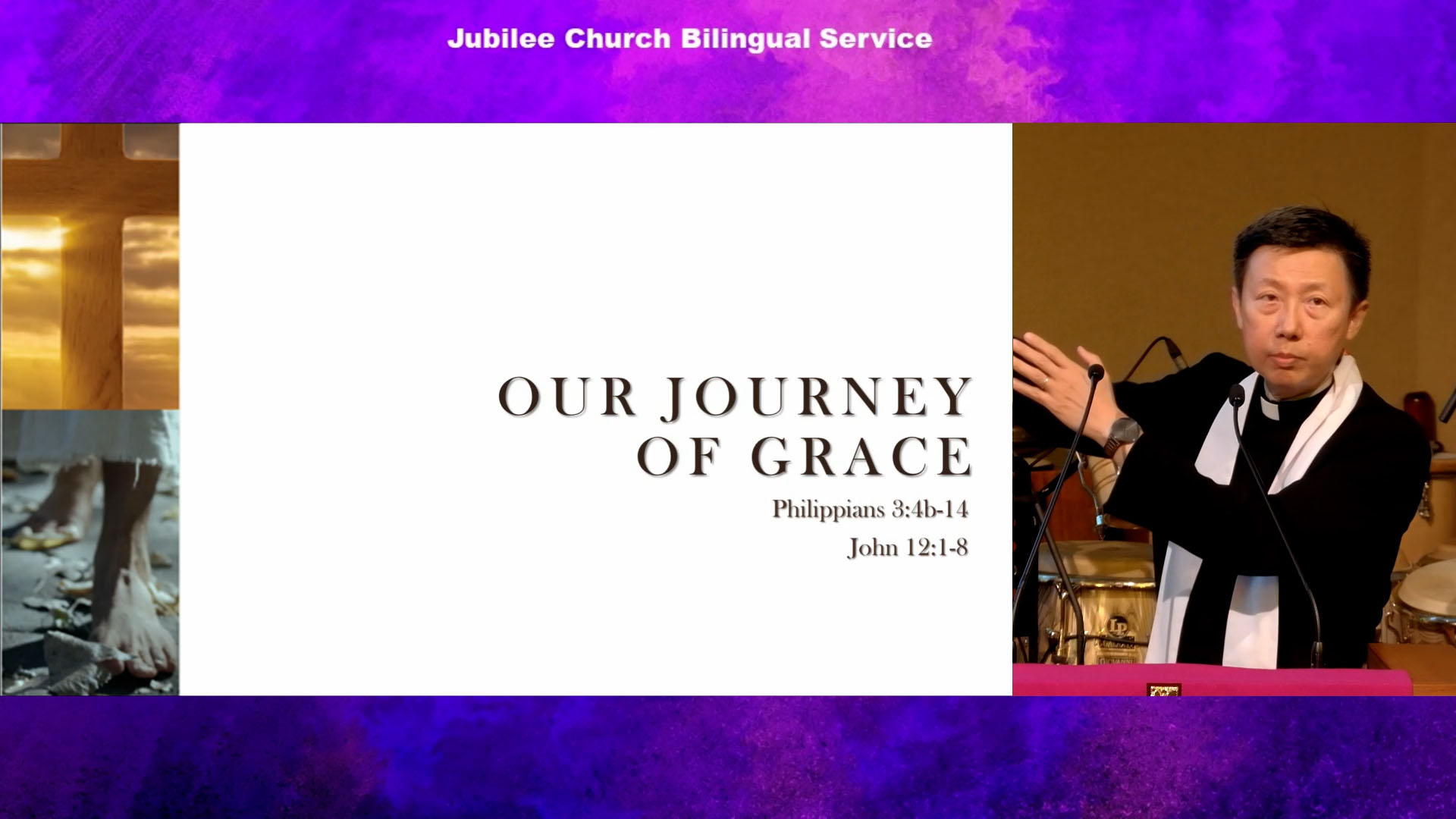
Our Journey of Grace
Text: Phil 4:4b-14; John 12:1-8
One pastor began her sermon on this passage with the question, “Are you becoming perfect?”[i]
This morning, I I’d like to modify her question slightly and to ask, “Are we still pursuing perfection in our journey of faith?”
We might find ourselves wondering, are these pastors being too intense by talking about perfection? To put things into perspective, to be perfect is a biblical encouragement. In the Sermon on the Mount, Jesus exhorts His listeners, saying, “You therefore must be perfect, as your heavenly Father is perfect.”
Is Jesus too intense, then? Let’s try to understand what He means by looking at a claim Paul makes in today’s passage. Paul claims to be blameless according to the law. The Jewish law contains 613 commandments, and by faithfully keeping each one, Paul had done it all—he had reached the limit of what was required and was, by all accounts, blameless.
Yet Jesus challenges this understanding of being blameless, the idea of having “done it all” or “reached the limit.” His point is not about meeting every requirement but about shifting the focus entirely—from law-keeping to relationship, from obligation to the Father. Healthy spirituality does not revolve around fulfilling a checklist but in being oriented toward God Himself. That is the heart of Jesus’ message.
The word “perfect” that Jesus uses, requires some clarification. In modern usage, we often associate perfection with flawlessness—a standard of absolute faultlessness. Skincare brands, for example, use the word “flawless” to suggest the idea of perfect, blemish-free skin.
However, this is not how Jesus and Paul understood the word “perfect.” Their concept of perfection was not about being flawless but about wholeness, maturity, and completeness—a life fully aligned with God’s will. In his letters to the Corinthian church, Paul uses the same Greek word to emphasize spiritual growth and maturity—not flawlessness, but a process of becoming whole and fully aligned with God’s will.
When it comes to fulfilling religious obligations, there is a point where we might say we have “reached the limit.” But when it comes to spiritual maturity, the journey is limitless. It is an ongoing pursuit of growth and ever deeper alignment with God.
Today marks the final Sunday of the Lent season, where spiritual growth is one of the emphases. How are we doing in this regard? Or, to echo the question I posed earlier, “Are we still pursuing perfection in our journey of faith?”
In the question displayed on the slide, the adverb “still” is emphasized because it is not uncommon to encounter fellow believers who believe they have already reached spiritual maturity and no longer see it as a serious pursuit. Others recognize that there is always room for growth, yet they either feel too busy or simply lack the desire to make it a priority. How about us?
Whether our answer to the question is yes, no, or uncertain, today’s passage from Philippians, placed on this final Sunday of Lent, invites us to pause and reflect on our relationship with Christ—and to consider how we can move forward from where we are.
II.
When it comes to deepening our relationship with Christ, Paul’s words to the Philippians offer invaluable insight.
In his letter, Paul addresses a specific situation in the Philippian church, where Judaizers were pressuring the young Christians to undergo circumcision as an outward sign of their commitment to God. Paul sought to dissuade his fellow believers from giving in to this pressure by sharing his own journey.
Circumcision? He had already been through it. If the Philippian Christians were to succumb to the pressure, their circumcision—performed in their adulthood and as Gentiles—would be considered second-class by Jewish standards. In contrast, Paul had been circumcised on the eighth day according to Jewish custom, symbolizing a lifelong dedication to God from birth—what one might call first-class circumcision. So, if circumcision were a source of confidence, Paul had every advantage.
But not just in that—he surpasses the Judaizers in almost every area they took pride in. You can say that he was someone of very high net worth. Using accounting terms, such as gain and loss, Paul presents his personal profit and loss statement to his readers. Line by line, he lays out his credentials—his birth, education, training, and achievements—demonstrating how, by their own standards, he has outclassed them.
Then, in a single stroke of the pen, Paul declares that everything he once considered a gain was, in reality, one single massive loss—an overwhelming disadvantage. Not because those things were inherently bad, but because none of them could bring him even an inch closer to Christ.
During Paul’s time, people would have envied him for his status and accomplishments. Yet, he not only came to see his gains as a loss, but he even calls them “rubbish”, a word that referring to dung.
If Paul seems intense—even extreme—it is because he clearly sees the surpassing value of Christ and depth of his matchless love.
Today’s gospel reading tells the story of someone who is equally intense and extreme. Mary pours a large amount of high-end perfume made of nard on Jesus’ feet and wipes them with her hair. The quantity she used was about 325g, no wonder the entire house was filled with fragrance. Mary was extreme, not only because what she did was an overkill, something that could buy a manual worker a gap year and not do any work. Wiping Jesus feet with her hair would have been seen as potentially scandalous in her cultural context. She was risking her reputation. Yet Mary considered all of that—her resources, her image—worth nothing in comparison to the surpassing value of Christ and the depth of His matchless love.
For Paul and Mary, the surpassing value and matchless love of Jesus were not truths they read in books—they were real and firsthand personal experiences.
Paul, despite his deep knowledge of the Torah—which constantly emphasizes mercy and righteousness—became a persecutor of Christians—human beings. Yet, he received forgiveness and was entrusted with bringing the gospel to the gentiles. That grace and forgiveness he received changed everything for him.
Mary had blamed Jesus for arriving too late in Bethany—after Lazarus had already been buried for several days. When she met Jesus, her emotions were deeply conflicted. She wanted to believe, to trust rather than doubt or blame—but in the depth of her grief, she couldn’t help herself. But then, Jesus called Lazarus out of the tomb, and everything changed. Mary’s conflicting emotions dissolved and transformed into solid, unwavering faith in her Teacher. And an entire bottle of high-end perfume was not too much for expressing her devotion.
Paul and Mary’s devotion wasn’t rooted in theory—it was born out of grace received, love experienced, and lives transformed.
We sang these words earlier[ii].
If Paul and Mary were to sing this song, they would sing it with their own stories in mind. What about us? What personal story would we bring to this song? Whether we are long-time believers or in the process of exploring the Christian faith, I believe each of us has a story to tell. Ours may not be as dramatic as Paul’s or Mary’s, but we’ve each had moments of encountering Jesus—His grace, His love, His faithfulness.
I know in my own life that there are areas where I fall short of the glory of God—mistakes I’ve repeated, struggles I still wrestle with. Some of those I’ve, by God’s grace, overcome. Others I’m still crying out to Him for more grace and strength.
And yet, as the words of the song ring true:
How far we had fallen from righteousness,
But not from the mercies of Christ.
If we are willing to look honestly at our past and our weaknesses—while also gazing upon the surprising, matchless love of Jesus—what would our response be? What would we find ourselves doing in light of such grace?
For Mary, her action filled the entire house with fragrance, and what she had done “will be told in in memory of her” (Mark 14:9) wherever the gospel is preached, says Jesus.
Paul, on the other hand, made knowing Christ his primary pursuit in life. After 30 years of missionary work and having written some of the most profound and theologically rich letters in the New Testament, what could he possibly not know at this point in his life? So, it’s not only striking and surprising, but also inspiring to hear this giant of an apostle declare that he is still seeking to know Christ and to deepen his relationship with his Lord.
III.
And what does Paul still want to know? According to how the word “know” is used in the Bible, it means not just intellectual knowledge but also experiences and participation. For Paul, this means encountering the power of Jesus’ resurrection and sharing in His suffering.
May I ask, which would we prefer—resurrection power or suffering? That’s probably a dumb question to ask, isn’t it? If we’re being honest, most of us would never have a preference here. We simply don’t want suffering. And when life gets tough, we often wonder if we’ll even be able to handle it.
So, the question is a bad one. But guess what? Paul’s about to drop some solid theology on us.
Based on Paul experience, encountering Jesus’ resurrection power and enduring suffering were intertwined aspects of a believer’s journey. This duality was evident in Jesus’ life, in Mary’s devotion, and in Paul’s own journey. It’s a pattern that extends to us as well.
We may not like hearing this, but to suffer with Christ is to experience His grace. As Karl Barth puts it, “The grace of being permitted to believe in Christ is surpassed by the grace of being permitted to suffer for him, of being permitted to walk the way of Christ with Christ himself to the perfection of fellowship with him.”[iii] In other words, a journey of grace is one where encountering Jesus’ resurrection power and enduring suffering are intertwined.
Still, we don’t seek out suffering; rather, we pray for its alleviation, focusing on the power of Christ’s resurrection. Yet, when we recognize that resurrection power and suffering often go hand in hand, it calls us to reflect as we conclude this year’s Lenten season: Are we willing to follow Jesus’ leading, even if it involves suffering? Suffering can take many forms: emotional wounds and rejections, being deprived or choosing to deprive oneself for the sake of others, physical pain, and more.
For Paul, the missionary journey was anything but easy. He faced accusations from the very churches he helped establish, endured severe beatings, survived multiple shipwrecks, and was eventually imprisoned near the end of his life. So, what kept him going?
The answer to this question is not a what but a who.
IV.
In Philippians 3:12–14, Paul exhorts the Philippian believers to follow his example—to press on toward the goal of gaining Christ, never looking back. In verse 12, Paul uses the same Greek word to describe both his own pursuit and what Christ has done for him. There is no single English word that fully captures the dual meaning Paul intended, which is why various translations render the Greek word into different short phrases. We see this on the screen.
Following the renderings in the NET and NKJV translations, we begin to see the source of Paul’s tenacity. Let me outline my understanding in a few steps:
Step 1: Paul was gripped—or arrested—by Christ’s love.
Step 2: This reality allowed him to see clearly that Christ’s love is matchless and of surpassing worth.
Step 3: With this vision, born out of being gripped by Christ, Paul stretches forward, striving to lay hold of that which is of ultimate value —Christ Himself and an ever-deepening fellowship with Him.
Paul refers to this as the “upward call” in verse 14.
Pursuing such a goal in a broken world naturally involves hardship. But Paul need not give up. He continues pressing on—not in his own strength alone, but because Jesus’ grip is firmly on him. As he presses forward, he is being led.
This is what Jesus does for all His brothers and sisters—we are being led. I believe His grip is also on us, desiring to lead us, even to pull us forward.
The question is: Are we still seeking? Are we still pursuing perfection in our journey of faith?
This morning, my simple hope is this: that we would reflect on this question in the presence of the One who first laid hold of us—and in doing so, be drawn into an ever-deeper fellowship with our Lord.