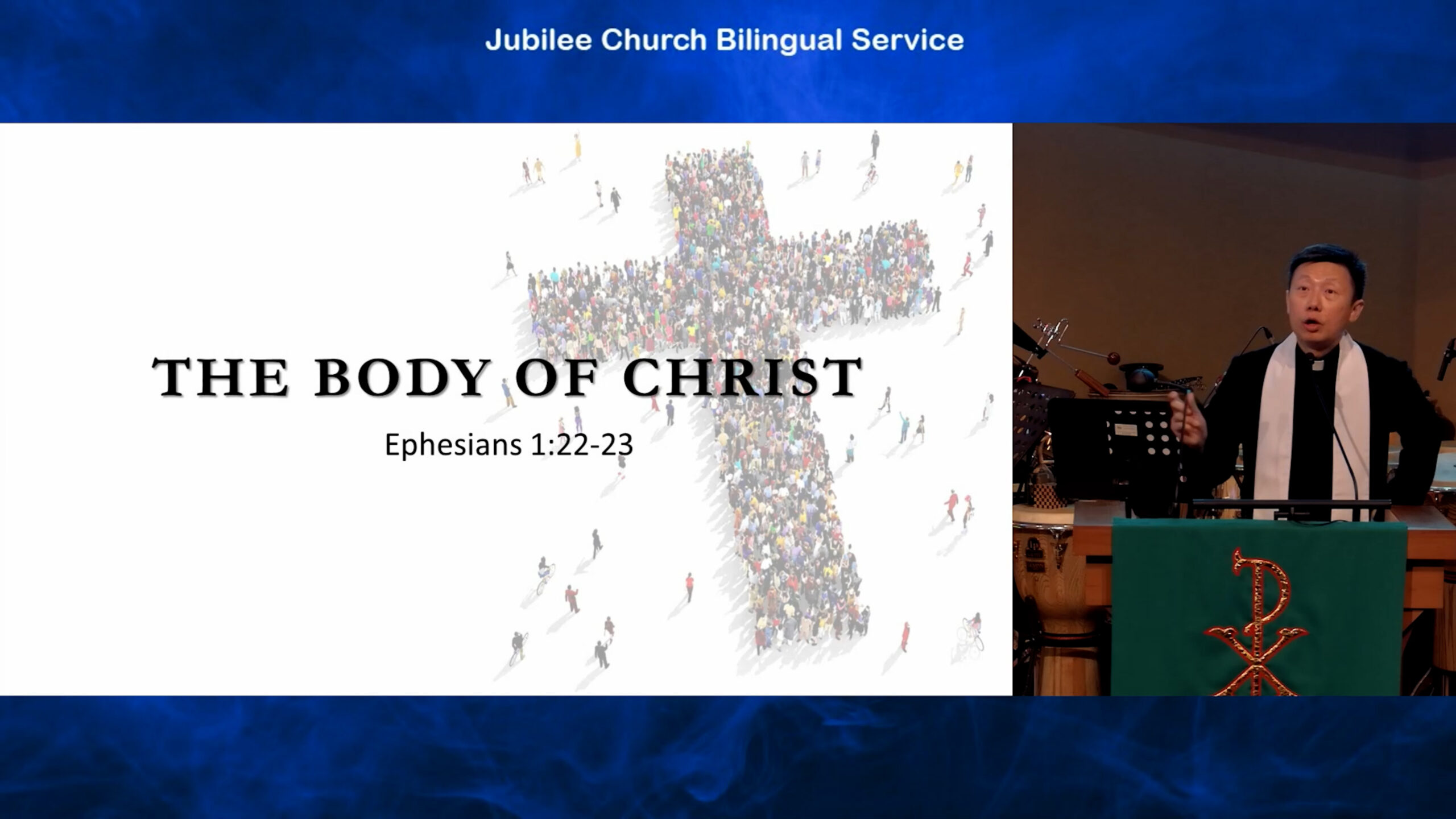
Good morning, church. Today’s sermon topic is… the church. So, if anyone asks you later, “What did you learn in church today?” you can simply say: “Church.” Simple enough.
But of course, we won’t stop there. Let me ask: How would you describe our church in just a few words?
Some of us might begin with, “It’s near Tiong Bahru bao and the famous chicken rice stall”—very useful if you’re giving directions to a newcomer. Others might say, “It’s a Presbyterian church, with members across generations.” I’m sure each of us would have something to say about the Jubilee family.
But what if the question is bigger: How would you describe the Church—as in the universal Church of God?
That’s where the Westminster Confession of Faith, Chapter 25, helps us. It has six sections that speak to the church. Two quick observations to start.
First, some of these sections are especially helpful for answering the question on the screen, while others may feel less relevant today. For example, section 6, which emphasizes that Christ alone is the Head of the Church. In the 17th century, this was crucial, because church and state were not separated. Whole cities—and even entire nations—aligned themselves as either Roman Catholic or Protestant, and these allegiances often sparking wars. The Reformers also had theological reasons for rejecting the pope’s authority: it was not biblical, and it undermined the truth that salvation is by grace alone—not grace plus works.
Second, about the chapter as a whole. On the screen, you’ll see a summary of each section. Notice what’s not here: there’s very little said about what we most often do as a church—worship, preaching, sacraments. And Christian mission, so central to the church’s calling, is not explicitly mentioned either.
But that doesn’t mean the WCF ignores these things. They’re addressed in other chapters or implied indirectly. I point this out because our preaching series is not a cover-to-cover walkthrough of the Confession. So, if we want the full picture—for example, what the WCF teaches about worship—we’ll need to look at those other chapters.
So what’s the value of this chapter for us today? In short, it gives us a clear, biblical vision of the Church—its identity, purpose, and nature.
With that in mind, let’s begin at the top with WCF 25.1 and 25.2, which focus on the Church’s identity, and see what these first sections teach us about God’s design for His people.
WCF25.1: The catholic or universal church, which is invisible, consists of the whole number of the elect, that have been, are, or shall be gathered into one, under Christ the Head thereof; and is the spouse, the body, the fullness of him that filleth all in all.
WCF25.2: The visible church, which is also catholic or universal under the gospel (not confined to one nation, as before under the law), consists of all those throughout the world that profess the true religion; and of their children: and is the kingdom of the Lord Jesus Christ, the house and family of God, out of which there is no ordinary possibility of salvation.
- The first two sections use six different images to describe the church. This morning, we’ll focus on just one—the church as the body of Christ—and draw three observations from it.
Our key Scripture is Ephesians 1:22–23: “And he put all things under his feet and gave him as head over all things to the church, which is his body, the fullness of him who fills all in all.”
At first glance, we might think Paul means that Christ, as the head, is the source of the church’s life and being. But here the emphasis is different. Notice the phrase: “He put all things under his feet.” Paul is highlighting Christ’s power and authority over the church.
As one commentator explains: “The head is to be understood as inspiring, ruling, guiding, combining, sustaining power—the mainspring of its activity, the centre of its unity, and the seat of its life.”[i]
If Christ is the head with power and authority, then the church, as His body, belongs under His lordship. That means the church does not ultimately answer to shifting cultural trends or to the pressures of survival—though we often act as if it does—but to Christ himself.
Having looked at the church as the body of Christ, let’s now turn to an important distinction the Confession introduces: the invisible church and the visible church.
The visible church is the church we see—our local congregations and the people gathered in them. The invisible church, on the other hand, is made up of all true believers across time, from the past until Christ returns. And only God truly knows who belongs to this invisible church.
This distinction matters, because not everyone in the visible church is necessarily part of the invisible church—just as not all who were born into Israel were truly children of God. Some may be active members of a congregation yet lack genuine faith. And at the same time, some in the invisible church—whether because of illness, persecution, or imprisonment—may be unable to gather in a visible church at all.
So we recognize, as the WCF does, that the visible church is made up of both genuine believers and those without true faith. That raises the next question: What is the role of the visible church—the body of Christ on earth—even in its imperfection?
Here’s my suggested answer: Right now, Christ’s reign is invisible—but His church is visible. Our task is to make the invisible visible, to be living proof of what is already true—that Jesus is, right now, the King of kings and Lord of lords.
So how do we do this—at least in principle?
At Jubilee we recite the Apostles’ Creed, but many of us are also familiar with the Nicene Creed, which, when speaking of the church, declares: ‘We believe in one holy, catholic, and apostolic church.”
When these words were first written, they brought comfort to God’s people —small, often persecuted, and living on the margins. Today, many churches still recite them as a statement of faith. Yet the reality of the church often looks very different from what is confessed.
The creed proclaims that the church is one, yet many churches today prize independence over interdependence. Unity? Too often it feels more like a slogan than a reality. Holy? Church attendance can easily become about meeting personal needs rather than faithfully following Christ. And being apostolic—living out the teaching and mission of the apostles—can feel out of step with the trends and attitudes of our day. For some, even Paul’s devotion might seem too intense in his pursuit of the Lord.
So how can the church make the invisible visible? We recover the church’s true identity by becoming what she confesses in the Nicene Creed. The church is not merely a group that gathers on Sundays, but a people called to show the world the love of the Triune God.
The Father gives, the Son receives and gives back, and the Spirit shares life. This is the self-giving love of the Triune God. And when that same love shapes how we live—in our homes, in our friendships, and even with strangers—we become visible, living proof of the reality that is already true. That is how the church makes the invisible visible.
- Let’s turn now to the next section, which says:
“Unto this catholic visible church Christ hath given the ministry, oracles, and ordinances of God, for the gathering and perfecting of the saints, in this life, to the end of the world: and doth, by his own presence and Spirit, according to his promise, make them effectual thereunto.”
This section highlights Christ’s gift to the church for one central purpose: gathering and perfecting believers.
One way the church lives this out is through mission and evangelism— simply being faithful to what the Bible calls us to do.
But we must approach this with a biblical mindset. Many churches hold what are called seekers’ services. I’m not sure if Jubilee ever tried something like that. The idea is to attract those searching for God, shaping services to appeal to them. On the surface, it sounds reasonable. But the Bible says otherwise. Romans 3:11 states plainly: “No one seeks for God.”
According to the bible, only believers seek God. No one begins that search on their own; a person cannot seek God until He first draws them to Himself. In other words, seeking God begins when faith is first granted, and from that point, it becomes a lifelong pursuit.
If even our seeking begins with God’s initiative, then how much more true is it that the life of the church depends not on our efforts, but on Christ’s gift and ongoing work among us.
Section 3 affirms that Christ has given the church the ministry of the Word and the sacraments to gather, nurture, and shepherd His people. Yet it is not our effort that makes these effective. It is Christ Himself, through the presence of the Holy Spirit, who brings life and fruitfulness to all that we do.
Take the sacraments as an example. In baptism, we see Jesus identifying with us. Though without sin, He willingly submitted to be washed as sinners are. By doing so, He stood in solidarity with humanity and opened the way for us to share in His holiness.
In Holy Communion, a rite we regularly observe, we again receive God’s ongoing gift of life and love. At the Lord’s table, He draws us deeper into fellowship with Himself and strengthens us for service in the world. Communion is more than fellowship among baptized believers—it is a feasting on the presence of Christ. Though we cannot see Him, He has promised to be present and never misses His appointment with us. His presence does not depend on the strength of our faith or our sincerity, but on the integrity of His word.
Communion carries even greater significance. It is not only about strength for today; it also points us forward, as a sign and seal of God’s promise: that one day He will bring about a new heaven and a new earth, a renewed humanity fully reconciled to Him and to one another. Every time we eat this bread and drink this cup, we declare that Christ will finish what He has started, and that His kingdom will come in fullness—a kingdom marked by justice, freedom, and peace.[ii]
Through the giving of bread and wine, month after month, God teaches His church what it means to live a life of sharing and serving. At the table, He shapes us little by little into His way of loving and caring. And so—even though the church is imperfect, always needing reform and renewal—she is the real, visible beginning of what God has promised. We are a community called to bear witness to Him and sent by Him to serve the world.
From what we’ve seen so far, we can say that the Body of Christ:
- Makes the invisible Head visible to the world
- Is led by the Head to serve the world
III.
Next, we’ll look at sections 4 and 5, which deal with the purity of the church. Only the portions most relevant for our discussion will be read.
Let’s begin with section 5. It opens with: “The purest churches under heaven are subject both to mixture and error,” and goes on to say something very harsh, that some churches have so degenerated that they are “no churches of Christ, but synagogues of Satan.”
This strong language arose from the Protestant–Catholic controversy of the 17th century. At that time, Rome condemned the Protestants for schism and teaching what it saw as false doctrines. The Reformers, in turn, argued that by denying justification by faith alone, Rome had ceased to be a true church, no matter how many other truths it upheld—this was the conviction of Luther, Calvin, Knox, and others.
Yet the Protestant arm also recognized their own shortcomings. Confident in the truth of justification by faith alone, they admitted that their churches were far from perfect. Section 4 reflects this humility, acknowledging that even true churches display varying degrees of purity.
But doesn’t the Nicene Creed confess that the church is holy. Doesn’t that sound like a contradiction? On the surface, it does—because to be holy is to be pure. Yet this tension is biblical. Holding these two truths together is not a denial, but an honest reflection of the church’s real condition.
Take the church in Corinth as an example. Paul rebuked them for acting like children urging them to grow up in Christ, yet he still called them saints—holy ones. That’s the paradox and the reality: the church is holy, not because of her performance, but because she is set apart by God, indwelt by the Spirit, and called to a holy vocation. At the same time, the church is imperfect—always in need of growth—a work in progress.
Amidst all this imperfection, section 5 closes with a strong affirmation: “There shall always be a church on earth, to worship God according to His will.” With these words, the Presbyterian tradition reminds us here that the church is ultimately God’s work, not ours. Just as He sustained Israel through every age and place, He will sustain the body of Christ through the long pilgrimage until the end.
WCF 25, then, shows both the weakness and the strength of the church—weak because of human fallibility, strong because God is faithful and always at work. With that in view, we can sum up this chapter in three key truths about the church.
[i] By Lighfoot J. B., taken from O’Brien P. T, The Letter to the Ephesians, PNTC, (1999), p.148.
[ii] Migliore, D. L. Faith Seeking Understanding: An Introduction to Christian Theology, third ed. (2014), p. 305. Kindle Edition.