Psalm 104: 1 Praise the Lord, my soul.
Lord my God, you are very great;
you are clothed with splendor and majesty.
2 The Lord wraps himself in light as with a garment;
he stretches out the heavens like a tent
3 and lays the beams of his upper chambers on their waters.
He makes the clouds his chariot
and rides on the wings of the wind.
4 He makes winds his messengers,
flames of fire his servants.
5 He set the earth on its foundations;
it can never be moved.
6 You covered it with the watery depths as with a garment;
the waters stood above the mountains.
7 But at your rebuke the waters fled,
at the sound of your thunder they took to flight;
8 they flowed over the mountains,
they went down into the valleys,
to the place you assigned for them.
9 You set a boundary they cannot cross;
never again will they cover the earth.
10 He makes springs pour water into the ravines;
it flows between the mountains.
11 They give water to all the beasts of the field;
the wild donkeys quench their thirst.
12 The birds of the sky nest by the waters;
they sing among the branches.
13 He waters the mountains from his upper chambers;
the land is satisfied by the fruit of his work.
14 He makes grass grow for the cattle,
and plants for people to cultivate—
bringing forth food from the earth:
15 wine that gladdens human hearts,
oil to make their faces shine,
and bread that sustains their hearts.
16 The trees of the Lord are well watered,
the cedars of Lebanon that he planted.
17 There the birds make their nests;
the stork has its home in the junipers.
18 The high mountains belong to the wild goats;
the crags are a refuge for the hyrax.
19 He made the moon to mark the seasons,
and the sun knows when to go down.
20 You bring darkness, it becomes night,
and all the beasts of the forest prowl.
21 The lions roar for their prey
and seek their food from God.
22 The sun rises, and they steal away;
they return and lie down in their dens.
23 Then people go out to their work,
to their labor until evening.
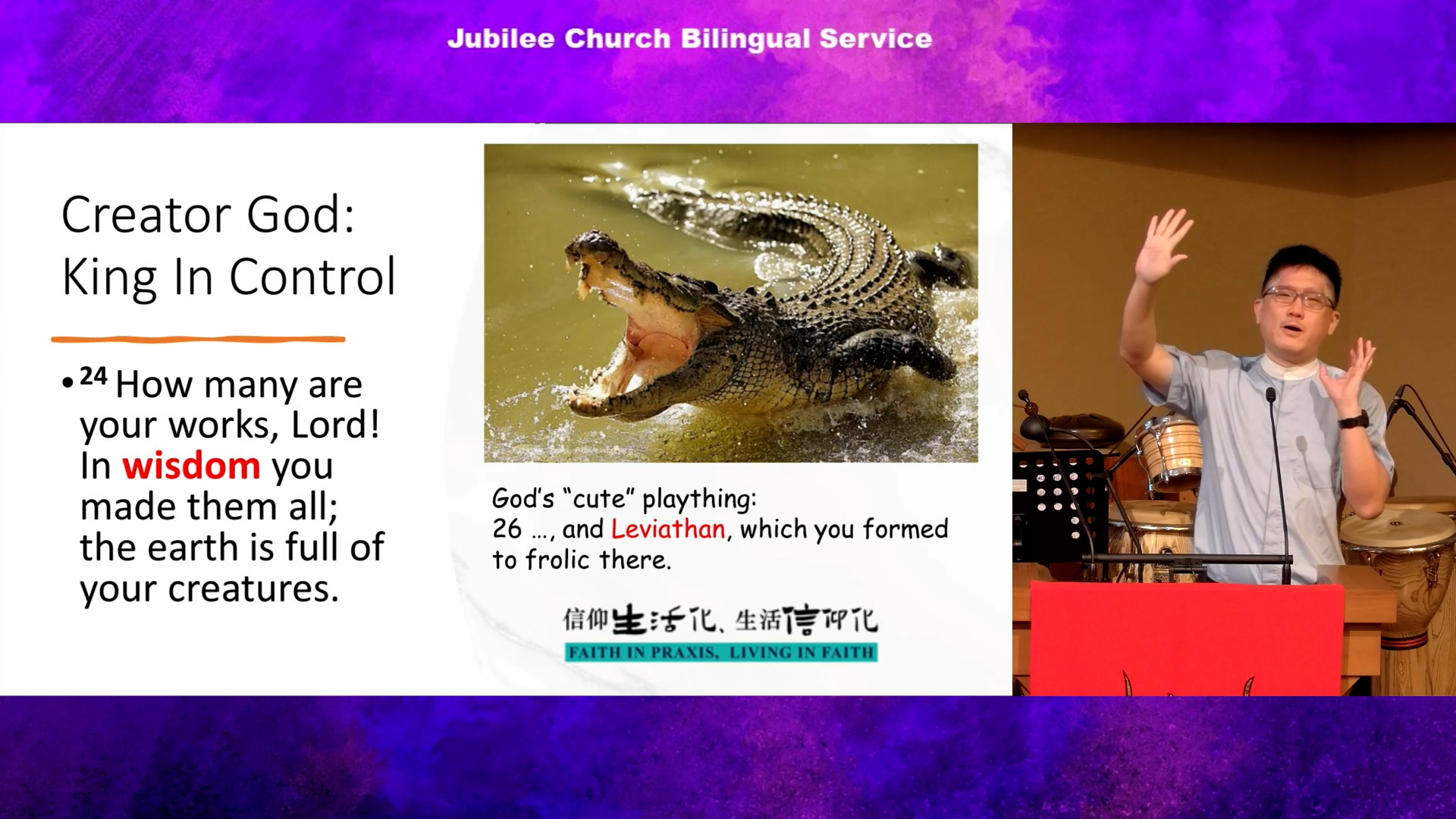
24 How many are your works, Lord!
In wisdom you made them all;
the earth is full of your creatures.
25 There is the sea, vast and spacious,
teeming with creatures beyond number—
living things both large and small.
26 There the ships go to and fro,
and Leviathan, which you formed to frolic there.
27 All creatures look to you
to give them their food at the proper time.
28 When you give it to them,
they gather it up;
when you open your hand,
they are satisfied with good things.
29 When you hide your face,
they are terrified;
when you take away their breath,
they die and return to the dust.
30 When you send your Spirit,
they are created,
and you renew the face of the ground.
31 May the glory of the Lord endure forever;
may the Lord rejoice in his works—
32 he who looks at the earth, and it trembles,
who touches the mountains, and they smoke.
33 I will sing to the Lord all my life;
I will sing praise to my God as long as I live.
34 May my meditation be pleasing to him,
as I rejoice in the Lord.
35 But may sinners vanish from the earth
and the wicked be no more.
Praise the Lord, my soul.
Praise the Lord.
Title: The Spirit of God in Creation
Introduction: What Is Worship?
"May my meditation be pleasing to him, as I rejoice in the Lord. But may sinners
vanish from the earth and the wicked be no more." (Psalm 104:34–35)
These two verses seem to offer two very different moods. One speaks of delight
and joy—meditation that pleases God. The other prays for sinners to vanish and
the wicked to disappear. If we are not careful, we may think that worship can be
pure only when the bad is gone and the righteous remain. We might imagine
that true worship happens only when the sanctuary is silent, serene, and
sanitized. But that is not how Psalm 104 presents creation, the arena where we
worship God. Nor is it how Pentecost Sunday calls us to perceive the world.
Worship is not escaping from the world to find perfection. Worship is drawing
closer to God's will, in the world God has made. Worship is delighting in what
delights the Lord. It is meditating on God’s works until our hearts sing in tune
with His Spirit.
On this Pentecost Sunday, we remember the Spirit who hovered over creation
in Genesis 1 and resting upon the disciples in Acts 2. Psalm 104 shows us that
the Spirit has always been at work—not just in people, but in the breaths of
lions, Leviathan the sea monster, and the rhythms of the earth. We ask: What
does this psalm teach us about God? What does it reveal about the Spirit of God
in creation? And how can we then understand the will of God, for that is our
true worship in Spirit and in Truth?
1. The Creator King Who Sets the World in Order
Psalm 104 opens with majestic poetry: "Praise the Lord, my soul. Lord my God,
you are very great; you are clothed with splendor and majesty. The Lord wraps
himself in light as with a garment; he stretches out the heavens like a tent." (vv.
1–2)
This is not a distant or detached God. This is a sovereign king who rules over
creation with wisdom. 24 How many are your works, Lord! In wisdom you
made them all; the earth is full of your creatures. God is wise because he is able
to create a world that thrives in diversity. How so? Like a king organizing his
kingdom, God sets boundaries: He tames the waters (vv. 6–9), orders day and
night (vv. 19–23), and commands the animals to know their place (v. 17-18). In
this divine choreography, we find a rhythm in the world—sunrise and sunset,
hunger and feeding, birth and death.
But what is remarkable about Psalm 104 is its portrayal of a non-hierarchical
ecosystem where every creature and elemental force has its belonging. Water
is scary in the form of thunderstorms. But in the form of rain, it allows the grass
to grow for cattle (v. 14). Even the Leviathan—the chaos monster of the deep
sea—becomes God’s playful companion (v. 26). Job 41 describes this creature
like a giant crocodile. Anybody think of it as a pet? But given its proper place, it
is no different from any other beautiful fish in an aquarium. This psalm presents
a dynamic, interdependent universe, revealing that humans are just one part of
a vast web of life.
When we call God “Creator,” we do not only mean that He made things long
ago. We mean that He continues to uphold all things by His wisdom and will.
The world is not an accident. It is not unmanaged. It is a well-ordered kingdom
of a wise King where all forms of life can thrive, even the scary looking ones. In
this ordered world, good and “evil” coexist. The lions, who devour, are part of
God’s food chain. Darkness, often feared, is also God’s gift to nocturnal
creatures. This is a world of balance—not absolute safety, but careful
interdependence. That is God's wisdom on display.
2. The Spirit Who Animates All Life
Psalm 104:29–30 says this: "When you hide your face, they are terrified; when
you take away their breath, they die and return to the dust. When you send
your Spirit, they are created, and you renew the face of the ground."
Here we come to the Spirit—the breath (ruach) of God. In Genesis 2:7, we learn
how Adam became a living being through the breath of God. In Psalm 104, the
same Spirit is now revealed as the sustaining breath of every creature. This
means that we are all connected—plants, animals, humans—by this invisible
thread of divine breath. Our life is not ours by right. It is a gift. Every breath we
take is a sign that God’s Spirit is still at work. We are not owners of life. We are
recipients of grace.
Psalm 104 doesn’t hide the reality of death—it embraces it as part of God’s
design. Life and death are held in balance, both sustained by God’s Spirit. In our
created world, to eat is to depend on the death of another creature. And in this
divine choreography, the passing of one life gives rise to another. This doesn’t
diminish the sadness of death—but it invites us to reframe it. Death, as
described here, is less about the punishment of sin, but part of a mysterious,
sacred rhythm that sustains creation. And the Spirit, who gives breath, also
gathers it back.
When we grasp this truth, we begin to see the world not as raw material for
human consumption, but as a living network of Spirit-filled beings. The trees
that breathe, the birds that sing, the oceans that teem with life—all of them
respond to the same Spirit who God gives and takes away. The Spirit who
brought order to chaos in Genesis now sustains a world where diversity is not a
threat but a gift. Remember this, at Pentecost and in the Corinthian church, the
Spirit didn’t erase differences—He empowered them.
3. Application: Caring for Creation
So far, we’ve seen how God creates a world of balance and beauty, and how the
Spirit sustains it all with breath. Now, how should we respond? What does all
this mean for us today? We must repent of the idea that the world is only here
to serve human needs. That mindset has led to pollution, extinction, and climate
imbalance. It is not only unwise—it is unspiritual. In Genesis 2, God places
humans in the garden to 'serve and preserve' it—not to use and discard it.
Pentecost renews that calling. To be filled with the Spirit is to love what God
loves. And God loves the world He made—not just humanity, but all of it. The
land, the seas, the skies, and the creatures, even the ones that are not cute.
Environmental care should not be a political issue like it is in America. It is a
worship issue. When we ignore the cries of a groaning creation, we are ignoring
the voice of the Spirit who sustains it. As Christians, we must embrace a view of
creation that acknowledges our interconnectedness and the shared breath of
life that flows through all beings.
There are three things we can do.
One, seeking the Divine Wisdom of our Creator King: Pray for the Spirit's
guidance in our understanding of the world and our role within it. Let us listen
for God's voice in the rhythms of nature and in the cries for order and harmony
that echo throughout creation.
Two, to develop Ecological Awareness: Understand our place within the
ecosystem and strive to protect and preserve the environment. This includes
advocating for policies that promote sustainable practices and respecting the
natural world as a manifestation of God's creativity.
Three, Psalm 104 invites us to pay attention. Not just in theory, but with our
senses. This week, take time to walk outdoors—no headphones, no agenda.
Listen to the birds. Watch the clouds. Smell the trees. This isn’t just being
mindful—it’s being prayerful. Maybe even write your own version of Psalm
104—your own local song of praise. When we delight in our corner of creation,
we are joining in God’s own joy.
4. A Different View of Evil
But my main worry as a pastor is not only how we view animals that are not
cute, it includes how we view people that are not “cute”. Verse 35 ("May
sinners vanish…") seems jarring, but in context, it’s a plea for harmony. The
psalmist longs for a world where sinners no longer disrupts God’s wise order.
Perhaps there is another way to understand the disappearance of sinners. What
if the psalmist is longing for a world where sin and harm are no longer
active—not because people are destroyed, but because hearts are
transformed? This is not about elimination. This is about renewal. When we
read 'may sinners vanish,' we must remember: we are not reading about ‘them.’
We are reading about us. We all disrupt the harmony of creation. We all fall
short. But because of Christ and through the Spirit, we are not cast out—we are
called in. God’s answer to sin is not annihilation but reconciliation. The Spirit
doesn’t burn to destroy, but to refine.
Remember verse 4: “He makes winds his messengers, flames of fire his
servants.” Wind and fire—this echoes Pentecost. On that day, the Spirit came as
wind and fire, not to destroy, but to empower, to purify, to send out witnesses
of God's grace. So perhaps this is our hope: that one day, all creation will be so
filled with the Spirit that sin itself will have no place to hide. That sinners, too,
might be caught up in the Spirit’s work and be changed. That wickedness will be
no more—not by force, but by transformation.
The Spirit at Pentecost is the same Spirit that animates creation. Just as God
breathed life into Adam and again into all creatures in Psalm 104, so on
Pentecost, He breathes life into a new humanity—His Church. The Spirit’s
descent is not just empowerment for mission; it is the launch of God’s new
creation in Christ. The Spirit who renews the earth is also the Spirit who
convicts of sin (John 16:8) and transforms hearts. Pentecost is not just about
speaking in tongues—it’s about participating in God’s renewal of all things. We
are called to continually seek the guidance and empowerment of the Holy Spirit
in our lives and in the life of our community, allowing God’s living breath to
shape us into the people God intends us to be.
Worship is delighting in the world not as we wish it to be, but as God has made
it. This includes beauty and mystery, harmony and tension, order and surprise.
Through the common breath of God, we recognize our interconnectedness. We
are called to make space on earth for creatures we do not fully understand. In
the same way, let us make space in our hearts of people different from us and
to trust that God’s Spirit holds more than we can see. We must resist the urge
to simplify the world into good guys and bad guys, clean and unclean, righteous
and wicked. Psalm 104 teaches us that God can manage complexity. He can set
boundaries and hold tensions. He can let lions hunt and prey run, and still call it
good. Just as God tames chaos (Leviathan), He can tame human wickedness.
Our calling is not to purify the earth by removing all who are inconvenient, but
to live wisely and humbly within the limits God has set.
Conclusion: The Spirit Renews the Earth
Psalm 104 is a Pentecost psalm—not because it mentions tongues of fire, but
because it reveals the Spirit who gives life to all. The Spirit is the breath of joy.
The one who causes the grass to grow, who fills the earth with fruit, and who
inspires songs in the night and awe in the day. As we go about our daily lives,
look at the trees. Watch the birds. Feel the breeze. Listen to the sounds of life
around you. And give thanks. This is worship. It reminds us that God is King, that
His Spirit fills the world, and that worship means delighting in His will.
So may your meditation be pleasing to Him. May you rejoice in the Lord—not
just in church, but in creation.
And may we live as Spirit-filled people, caring for the earth, walking humbly
within its limits, and singing with all creation:
“Praise the Lord, my soul. Praise the Lord!”