Luke 19: 28 After Jesus had said this, he went on ahead, going up to
Jerusalem. 29 As he approached Bethphage and Bethany at the hill called the
Mount of Olives, he sent two of his disciples, saying to them, 30 “Go to the village
ahead of you, and as you enter it, you will find a colt tied there, which no one
has ever ridden. Untie it and bring it here. 31 If anyone asks you, ‘Why are you
untying it?’ say, ‘The Lord needs it.’”
32 Those who were sent ahead went and found it just as he had told them. 33 As
they were untying the colt, its owners asked them, “Why are you untying the
colt?”
34 They replied, “The Lord needs it.”
35 They brought it to Jesus, threw their cloaks on the colt and put Jesus on it. 36 As
he went along, people spread their cloaks on the road.
37 When he came near the place where the road goes down the Mount of
Olives, the whole crowd of disciples began joyfully to praise God in loud voices
for all the miracles they had seen:
38 “Blessed is the king who comes in the name of the Lord!”
“Peace in heaven and glory in the highest!”
39 Some of the Pharisees in the crowd said to Jesus, “Teacher, rebuke your
disciples!”
40 “I tell you,” he replied, “if they keep quiet, the stones will cry out.”
Today we celebrate Palm Sunday. This is the day in the liturgical year in
remembrance of the moment when Jesus entered Jerusalem for the final
week of his earthly ministry. We call this the Holy Week: Thursday will be
Maundy Thursday, Friday will be Good Friday, and by next Sunday, it will
be Easter Sunday. This year, following the lectionary, we shall remember
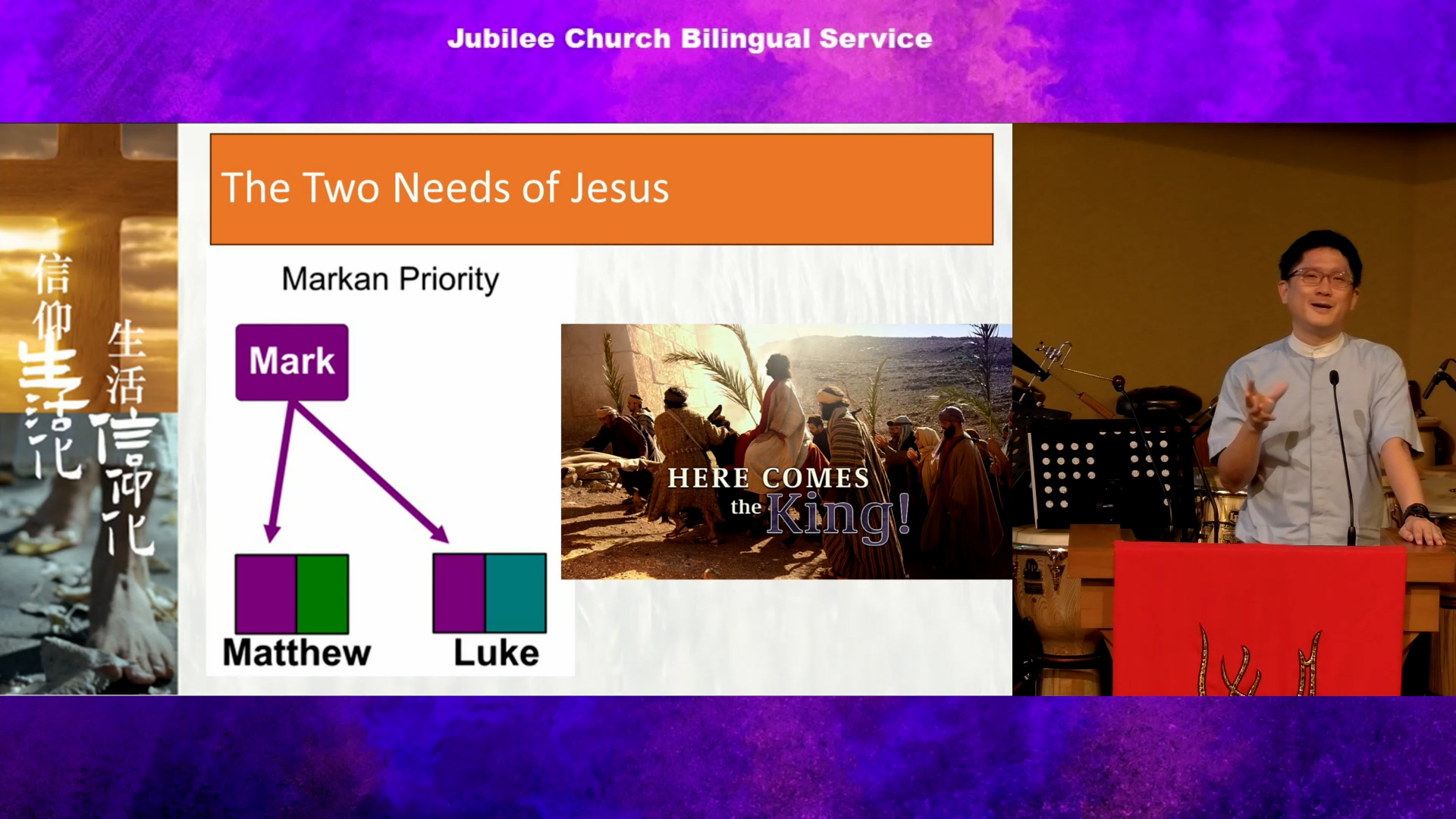
this day using the Gospel of Luke. For this sermon, we will be
approaching Luke's account in a different way, using a game we play in
children ministry: spot the difference. What we do in children ministry is
we teach the Gospel of Mark from P3 to P5, and then in P6, we ask the
children to compare Mark with Matthew and Luke to highlight how the
other two Gospels transform their account based on the original Mark. In
this way, using what they already know from Mark, they can discover the
uniqueness of Matthew and Luke.
Let's try the first one. Spot the difference. Find the most significant
difference in which Luke deviated from Mark:
Mark 11: 2 saying to them, “Go to the village ahead of you, and just as you
enter it, you will find a colt tied there, which no one has ever ridden. Untie
it and bring it here. 3 If anyone asks you, ‘Why are you doing this?’ say,
‘The Lord needs it and will send it back here shortly.’”
Luke 19: 30 “Go to the village ahead of you, and as you enter it, you will
find a colt tied there, which no one has ever ridden. Untie it and bring it
here. 31 If anyone asks you, ‘Why are you untying it?’ say, ‘The Lord needs
it.’”
Are you ready? The most significant difference is Luke removed the
second half of the reply: "will send it back here shortly". Why? Does
Jesus not intend to return it after all? We know that Luke investigated all
his information, and what happened was, he found that the colt which had
already grown up into an adult donkey by then is still with Peter. So,
since they didn't return it, Luke had to shorten the reply. Otherwise, it
would be a broken promise. Make sense? I'm just kidding. I will attempt
an answer later.
Was the first attempt fun? Let's try another one. This time, spot the three
most significant differences.
Mark 11: 4 They went and found a colt outside in the street, tied at a
doorway. As they untied it, 5 some people standing there asked, “What are
you doing, untying that colt?” 6 They answered as Jesus had told them to,
and the people let them go.
Luke 19: 32 Those who were sent ahead went and found it just as he had
told them. 33 As they were untying the colt, its owners asked them, “Why
are you untying the colt?”
34 They replied, “The Lord needs it.”
Are you ready?
The first difference is Luke remove the detail about where the colt is
found: "outside in the street, tied at a doorway".
The second difference is Luke clarified that it wasn't just "some people
standing there" questioning the apostles, they were the owners of the
colt.
The third difference is Luke repeated the reply "The Lord needs it". This
repetition is therefore intentional. Luke feels this reply is important.
Did you manage to find the three significant differences? I hope you had
fun playing this game.
But the actual fun is processing why Luke made these changes. When
you put the four differences together, I think you might spot a pattern. If
you read the account from Mark, which is the original version, you might
end up with a misunderstanding that the Jesus send the apostles to
borrow a random colt. The colt just happened to be there on the streets,
and although some random bystanders questioned them as they were
untying it, they manage to borrow it because they promised to return it
shortly. I think Luke want to eliminate any possibility of such a
misunderstanding. There is nothing random in the entire process.
Bible scholars typically highlight two possible reasons why Matthew, Mark
and Luke included the details about the borrowing of the colt. Some
scholars say Jesus prearranged this, making "The Lord needs it" the
secret password. Others see it as divine foreknowledge—Jesus knowing
exactly where the colt was. Personally, I wish I had that power when
finding a parking spot in a crowded mall!
In my research, I found a third reason that makes the most sense
especially for Luke. "Jesus was, in effect, invoking the ancient principle
of angaria whereby individuals with official responsibilities could
requisition property for official use. In the Judea of Jesus’ day, under
Roman rule, animals could be commandeered in this way, and the right
was also expanded to even magistrates and rabbis." 1 A modern day
equivalent will be the Requisition of Resources Act used by MINDEF to
requisition civil resources. However, I think we see this most often in
action movies and dramas. You have a criminal escaping, and the hero
policeman or woman will requisition a car or bike from a nearby civilian to
give chase.
If the principle of angaria is the basis of the borrowing of the colt, then we
see how Luke's version, compared to Mark's, added much legitimacy to
the process. The colt wasn't just by the roadside randomly to be
borrowed, it was requisitioned from its proper owners, and all it takes for
the apostles was to declare "The Lord needs it." This is an official
demand for official purposes. And just in case you missed just how
authoritative it sounded, Luke repeated this reply a second time. "The
Lord needs it". None of the apologetic "(we) will send it back here
shortly". Admittedly, you need to say this kind of line with gravitas.
Maybe, I'll try it out in the carpark later: I'll attempt to requisition a car I
like, and if the owner asks, I'll declare: The Pastor needs it. (kidding) Just
to be clear, Luke omits the phrase about returning the colt—not because
the colt was never returned, but because he wanted to emphasize Jesus’
authority. 'The Lord needs it' was a statement of authoritative right, not a
request to borrow.
Now that we understand the legal and cultural context, let’s explore an
even deeper question: Why did Jesus insist on using a colt at this
moment? Throughout his three years ministry, he has always travelled by
boat and on foot. He didn't even use an animal to rush to a dying patient,
e.g. Lazarus. He and his entourage would have walked for weeks from
Galilee to the Mount of Olives, and yet at the final stretch of the journey,
he needed a colt so badly that he had to requisition one? The answer
lies in Zechariah 9:9.
Zechariah 9: 9 Rejoice greatly, Daughter Zion!
Shout, Daughter Jerusalem!
See, your king comes to you,
righteous and victorious,
lowly and riding on a donkey,
on a colt, the foal of a donkey.
The purpose of the colt is a prop to fulfil the theological meaning of
Zechariah 9:9: Jesus enters as a king into Jerusalem. Jesus has been to
Jerusalem many times. He was there every year for Passover as a child
(Luke 2:41), and in his adult ministry, John recorded his visit there three
times (John 2:23; 5:1; 10:23). But this time, Jesus enters the holy city as
a king. This is why the colt is needed. It is to symbolize that this is a
royal entry different from all other times. This is also why this colt has
never been ridden before. It is as if to emphasize that it is specially
prepared for this momentous occasion. Taken in this light, the phrase
"The Lord needs it" becomes much more meaningful. The Lord refers to
more than just Jesus as a rabbi teacher, it means Jesus exercising his
royal authority as the king.
Let us now do our third spot the difference. This time there is only one
significant difference.
Mark 11: 7 When they brought the colt to Jesus and threw their cloaks
over it, he sat on it. 8 Many people spread their cloaks on the road, while
others spread branches they had cut in the fields.
Luke 19: 35 They brought it to Jesus, threw their cloaks on the colt and put
Jesus on it. 36 As he went along, people spread their cloaks on the road.
Are you ready?
The significant difference is Luke removed the detail about the palm
branches. If we only have the Gospel of Luke, today will be remembered
as Cloak Sunday.
Let's do the last spot the difference activity. There are at least three
significant differences this time.
Mark 11: 9 Those who went ahead and those who followed shouted,
“Hosanna!”
“Blessed is he who comes in the name of the Lord!”
10 “Blessed is the coming kingdom of our father David!”
“Hosanna in the highest heaven!”
Luke 19: 37 …, the whole crowd of disciples began joyfully to praise God in
loud voices for all the miracles they had seen:
38 “Blessed is the king who comes in the name of the Lord!”
“Peace in heaven and glory in the highest!”
39 Some of the Pharisees in the crowd said to Jesus, “Teacher, rebuke
your disciples!”
40 “I tell you,” he replied, “if they keep quiet, the stones will cry out.”
Are you ready?
1. The first difference is Luke removed the shouting of "Hosanna".
This is a Jewish phrase from Psalm 118 meaning "Lord, save us"
which perhaps would be unfamiliar to Luke's gentile readers.
2. The second difference is important: Luke replaced the words "he"
and "the kingdom" to become "the king". "Luke is careful to convey
the idea that what has arrived is not the “kingdom,” but the “king.”
Saying that the kingdom is coming could leave the impression that
the kingdom of God should have been inaugurated with Jesus’
arrival at Jerusalem (or shortly thereafter). This idea Luke is careful
to avoid. This may explain why Luke omits mention of the palm
branches which signify political ideas." 2 Palm branches symbolize
victory in the Roman world. 3
3. The third difference is this line in Luke: “Peace in heaven and glory
in the highest!” You might recall that this is similar to what the
angels declared to the shepherds during Christmas. Luke 2: 14 “Glory
to God in the highest heaven, and on earth peace to those on whom
his favor rests.”
4. The fourth difference is verse 39-40 in Luke, which is about the
protest from some Pharisees about the way the disciples celebrated
Jesus' royal entry in Jerusalem. In Jesus' perspective, this
celebration is a need.
My sermon title is the two needs of Jesus. The first need is the need of
the colt as a prop as Jesus entered Jerusalem as a king. This focus on
Jesus' kingship is highlighted in the disciples' celebration as well.
38 “Blessed is the king who comes in the name of the Lord!” When some
Pharisees protested such a celebration, Jesus replied that this celebration
to praise God for Jesus' kingship was needed. This is the second need of
Jesus. 40 “I tell you,” he replied, “if they keep quiet, the stones will cry out.”
This is the reason why worship is absolutely necessary, just like how the
angels cried out in the heavens to the shepherds. All praise to God in the
highest because he has brought about Jesus' kingship which will bring
peace. But this peace might be different from the usual expectation that
all enemies are defeated. As Zechariah declares, "See, your king comes
to you, righteous and victorious, lowly and riding on a donkey." Since
Jesus is a humble king, his peace will not be a military conquest over the
Romans. Instead, peace will come in other forms.
Peace is victory over the power of the devil. Peace is bringing reconciliation
between us and God. Peace is restoring the community as one. To solve the
problem of sin, God sent his king in the person of Jesus. Jesus is victorious over
Satan. Jesus restored the sick and the sinners. In short, Jesus became the
solution to humanity. And when humanity is solved, true peace will eventually
be forever.
Brothers and sisters, don’t you see? Jesus’ coming is the ancient promise in
Zechariah happening for real. This is true divine peace. That is why at the royal
entry of Jesus, the disciples need to celebrate the moment. If not, even the
stones will cry out. Jesus is still the King today, bringing peace in our lives and
communities. Just as the disciples couldn’t keep quiet about his arrival, we, too,
must proclaim his reign. Will we be the ones to celebrate him, or will we leave it
to the stones to cry out? Brothers and sisters, if you know that Jesus’ kingship
will bring about such peace, won’t you also give praise to God?
To reiterate my key points today:
Need #1: Jesus needed the colt to fulfil prophecy and declare his
kingship.
Need #2: Jesus needed the celebration because his kingship brings
peace.
In our passage today, Jesus came to Jerusalem, riding on a colt, intentionally
arranged. It is a graphic message to all witnesses: the promised King has
arrived. From now on, God has brought his king to his people, fulfilling the
ancient prophecies and peace shall prevail.
For reflection, I want to focus on two reflections on what it means that Jesus is
king.
First, it means a total surrender when our king declares, “The Lord needs it”.
We are right to be focused on building their careers, accumulating wealth, or
achieving personal goals. But Jesus’ kingship sometimes asks us to surrender
what we hold onto—whether it's our time, talents, or ambitions—for his
purposes. Are you willing to say, “The Lord needs it” when it is requisition time?
Second, Jesus’ kingship implies the need for his people to praise him openly.
Some of us may struggle with openly sharing our faith due to the fear of being
judged. Think about how influencers boldly promote brands or lifestyle trends
on Instagram and TikTok. What if we had that same boldness to share about
Jesus? When was the last time you talked about Jesus outside of church? How
can you make sharing your faith a natural part of your life?