Psalm 68: 1 May God arise, may his enemies be scattered;
may his foes flee before him.
2 May you blow them away like smoke—
as wax melts before the fire,
may the wicked perish before God.
3 But may the righteous be glad
and rejoice before God;
may they be happy and joyful.
4 Sing to God, sing in praise of his name,
extol him who rides on the clouds;
rejoice before him—his name is the Lord.
5 A father to the fatherless, a defender of widows,
is God in his holy dwelling.
6 God sets the lonely in families,
he leads out the prisoners with singing;
but the rebellious live in a sun-scorched land.
7 When you, God, went out before your people,
when you marched through the wilderness,
8 the earth shook, the heavens poured down rain,
before God, the One of Sinai,
before God, the God of Israel.
9 You gave abundant showers, O God;
you refreshed your weary inheritance.
10 Your people settled in it,
and from your bounty, God, you provided for the poor.
32 Sing to God, you kingdoms of the earth,
sing praise to the Lord,
33 to him who rides across the highest heavens, the ancient heavens,
who thunders with mighty voice.
34 Proclaim the power of God,
whose majesty is over Israel,
whose power is in the heavens.
35 You, God, are awesome in your sanctuary;
the God of Israel gives power and strength to his people.
Praise be to God!
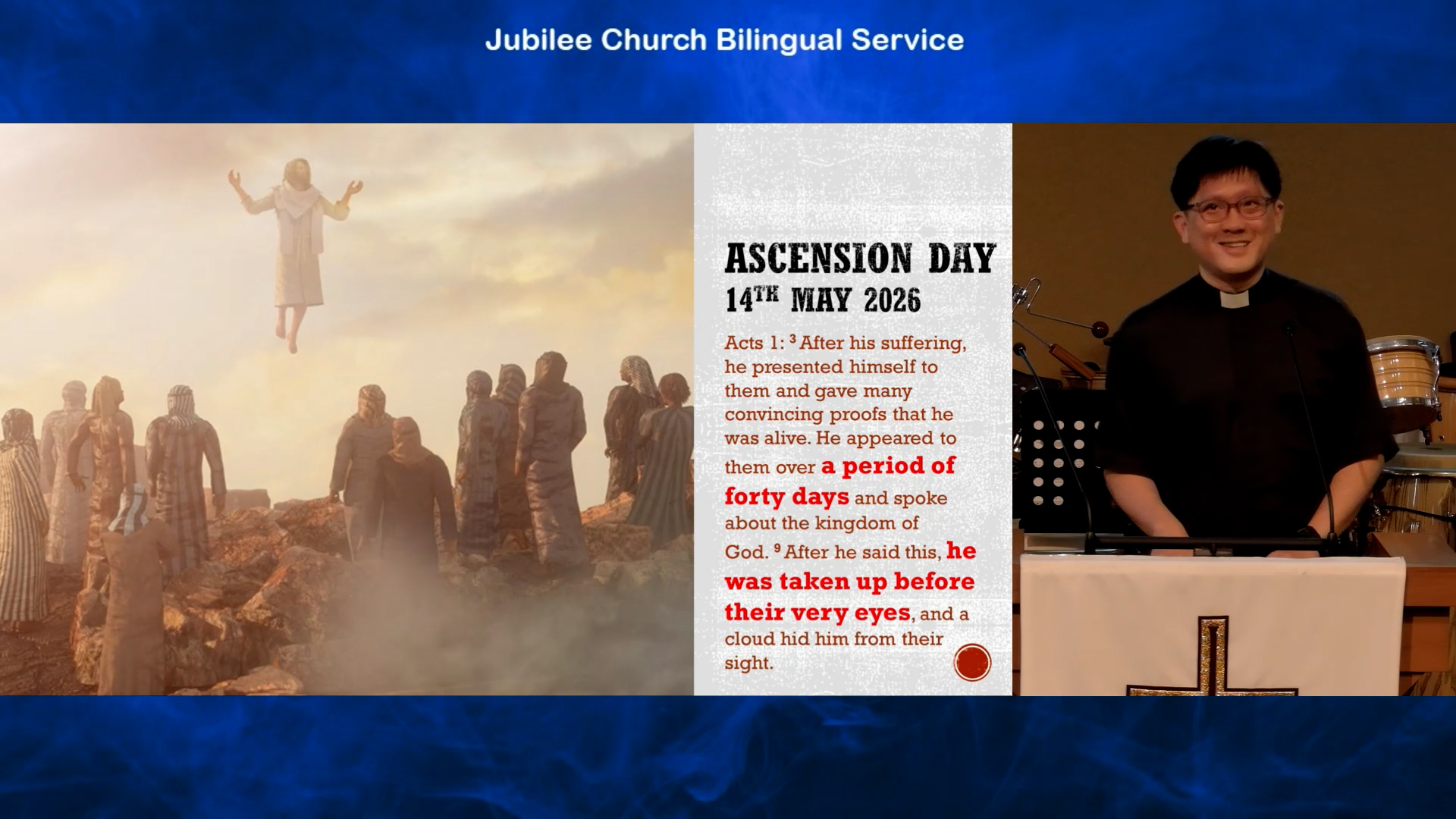
Today’s passage is based on the Psalm reading of the lectionary: Psalm 68. The reason why this particular psalm is selected as a reading for this Easter season is because coming Thursday is the Ascension Day of our liturgical calendar. What is the Ascension Day? As recorded in Acts 1: 3 After his suffering, (Jesus) presented himself to (his apostles) and gave many convincing proofs that he was alive. He appeared to them over a period of forty days and spoke about the kingdom of God. 9 After he said this, he was taken up before their very eyes, and a cloud hid him from their sight. So, forty days starting from Easter Sunday, which ends on coming Thursday, we commemorate Ascension Day, which is the day Jesus was taken up to the heavens to be enthroned at the right hand of God. The lectionary has chosen Psalm 68 as the psalm reading to commemorate Ascension Day.
Psalm 68 is originally about the ascension of God into the Jerusalem Temple on Mount Zion.
Psalm 68: 17 The chariots of God are tens of thousands
and thousands of thousands;
the Lord has come from Sinai into his sanctuary.
18 When you ascended on high,
you took many captives;
you received gifts from people,
even from the rebellious—
that you, Lord God, might dwell there.
The ascension to the Jerusalem Temple is actually the climax of the Psalm. The entire psalm is set in the context of a worship procession during a worship festival. Based on the history of Israel, God has been journeying with his people for a long time, literally across vast lands. And God has chosen Mount Zion as his final dwelling place. Psalm 68 traces the entire movement of God:
- Departure from Egypt and the Wilderness
The march begins with God “arising” and “going out” before His people to lead them from bondage. This stage portrays God as a Divine Warrior marching vigorously through the “wasteland” or “wilderness”. This initial movement is associated with the Ark of the Covenant, which served as the symbolic throne of God leading the journey through the desert.
- The Milestone at Mount Sinai
A pivotal point in the journey occurs at Mount Sinai, described as God’s ancient “holy place” and dwelling. This is the place of the burning bush where Moses first encounter God, and now the place where the Ten Commandments will be written. This transition signifies “the God of Sinai” becoming “the God of Israel” by covenant.
- The Conquest and Settlement of Canaan
As the march continues from Sinai into the land of Canaan, the psalm describes God scattering enemy kings “like snow”. The tall peaks of Mount Bashan symbolizes the rich and powerful who were oppressing the land of Canaan. But God liberated the powerless. 5 A father to the fatherless, a defender of widows, is God in his holy dwelling. During this movement, God is said to provide “generous rain” and refreshment for His “weary inheritance,” settling the desolate and the poor in their new home.
- The Final Procession to Zion
The climax of the journey is God’s ascent to Mount Zion in Jerusalem. Let’s imagine what it must be like as the people are singing Psalm 68. After tracing the history of God journeying with them, they end with a “festal procession” into the sanctuary, featuring: Singers led the way, followed by stringed instruments. Young women played tambourines in the midst of the throng. Representatives from various tribes, such as Benjamin, Judah, Zebulun, and Naphtali, accompanied the march.
If I have preached this psalm a few years ago, I would have moved quickly from the ascension of God in Jerusalem to the ascension of Jesus into heaven. But in 2023, we witnessed the war in Gaza, and now in 2026, we are in the midst of the war in Iran. In America, we have politicians and pastors who cite verses from Psalm 68 in support of their military. In line with our theme of faith in praxis, allow me to devote some time to address the topic of passages like Psalm 68, which is about God being the warrior of his people, fighting against his enemies. These passages are being used as justification for the wars today. I heard that the Pope tried to address this issue, but he was warned to be careful with his words.[i] So, no worries, I will be extra careful too.
What Just War Thinking Actually Requires
Psalm 68 is sometimes dressed in the language of just war theory, meaning that was can be justified if used correctly. But standard just war thinking — from Augustine and Aquinas onward — does not rest on a literal application of the Divine Warrior motif. Augustine was insistent that the ultimate goal of any just war must be peace — not victory, not revenge, but the restoration of a just order in which peace becomes possible again.
There are at least four just war criteria: just cause, legitimate authority, right intention, last resort. They are intended to be constraining principles, designed to limit violence. They were never meant to provide a blank cheque for nations to read their conflicts into sacred texts. Just to be clear: not every war that involves Israel is a holy war. Not every fight that is started, even if the enemy is truly evil, is a just war.
The Ark Is Not a Weapon
In Psalm 68, the ark of the covenant is used to symbolize God’s presence with his people, especially through the wilderness and in the conquest of the promised land. I can think of no better example of how the authority of God Psalm 68 should be claimed more carefully than the funny story in 1 Samuel 4-6. When Israel found itself losing badly to the Philistines, the elders hit upon what seemed like an obvious solution: bring the ark of the covenant into the battle camp. If God dwells above the ark, surely his presence guarantees victory. The ark arrived, the army roared so loudly that the Philistines genuinely panicked — but then Israelite army was comprehensively defeated anyway. Thirty thousand dead. The ark captured. The two evil sons of Eli who had escorted it, killed. It is one of the most spectacular backfires in the whole of Scripture.
But the real comedy begins in chapter 5. The Philistines, delighted with their trophy, installed the ark in the temple of their god. But the idol fell down before the ark twice as if it is bowing down before it. And then the cities that housed the ark began to break out in tumors and chaos, the Philistines were now desperate to get rid of the ark. Nobody wanted it. After seven months, the Philistines had had enough. They sent it back to Israel all the way home. The Divine Warrior had proven his ultimate authority. Israel had tried to use the ark as a weapon and lost everything. The Philistines had tried to use it as a trophy and spent seven months in chaos. The point is if you try to use God as a tool for your own agenda, be prepared to backfire on yourself spectacularly.
The Battle Was Never Ours
If we examine Psalm 68 carefully, Israel is not the warrior. God is. The people are never authorized by this specific text to take violence into their own human hands and call it holy. Sometimes, God commands his people to fight, like in the case of the Amalekites. But he is silent most of the time. The moment we transfer the warrior’s role from God to a human army or a specific nation, however righteous it may appear, we risk entering into something far more dangerous: the ancient temptation to dress human ambition in religious language.
What the Psalm Calls Us To
The Christian who reads Psalm 68 rightly will feel its full moral and emotional force: the fierce justice of a God who fights for the powerless, who will not remain neutral in the face of oppression, whose holiness cannot coexist with wickedness indefinitely. That conviction should move us. But the direction it moves us is not necessarily toward violence in God’s name. It moves us toward prayer, toward advocacy, toward courageous solidarity with those who suffer, and toward the humility of those who know they are not the Divine Warrior and never will be.
Thankfully, the best way to interpret the ascension of the Warrior God is through the ascension of Jesus Christ, the Prince of Peace, into the heavens. This is found in Ephesians 4: 7 But to each one of us grace has been given as Christ apportioned it. 8 This is why it says: “When he ascended on high,
he took many captives
and gave gifts to his people.”
9 (What does “he ascended” mean except that he also descended to the lower, earthly regions? 10 He who descended is the very one who ascended higher than all the heavens, in order to fill the whole universe.)
The Ascent of the King: Psalm 68 and the Christ Event
Paul, writing to the Ephesians, lifts this ancient song and places it over the life of Jesus. The one who descended is the Son of God himself, who left the heights of heaven to enter our darkness. He walked where we walk. He bore what we could not bear. And then after his death and resurrection, forty days later, he ascended. Not to an earthly mountain, but to the heavenly sanctuary itself — to the very throne at the right hand of God. There he sits, enthroned in glory, the sovereign King over all things seen and unseen.
Just as the ancient king returned from battle to lavish his loyal people with the spoils of war, Christ in his ascension pours out his gifts upon his church. The same King who ascended above all the heavens, who fills all things, has chosen to make the church his fullness, his presence in the world. The gifts he distributes from his throne are given so that the body might be built up, so that the whole community might grow into maturity. Every gift finds its meaning in relation to every other gift. None of us, alone, is the fullness of Christ. Together, we might begin to be. A community that is genuinely in unity is a living declaration that King Jesus has conquered sin and death.
Now that we understand the true meaning of the ascension, I wish to end with two applications:
First, Paul in Ephesians 4 fundamentally redefined who the enemies of God are. They are no longer the enemies of Israel, or even the enemies of the Church. The conquest imagery is fulfilled through Jesus Christ’s defeat of sin, death, and Satan. Our real enemies are these powers that hold all men captive through our selfish desires. Now they have been taken captive by Jesus instead. And the psalm 68’s own context confirms this. It does not end with the annihilation of the nations. It ends with their procession to God’s throne — kings bringing tribute, peoples offering worship. The ultimate purpose of the Divine Warrior’s campaign was never military conquest or world dominance. It was the establishment of a universal kingdom of peace: asserting God’s justice for the powerless and establishing his universal rule. The ascension is the declaration that Jesus Christ reigns. And from his throne he equips his people to live as those who serve a King who has already defeated sin and death.
So the first application is to rethink who are our true enemies. The second application is to rethink the purpose of our spiritual gifts. Unfortunately, we tend to think of the gifts of the Spirit as personal — things given to us, for our own enrichment or use. Why else would we always use our gifts to criticize those that are different from us? The ear criticizes the foot for not listening, the foot criticizes the eyes for not walking, the eyes criticizes the ear for not seeing, and so on.
But Paul will not let the church stay there. This is the proper understanding of spiritual gifts: divine grace given to every member of his body, so that the church may grow, and be a blessing to the world. However varied the gifts, however different the people who carry them, it is one Lord who is personally present by his Spirit in each of them. He lives within each member of his body. This is the very foundation of Christian community. To receive a brother or sister is to receive the Christ who dwells in them. To despise them is to despise him.
The King has ascended. He has filled all things. He has given his gifts. Now he calls his church to become, together, what he has already made them: one body, one Spirit, one hope — his fullness, present and visible, in the world.