Introduction
Let me begin with a short story.
A young woman of high-school age was out late one evening…. Her father fell into an untroubled slumber, but her mother sat up, fretting and brooding and imagining a variety of disasters that might happen to their daughter. Finally, the mother could stand it no longer. She looked down, punched her husband real hard, and said, “Wake up. It’s your turn to worry,” at that very moment, the man took over worrying and the woman went to sleep.[i]
The story sounds comical because its author, Ellis Weiner, a satirist, intended it so. But we get the point: fear and worry are very much a part of life. We worry because we care deeply about the people and things we hold dear. Yet those very people and things are often the source of our greatest fears and anxieties—as the story illustrates.
But I don’t suppose anyone enjoys feeling fearful or anxious, even though these emotions are a natural part of human experience. We instinctively regard fear and anxiety as negative emotions. They can make us feel trapped, narrow our perspective, cloud our judgment, and bring both emotional distress and physical strain.
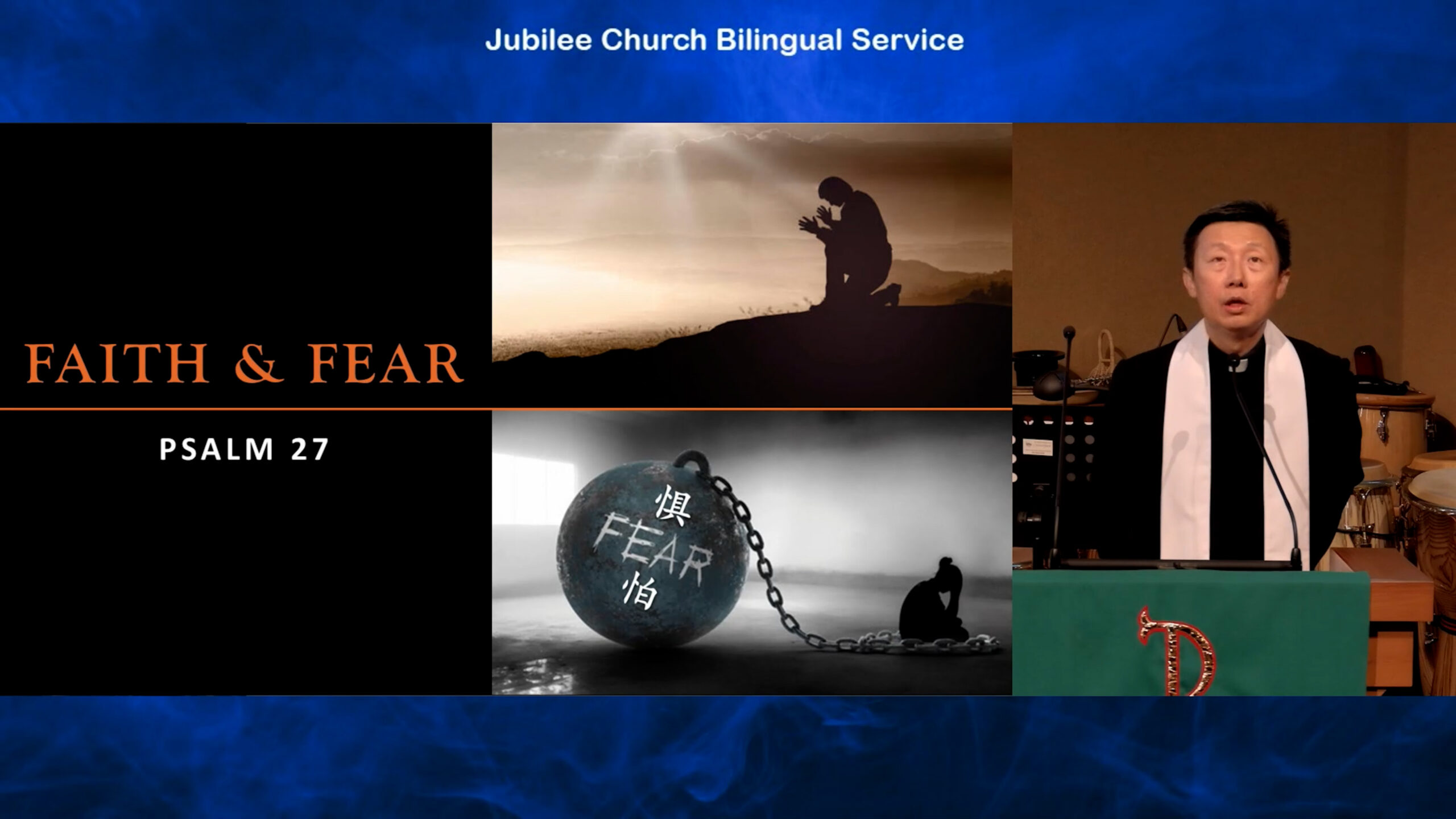
So let me ask you a simple question: When fear comes, what should a Christian do? Exercise faith or dwell in fear?
I suspect most of us would answer, “Exercise faith”—especially in a church setting. That’s the “right” answer.
But the psalmist might answer the same question rather differently. Let’s do a quick walkthrough of Psalm 27. The first six verses are filled with expressions of confidence. Take verses 5 and 6, for example:
For he will hide me in his shelter
in the day of trouble;
he will conceal me under the cover of his tent;
he will lift me high upon a rock.
And now my head shall be lifted up
above my enemies all around me,
and I will offer in his tent
sacrifices with shouts of joy;
I will sing and make melody to the Lord.
It would be much easier to preach this psalm if the psalmist had begun by pouring out his fears and ended with the confidence we hear in verses 5 and 6. The sermon would then write itself: faith overcomes fear. A familiar and encouraging Christian message.
But that is not how the psalm unfolds.
After six verses that declare confidence in God, the psalmist devotes the next six to his anxieties, pleas, and fears.
This equal weight given to confidence and anxious pleas reflects the reality of the life of faith.
Biblical faith is not triumphalistic, leaving no room for fear. Rather, it is a faith that continually holds confidence and fear together, because life is never free from dangers, pressures, or uncertainties.
Over the past two weeks, we’ve heard about migrant Indian construction workers in Singapore facing uncertainty over their jobs and unpaid salaries, an earthquake in Venezuela, and ongoing instability in the Middle East. These headlines remind us that we live in a world marked by insecurity and fear.
That is why the sermon is titled Faith and Fear, not Faith or Fear. The Christian life is not choosing between faith or fear; it is learning to trust God in the midst of our fears.
Both faith and fear have their place in life. Fear alerts us to danger. Without a healthy sense of fear and caution, we can become blind to risks, rash in our decisions, insensitive to others, and even ruthless in our actions.
Faith, on the other hand, enables us to see God and to recognise his work in our lives. Even when God seems hidden, faith sustains our hope, enabling us to keep looking to him. A genuine and living faith takes God seriously because it longs to know him as he truly is. It dares to ask real and difficult questions that sift out our false and wishful ideas about God, so that we may come to know him as he has revealed himself.
When we think about holding faith and fear together—not as a theological concept but as the reality of daily living—it becomes clear that faith is more than believing the right doctrines. Sound doctrine is important, but faith cannot remain merely a subject for discussion or Bible study.
More often than not, faith is lived out in our encounters with God.: crying out for help and discovering that he hears our prayers; confessing our sins and receiving his forgiveness and a fresh start; bringing to him sorrows that threaten to overwhelm us and finding comfort through his Word, his presence, and his people.
To hold faith and fear together, faith must be more than something we profess; it must be something we experience as we see God at work in our lives. This means that Christianity is not simply one part of life—it is the way we live our whole lives before God.
Psalm 27 helps us recognise this. But just as it makes life harder for preachers, it also makes life harder for every one of us. When we pray, we naturally want God to answer our prayers. Yet Psalm 27 is not ultimately about receiving immediate answers. It is a plea for help, a cry for renewed trust, and a prayer for the strength to wait—to keep waiting for the Lord—even when there is no sign that our prayers will soon be answered.
This is not blind faith. The psalmist waits because his confidence is rooted in God’s faithfulness in the past. Yet life has brought him once again to a place of waiting. Doesn’t that sound familiar? Many of us have experienced this before, and some of us may be living through it even now. Although the psalm does not promise immediate relief, it does show us how to live faithfully in the real world.
It teaches us to practice thankful remembering, earnest seeking, and patient waiting. We will consider each of these in turn.
II.
First, thankful remembering. We see this in the opening six verses, where the psalmist bursts into a song of confidence in God. Remembering does more than recall God’s past faithfulness; it bears witness to who God is. The psalmist proclaims words that we all need to hear: that God—not favourable circumstances or successful outcomes—is our light, our salvation, and the stronghold of our lives.
In remembering, the psalmist is also rejecting the false narratives that so easily shape our lives—the belief that life is ultimately governed by fear, scarcity, performance, or control. Instead, remembering frees both him and us to trust God’s character and to follow his leading.
Remembering also reshapes the way we see life. It enables the psalmist to reject the false narratives that so easily shape our lives—narratives that tell us life is ultimately governed by fear, scarcity, performance, or control. Instead, remembering frees both him and us to trust God’s character and follow his leading.
To remember also suggests that the psalmist has been attentive to God’s work in his life all along. Because he has noticed God’s faithfulness, he is able to count his blessings even in difficult times and to remain hopeful rather than discouraged in the midst of trouble.
All this means that thankful remembering weakens fear’s grip while strengthening our resolve to live faithfully.
This is the first lesson the psalm teaches us.
III.
Next, the psalmist models for us earnest seeking.
Facing enemies and other challenges (vv. 2–3, 6, 11–12), the psalmist prays earnestly. His earnestness is evident in the many petitions he brings before God. He makes no fewer than nine requests, covering his relationship with God, his enemies, his future, his conduct, and his deepest longings. The breadth of his petitions shows that he brings every part of life before God.
Earnest seeking, therefore, is not simply praying more. It is bringing every part of life into God’s presence.
The psalmist’s response stands in sharp contrast to the way many of us live today. Modern life encourages us to compartmentalise. Work belongs here, family there, leisure somewhere else, each carefully managed so that we can preserve our sanity. Before long, we begin to relate to God in the same way, bringing to him only the concerns we think are spiritual enough.
But the psalmist’s prayer shows us a different way to live. Let me illustrate it with the picture of an intersection.
The faithful live at the busy intersection where faith meets every part of life. At that intersection, they continually bring their trust and their fears, their hopes and disappointments, their successes and failures, their love and their anger—indeed, everything in between—before God, allowing Scripture to shape and guide those conversations. They do not decide which parts of life are holy enough to bring before God and which are not. They therefore dare to pray prayers that may at times sound raw, even disrespectful or theologically untidy, yet are always marked by honesty and a genuine desire to know God and his will.
Earnest seeking teaches us to bring every part of our lives before God. In doing so, it challenges our tendency to compartmentalise life and faith. This is the second lesson the psalm teaches us.
Thirdly, patient waiting.
The closing verse urges us to wait for the Lord. To be clear, patient waiting is not passive resignation but active dependence on God. The psalmist knows this well, and so at the heart of the psalm is this prayer:
One thing have I asked of the Lord,
that will I seek after:
that I may dwell in the house of the Lord
all the days of my life,
to gaze upon the beauty of the Lord
and to inquire in his temple.
Notice that while David longs for deliverance, his deepest desire is God’s presence—even before his circumstances change. His waiting is sustained by seeking God.
The same is true for us. Developing and sustaining our faith requires the encouragement and renewal that come through worship, listening to God’s Word, prayer, and reflection.
Because waiting is sustained by seeking God, let me encourage us to go beyond our usual quiet time by cultivating regular practices that deepen our attentiveness to him. In a moment, we will try one such practice[ii] of praying and waiting before God.
Before that, let me suggest what these practices—often called spiritual disciplines—can do for us. They help us make sense of both faith and fear, which we have been learning to hold together. By slowing down before God, we gain the space to process pain, learn wisdom, gain perspective, and sometimes even experience our circumstances differently.
So let me end where we began. Psalm 27 does not promise quick relief. Instead, it shows us how to live faithfully in a world where faith and fear often exist side by side. It calls us to practise:
Thankful remembering—interpreting the past through God’s faithfulness.
Earnest seeking—bringing every part of our lives before God in the present.
Patient waiting—entrusting the future to the God who remains faithful.
[i] Adapted from Bartlett, David L. (eds.) etc., Feasting on the Word: Year A, Vollum 1: Advent through Transfiguration (2010, p.656, Kindle version), with minor modifications.
[ii] The practice: Praying the Scriptures – Psalm 25:1-6