Matthew 2: 13 When they had gone, an angel of the Lord appeared to Joseph in a dream. “Get up,” he said, “take the child and his mother and escape to Egypt. Stay there until I tell you, for Herod is going to search for the child to kill him.”
14 So he got up, took the child and his mother during the night and left for Egypt, 15 where he stayed until the death of Herod. And so was fulfilled what the Lord had said through the prophet: “Out of Egypt I called my son.”
16 When Herod realized that he had been outwitted by the Magi, he was furious, and he gave orders to kill all the boys in Bethlehem and its vicinity who were two years old and under, in accordance with the time he had learned from the Magi. 17 Then what was said through the prophet Jeremiah was fulfilled:
18 “A voice is heard in Ramah,
weeping and great mourning,
Rachel weeping for her children
and refusing to be comforted,
because they are no more.”
19 After Herod died, an angel of the Lord appeared in a dream to Joseph in Egypt 20 and said, “Get up, take the child and his mother and go to the land of Israel, for those who were trying to take the child’s life are dead.”
21 So he got up, took the child and his mother and went to the land of Israel. 22 But when he heard that Archelaus was reigning in Judea in place of his father Herod, he was afraid to go there. Having been warned in a dream, he withdrew to the district of Galilee, 23 and he went and lived in a town called Nazareth. So was fulfilled what was said through the prophets, that he would be called a Nazarene.
There are 12 days of the Christmas season and today is the 4th day of Christmas. I hope to continue our reflection on the meaning of Christmas: John 1: 14 The Word became flesh and made his dwelling among us.
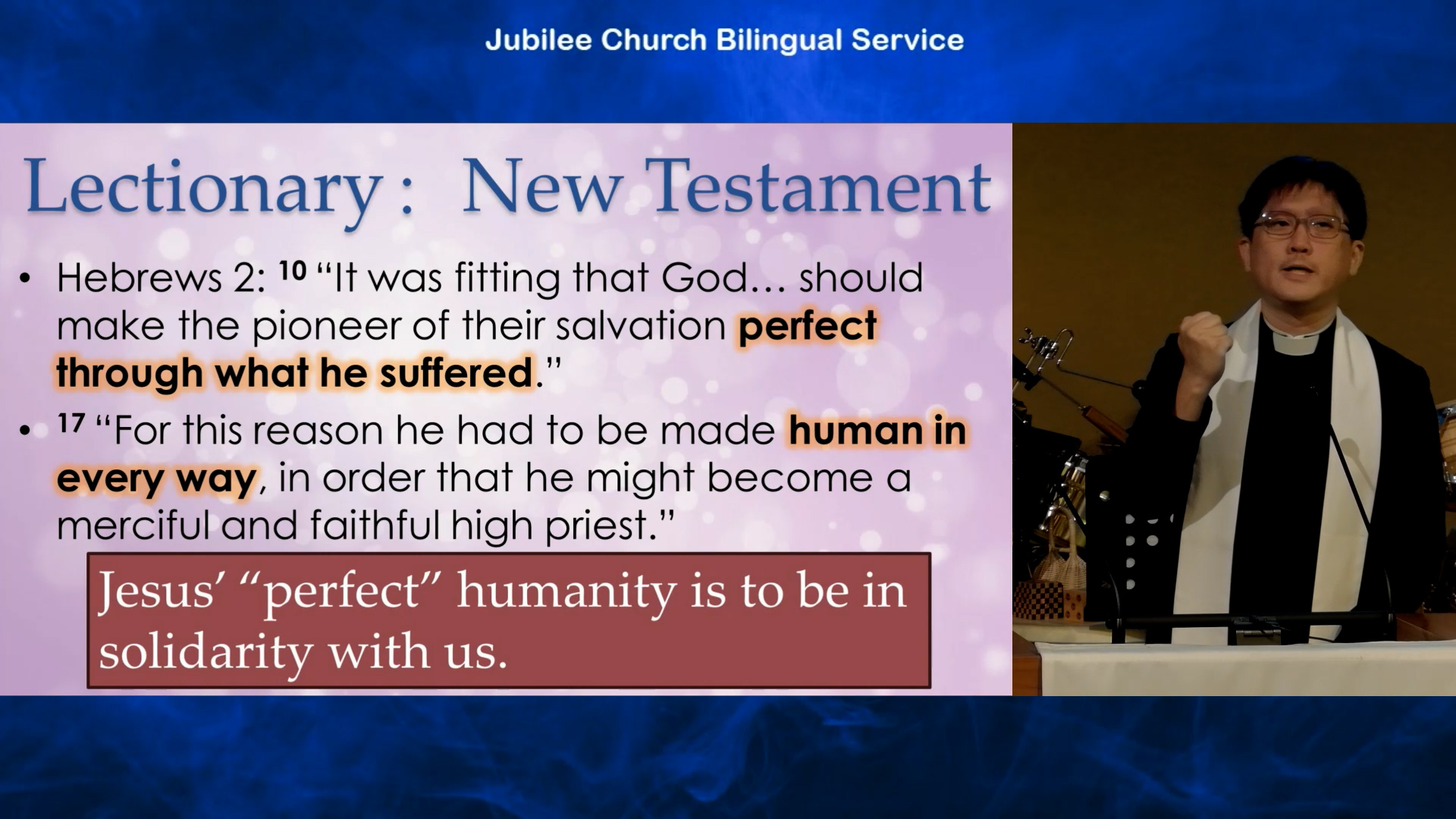
Brothers and sisters, let me begin with two striking phrases from the lectionary reading in Hebrews 2:
“It was fitting that God… should make the pioneer of their salvation perfect through what he suffered.” (Heb 2:10)
“For this reason he had to be made human in every way, in order that he might become a merciful and faithful high priest.” (Heb 2:17)
What does it mean that Jesus was made perfect through suffering?
And what does it mean to emphasize that the Son of God became human in every way?
Did the eternal Son lack something before He suffered?
Was He somehow “not considered human enough”—not fully qualified—until He entered into our pain?
These are uncomfortable questions.
Jesus was made perfect not because He lacked anything in His nature,
but because true salvation requires solidarity.
To save humans, He became fully human.
To stand with His people, He entered their story.
To redeem us from our suffering, He suffered.
I believe Hebrews emphasized this because of a subtle assumption many of us carry:
that real life, real belonging, real identity must be proven through certain experiences—
through hardship, through perseverance, through being “authentic” enough.
Sometimes I read comments online where so-and-so is not really Singaporean enough because he has not served National Service; or so-and-so new immigrant can be considered a true-blue Singaporean now that he or his son has served National Service.
We do this all the time.
We say that someone is not really mature unless they’ve tasted suffering.
Not really patriotic unless they’ve served.
Not really successful unless they’ve endured the grind.
In other words:
“You’re not one of us unless you’ve lived what we’ve lived.”
That is a very human way to measure worth.
I want to talk about this mindset we have because Matthew is a gospel written for a Jewish church. And whether someone can be considered Jewish enough, that is a mindset especially prevalent amongst the Jews.
And as we saw in modern political and cultural narratives—some Jews questioned the authenticity of other Jews because they had not endured exile, army service, or the hardship of building a nation.
I read a story about the more than a million Soviet Jews who immigrated to Israel after the fall of the Soviet Union. When they arrived, they faced a surprising dilemma:
What hat should they wear?
Because in Israel, your hat doesn’t just keep the sun off.
It tells people who you are.
- A small knitted kipa? You’re Modern Orthodox.
- A bigger one? Probably a settler.
- A black velvet one? Ultra-Orthodox.
- A colorful embroidered cap? Sephardic tradition.
- A wide-brimmed fedora? Hasidic, especially from the Lubavitch movement.
In other words, one hat says you’re Zionist; another suggests you’re anti-Zionist. One tells people what synagogue you might attend, how you pray, and sometimes even what you think politically.
So imagine being a Soviet Jew who survived antisemitism and persecution for being Jewish — and yet, the moment you arrive in the Jewish homeland, some people don’t judge you by your story, or your suffering, or your faith.
They judge you by your hat.
If Hebrews tells us that Christ is fully human,
Matthew shows us that Christ is fully Jewish.
Not Jewish only by birth.
Not Jewish only by genealogy.
But Jewish by experience.
Matthew is very careful here. He does not rush Jesus from the manger to the ministry. He lingers. He slows down. He tells a story that seems, at first, unnecessarily painful — flight, fear, slaughter, tears, exile, obscurity. But Matthew knows exactly what he is doing.
Jesus does not simply arrive as Israel’s Messiah.
He re-walks Israel’s path.
First, Matthew tells us that Jesus flees to Egypt.
“Out of Egypt I called my son.”
This is not merely a geographical note. Matthew is deliberately echoing Hosea. Israel, God’s son, once went down into Egypt — not by choice, but by necessity. Famine drove them there. Vulnerability trapped them there. Oppression shaped them there.
And now Jesus, God’s Son, does the same.
He does not bypass Israel’s exile.
He enters it.
As a child — not a warrior, not a king — He becomes a refugee. Dependent. Displaced. Vulnerable to the violence of empire.
Matthew wants us to see this clearly: Jesus does not redeem Israel from a distance. He redeems Israel by standing where Israel once stood.
Then Matthew moves us from Egypt to Ramah.
Herod’s rage explodes into violence. Children are killed. Mothers weep. And Matthew quotes Jeremiah:
“A voice is heard in Ramah,
weeping and great mourning,
Rachel weeping for her children
and refusing to be comforted.”
This is one of the darkest moments in Matthew’s Gospel. And again, it is not incidental.
Ramah was associated with exile. It was the place where mothers watched their children taken away to Babylon. It was the sound of loss without explanation. Pain without resolution.
By placing Jesus’ story here, Matthew is saying something profound:
Jesus does not only share Israel’s exile.
He shares Israel’s grief.
He grows up under the shadow of loss.
His life begins with lament.
The Messiah is born into a world where tears already exist — and He does not silence them. He allows the cry of Rachel to be heard again. Jesus enters a story where suffering is not theoretical, but deeply personal.
And then, after Egypt and after Ramah, Matthew gives us a third Scripture:
“So was fulfilled what was spoken through the prophets, that he would be called a Nazarene.”
This one is different.
There is no single Old Testament verse that says this directly. And that is exactly the point.
Matthew is no longer quoting a single text.
He is summarizing an entire prophetic theme.
Nazareth was not a place of honor. It was not famous for learning or holiness. It was small, obscure, and easily dismissed. Later, someone will ask, “Can anything good come out of Nazareth?” — and the question will not be rhetorical.
To be called a Nazarene was to be labeled as insignificant.
And Matthew wants us to notice this.
Jesus does not only walk Israel’s story of exile and return.
He walks Israel’s story of being despised.
The prophets had long spoken of a servant who would be overlooked. Isaiah tells us He would have “no beauty or majesty to attract us to him.” The Psalms speak of the righteous sufferer mocked by others. Zechariah speaks of humility, not grandeur.
Matthew gathers all of this into one word:
Nazarene.
Jesus grows up not in Jerusalem, not in Bethlehem’s glory, but in a place people look down on. He is shaped by obscurity. He learns obedience and faithfulness far away from the center of power.
And now we see the full picture Matthew is painting.
Jesus:
- flees to Egypt like Israel did,
- faces oppression under a tyrant king like Israel did,
- grows up among grief and loss like Israel did,
- and lives in obscurity and rejection like Israel did.
He walks Israel’s path.
He lives Israel’s story.
He does not skip the painful parts.
He enters them.
That is why Matthew insists on telling this story with prophetic echoes of:
- Moses,
- the Exodus,
- Egypt,
- lament,
- return,
- and obscurity.
Because Jesus is not just “Jewish enough” to check a box.
He is Jewish enough to stand in the very center of Israel’s narrative.
Matthew has shown us that Jesus is fully Jewish — not only by birth, but by experience.
He walks Israel’s story from the inside.
But Hebrews now widens the lens.
What Matthew does for Israel,
Hebrews does for all humanity.
Hebrews 2:11 says:
“Both the one who makes people holy and those who are made holy are of the same family. So Jesus is not ashamed to call them brothers and sisters.”
This is a stunning claim.
Jesus is not merely Jewish enough for Matthew’s audience.
He is human enough for all of us.
For Gentiles who did not flee Egypt,
who did not stand at Ramah,
who did not return from exile in the land of Israel —
Hebrews says: You are not outsiders to this story.
Jesus does not create a spiritual elite.
He creates a family.
Notice the language carefully. Hebrews does not say that Jesus tolerates us. It does not say that He saves us from a distance. It says He is not ashamed to call us brothers and sisters.
Shame is the language of exclusion.
Shame draws boundaries.
Shame says, “You do not belong.”
Hebrews says Jesus rejects that logic entirely.
Because He became fully human,
He embraces all humans.
Different languages.
Different cultures.
Different histories.
Yet one family.
This is why the incarnation matters so deeply. Jesus does not unite us by erasing difference, but by sharing humanity. His Jewish story does not exclude Gentiles; it becomes the bridge by which Gentiles are welcomed in.
And Hebrews takes this even further in verse 17:
“For this reason he had to be made like them, fully human in every way, in order that he might become a merciful and faithful high priest in service to God.”
The phrase “for this reason” is crucial.
Why did Jesus need to be fully human?
Why did He need to experience fear, hunger, loss, rejection, suffering?
So that He could become a merciful and faithful high priest.
In other words, empathy is not an optional feature of His priesthood.
It is its foundation.
In the Old Testament, the high priest stood between God and the people. He carried the names of the tribes on his breastplate. He represented them before God.
Hebrews says Jesus does this — but not symbolically.
He intercedes not as an observer,
but as a participant.
He knows what it is to be displaced.
He knows what it is to grieve.
He knows what it is to live under threat.
He knows what it is to grow up unnoticed.
And because He knows,
His mercy is not abstract.
When Jesus intercedes for us,
He does not speak from theory.
He speaks from experience.
This matters deeply for us today.
Many people struggle to believe that God truly understands them. We wonder: Does God really know what it is like to be afraid? To feel pressure? To carry expectations we can’t meet? To feel like we are never quite enough?
Hebrews answers with clarity:
Yes — because Jesus was made like us in every way.
Not almost every way.
Not selectively human.
But fully human.
And that means when Jesus stands before the Father, He does not minimize our struggles. He does not dismiss our pain. He does not spiritualize our suffering away.
He brings our humanity with Him.
Matthew shows us that Jesus was Jewish enough to carry Israel’s story.
Hebrews shows us that Jesus is human enough to carry our story.
And this is the good news.
We are not saved by a distant God.
We are embraced by a Brother.
We are represented by a Priest who understands.
Jesus is not ashamed to call us family.
Jesus is able to intercede for us with mercy.
Because He did not stand above the human story —
He stepped into it.
And now, having walked it fully,
He stands before God
for us.
Conclusion & Application: One Humanity, One High Priest
Let me end by drawing this together with two simple but demanding applications.
- A New Identity Beyond Lived Experience
We live in a world that constantly sorts people by experience.
We ask:
- Have you suffered enough?
- Have you been through the right kind of pain?
- Do you really understand, or have you not lived my life?
Even in religious communities, we do this.
We draw lines between:
- insiders and outsiders,
- the “authentic” and the “not quite there yet,”
- those who belong and those who still need to prove themselves.
But Hebrews 2:11 confronts us directly:
“Both the one who makes people holy and those who are made holy are of the same family.”
In Christ, identity is no longer earned by experience.
It is received by grace.
Jesus does not unite us by matching our stories.
He unites us by sharing our humanity.
That means:
- We do not need the same background to belong.
- We do not need the same wounds to be family.
- We do not need to pass the same tests to be accepted.
Our deepest identity is not what we have been through.
Our deepest identity is who Christ has become for us.
As Christians, we are now united not by similarity, but by Christ’s humanity.
And if Jesus is not ashamed to call us brothers and sisters,
we have no right to shame, exclude, or rank one another.
This calls us to repentance.
It calls us to humility.
It calls us to a community shaped not by comparison,
but by grace.
- Christmas as Good News for All
And this brings us to Christmas.
Christmas is not just the celebration of a birth.
It is the declaration of a gospel.
Hebrews 2:17 tells us:
“For this reason he had to be made like them, fully human in every way, in order that he might become a merciful and faithful high priest.”
Christmas means God did not send help from a distance.
God came near.
Because Jesus is fully human,
we can bring anyone to Him.
The confident believer.
The struggling believer.
The doubter.
The wounded.
The angry.
The tired.
The one who feels unworthy.
The one who feels forgotten.
We can bring them all —
because our High Priest understands them all.
Christmas is good news because it tells us:
No one is too broken to be represented.
No one is too distant to be understood.
No one is too human to be embraced.
Jesus stands before God not only as the Son,
but as our Brother.
Not only as the divine Word,
but as the fully human High Priest.
So this Christmas,
we do not come with perfect stories.
We come with honest ones.
And we bring them —
and one another —
to the One who became human,
so that He could intercede for us before God.
That is the gospel.
That is the hope.
And that is why Christmas is truly
good news for all.