1 Peter 4: 7 The end of all things is near. Therefore be alert and of sober mind so that you may pray. 8 Above all, love each other deeply, because love covers over a multitude of sins. 9 Offer hospitality to one another without grumbling. 10 Each of you should use whatever gift you have received to serve others, as faithful stewards of God’s grace in its various forms. 11 If anyone speaks, they should do so as one who speaks the very words of God. If anyone serves, they should do so with the strength God provides, so that in all things God may be praised through Jesus Christ. To him be the glory and the power for ever and ever. Amen.
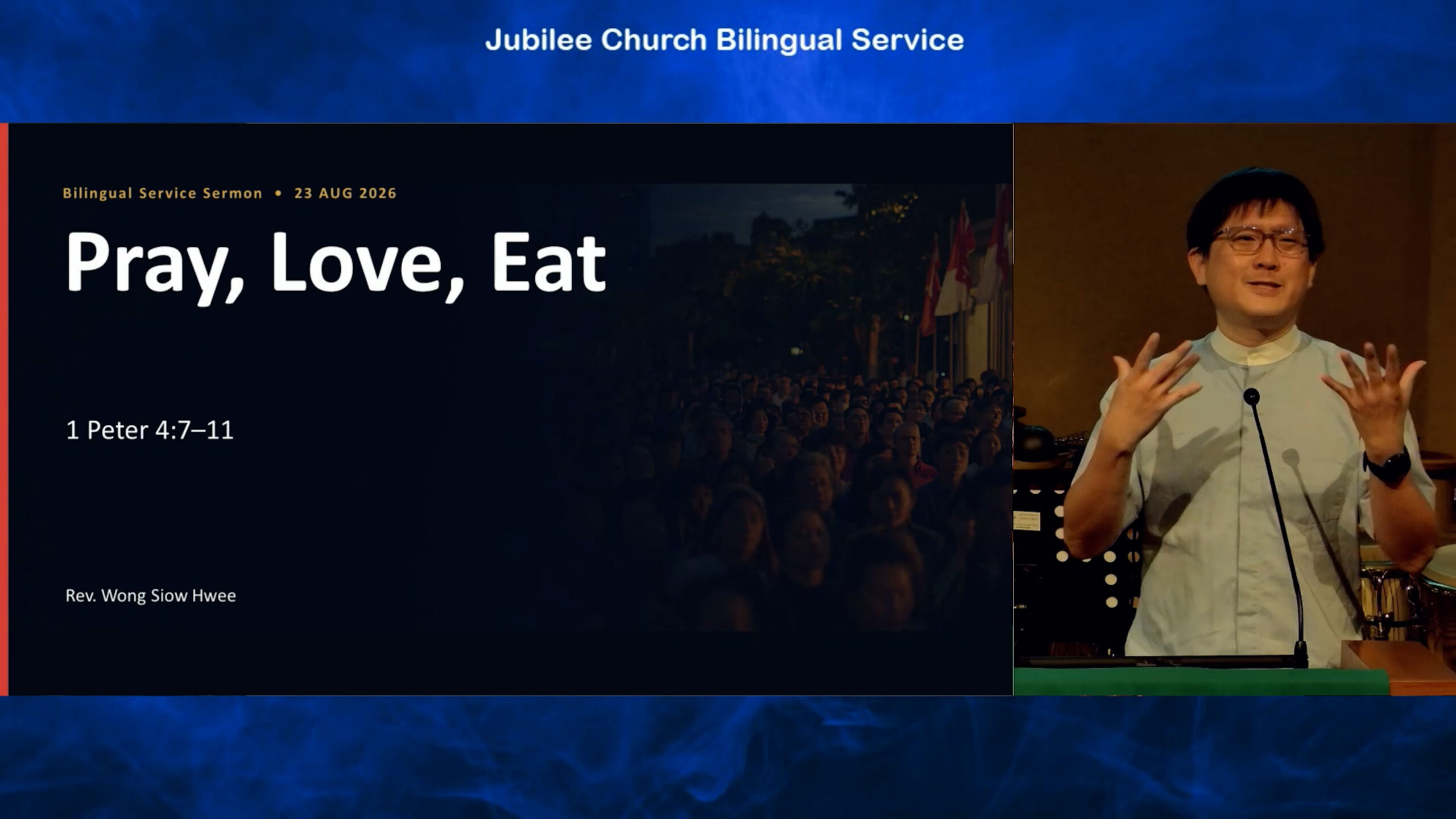
Pray, Love, Eat: Surviving 内忧外患 (1 Peter 4:7–11)
Today is National Day. Happy National Day to all fellow Singaporeans. I remember that during our Jubilee year, many honoured the first generation of Singaporeans for creating the miracle of Singapore — a nation that not only survived, but prospered. Interestingly, I also recall reading some comments that it wasn’t really that much of a big deal. These detractors argued that Singapore had natural geographical advantages, was small and easy to manage, and inherited a strong foundation from its colonial rulers. So instead of a miracle, they felt survival was already assured and success was bound to happen sooner or later anyway.
These opinions do have a valid point about Singapore’s inherent strengths in its infancy, but I believe they have grossly underestimated two key weaknesses. In Chinese, there’s a phrase for this: 内忧外患 (nèi yōu wài huàn) — “internal troubles, external threats.” It describes being besieged on two fronts at once: threatened from outside by hostile forces, and undermined from within by division and infighting.
Singapore was in such a state and survival at least in my opinion, was far from assured. Since this sermon will be uploaded online, I will refrain from expounding on the geopolitical danger外患 that Singapore was facing at that time, in case any other country feels offended. But I do wish to illustrate a little more on the danger that had erupted from within — 内忧. Racial riots in 1964 left dozens dead and hundreds injured, exposing how fragile inter-communal trust really was. This happened again in 1969, with more racial violence, death, and injury. A young nation fractured by racial and religious tensions would easily have self-destructed. We see that happening in many countries around the world throughout history. That Singapore not only survived it, but became what it is today, is why so many still insist on calling it a miracle.
I raise this history not only for National Day, but because 内忧外患 describes the early church perfectly. Externally, Christians faced persecution because they refused to join the pagan lifestyle of their time — often idol worship celebrated with sexual rituals — and were blamed for every misfortune as having offended “the gods.” Internally, Christians quarrelled over racial differences between Jews and Gentiles, theology, and church practices. We keep returning to these divisive issues whenever we preach through the letters, because so much of the New Testament epistles exist to address internal quarrels in the early church.
With 内忧外患 on both sides, the early church should have disintegrated. It didn’t. Like Singapore, it survived and prospered until today — and that survival, like Singapore’s, should never be taken for granted. Singapore addressed its 内忧 by deliberately integrating society into one nation of racial and religious harmony, a vision written into the Singapore Pledge itself. It was never easy, and the social cohesion that you see today is not an expected occurrence given human nature. It took a lot of deliberate policies from housing to education to enforce this unity and equality, but what was painful and difficult at that time ultimately bear fruits till today.
The early church’s survival tells the same story. As Rev. Enoch shared two weeks ago, Peter gave the church a roadmap to navigate its own 内忧 and 外患 by grounding its identity in Christ. For internal health, Peter says our calling is to treat one another like family. And our choice is to cultivate loving relationships in church. Peter listed five virtues: unity of mind, sympathy, brotherly love, compassion, and humility. For external opposition, Peter says our calling is to return blessing for insult and good for evil. And our choice is to be a faithful witness for Christ, even if that means following in his footsteps through suffering. Because of that, the early church achieved a miracle. It managed to overcome its 内忧外患 and it survived.
Rev. Enoch has clearly stated our calling and our choices in church relationships and how we face the world. It is the foundation of our identity in Christ, and the perfect start to our sermon series on conflict resolution. Yet, it’s easy to say we’re one family in Christ — but even families squabble out of self-interest. This is why Peter continues in 1 Peter 4: Therefore, since Christ suffered in his body, arm yourselves also with the same attitude, because whoever suffers in the body is done with sin. 2 As a result, they do not live the rest of their earthly lives for evil human desires, but rather for the will of God. How do we stay committed to our calling to live as one family, choosing self-sacrifice over personal desires? How do we stay sinless till the day we meet our Lord Jesus Christ? My sermon continues where Rev. Enoch left off. In today’s passage, Peter had three further pieces of advice, which I’ll summarise as Pray, Love, Eat — a small twist on the popular movie and book title Eat, Pray, Love. These three advices from Peter will help us stay strong in our calling and make the right choices.
Pray
The first is to pray. We often pray to ask God for things, and that’s not wrong. But prayer is communication, and communication runs two ways. Peter writes: “The end of all things is near. Therefore be alert and of sober mind so that you may pray.” The real purpose of prayer is not just to speak, but to listen — and when we listen, we start to see the world from God’s perspective. This is why the Lord’s Prayer begins with God’s fatherhood, name, kingdom, and his will before anything else, echoing Matthew 6:33: “Seek first his kingdom and his righteousness, and all these things will be given to you as well.”
When we pray to listen rather than merely to speak, we begin to think from God’s perspective of time — his agenda grows big, and our petty concerns grow small. Peter warns the church not to fall asleep, or we’ll miss what time it is. Prayer reminds us what matters most, because it reminds us we live in God’s time, not our own. I suspect Peter was remembering his own night with Jesus before the betrayal. This advice traces directly back to his failure at Gethsemane (Mark 14:32–42), where Jesus told him to “watch and pray,” yet he kept falling asleep. He then acted on his own will rather than God’s — cutting off the servant’s ear and later denying Jesus three times. But Jesus stayed awake and prayed, and God’s will was done, not his own.
Peter learned that lesson the hard way. Now he passes it on to the church. Time is short — especially in relationships. We assume we have all the time in the world; we don’t. I recall a church member, A, who said something careless about another member, B, causing others to misunderstand B. B left the church and refused to speak to A again. A tried repeatedly to reconcile, without success, until finally saying: “Come speak to me — I have no more time left.” They reconciled shortly before A passed away.
Stay awake to pray and pray to stay awake. When we listen, we learn what time it is — and what truly matters.
Love
The first advice is to pray. The second advice is to love. “Above all, love each other deeply, because love covers over a multitude of sins.” The word behind “deeply” carries the sense of being stretched out — a fitting image, since real love is often stretched to its limits, even among close friends. We’re called to forgive not seven times, but seventy times seven. I want to be careful here: this verse is sometimes misread as license to cover up sin. That isn’t its meaning.
Peter is quoting Proverbs 10:12 — “Hatred stirs up conflict, but love covers over all wrongs.” So the sin in 1 Peter 4 should be the wrongs referred to in Proverbs 10. For the Jews, community was built on covenant: we trust one another as neighbours and family, and we feel a wrong/transgression when that trust is broken when they act in a way that is unneighbourly or without kinship. So when someone offends you, you should still address it — but from love, not hatred, so the transgression is minimised rather than magnified.
Why is the attitude of love important in addressing perceived wrongs against youself? Consider the old Chinese story of 疑邻窃斧, “Suspecting the Neighbour of Stealing the Axe.” A man loses his axe and becomes convinced his neighbour’s son stole it; suddenly the boy’s every word and gesture looks like a thief’s. But the man eventually finds his axe exactly where he’d left it — and the boy no longer looks suspicious at all. The boy never changed; only the man’s mindset did.
This is what Scripture means by hatred “stirring up conflict.” A grudge makes us hunt for evidence of wrongdoing in every small thing someone does. Love, by contrast, “covers” offences — not by ignoring real problems, but by drawing a veil over small slights instead of fanning them into a fight, and choosing to build up the community rather than stay suspicious. Think about this: How many friendships have ended not because of one great betrayal, but because dozens of little misunderstandings were never covered by love?
Peter isn’t offering a nice sentiment — he’s speaking from his own story. This costly, stretching love is necessary because mutual forgiveness is what keeps ordinary tensions from turning fatal to a community. Though Peter had failed badly by denying Jesus at the most critical moment, even unable to “watch and pray” at Gethsemane, he was restored as recorded in John 21, and came to be defined by grace rather than failure. By commanding the church to let love “cover” sin, he teaches that Christ’s sacrifice becomes visible in a community when believers extend that same forgiving love to each other — treating one another as family, with love as the glue that holds everyone together.
Eat
The third advice is to eat — meaning acting with generosity and hospitality. In verses 9–11, Peter calls the church to radical generosity, rooted in the understanding that believers don’t own their lives but are “good stewards of the manifold grace of God.” This begins with hospitality “without complaining” — a costly command in the early church, where hosting travelling teachers and caring for the poor drew heavily on limited resources. Hospitality literally means “love of strangers,” and Peter urges the community to serve without reluctance, treating one another as family where host and guest are interchangeable. In today’s context: When a new visitor walks into church alone, hospitality begins before lunch. It begins with someone noticing them.
This generosity flows from understanding that every gift, every charisma, is a spiritual provision from God for the “common good,” not personal display. As stewards of God’s household, believers are the voice and hands of God to one another — whether speaking “the very words of God” or serving “with the strength God supplies” — so that “God may be glorified in all things.” We’re generous with our time, homes, and talents because we’re simply distributing a grace first given to us, keeping the church shaped by Christ’s character rather than individual interest.
Conclusion
The topical sermon series this year will mainly focus on conflict resolutions. This is because we did a survey with the younger generation two years ago. In the survey we asked them on the topic of loving relationships. The results were humbling. Our young people reflected that we do not know how to settle conflicts in church. We can declare that God is love, and we follow a loving Jesus who even sacrifice his life for sinners, yet we fail to settle our differences lovingly. As a pastor of more than 20 years in Jubilee, I feel a deep sadness. It is like parents who quarrelled in an unsightly manner in front of their kids. How would the next generation understand love if we fail to demonstrate it at the most crucial moments? So this year, we decided to let’s learn from the bible once again on conflict resolution.
From 1 Peter we learn two things. First, from Rev. Enoch, we learn that our calling is to be one family in Christ. Our only choice is to love. But in conflict resolution, this means that we must put away our selfish desires. It means that we must sacrifice for someone despite our differences. In short, we have to be like Jesus, when the person we are conflict with is a sinner in our eyes. How is that possible?
I started the sermon talking about 内忧外患 — internal trouble and external threat, striking together. Singapore faced it and, through grit and wise decisions, we formed unity despite our racial and religious differences. I believe that’s how we survived and prospered. The same 内忧外患 presses on every church today. The latest General household survey 2025 reveals Singaporeans losing their faith. In the onslaught of secularism and worldly values, the church needs to be united despite our differences, just like the early church. To me, it is a matter of survival.
The same 内忧外患 faces every church today. The pressures may look different, but the danger is the same. Churches rarely collapse overnight. More often, they slowly weaken from within while being pressured from without. Peter’s answer is surprisingly simple: Pray. Love. Eat. Stay awake to God’s purposes. Cover one another’s failures with love. Open the church, your homes and your lives in generous hospitality. If we become that kind of church, then by God’s grace Jubilee will not merely survive the challenges of our generation—it will become a living witness to Christ in the midst of them.
Imagine if every conflict in Jubilee began with prayer.
Imagine if every offence was first filtered through love.
Imagine if every member opened their home and table.
That church would survive almost anything.