Psalm 40: 1 I waited patiently for the Lord;
he turned to me and heard my cry.
2 He lifted me out of the slimy pit,
out of the mud and mire;
he set my feet on a rock
and gave me a firm place to stand.
3 He put a new song in my mouth,
a hymn of praise to our God.
Many will see and fear the Lord
and put their trust in him.
4 Blessed is the one
who trusts in the Lord,
who does not look to the proud,
to those who turn aside to false gods.
5 Many, Lord my God,
are the wonders you have done,
the things you planned for us.
None can compare with you;
were I to speak and tell of your deeds,
they would be too many to declare.
6 Sacrifice and offering you did not desire—
but my ears you have opened—
burnt offerings and sin offerings you did not require.
7 Then I said, “Here I am, I have come—
it is written about me in the scroll.
8 I desire to do your will, my God;
your law is within my heart.”
9 I proclaim your saving acts in the great assembly;
I do not seal my lips, Lord,
as you know.
10 I do not hide your righteousness in my heart;
I speak of your faithfulness and your saving help.
I do not conceal your love and your faithfulness
from the great assembly.
11 Do not withhold your mercy from me, Lord;
may your love and faithfulness always protect me.
12 For troubles without number surround me;
my sins have overtaken me, and I cannot see.
They are more than the hairs of my head,
and my heart fails within me.
13 Be pleased to save me, Lord;
come quickly, Lord, to help me.
14 May all who want to take my life
be put to shame and confusion;
may all who desire my ruin
be turned back in disgrace.
15 May those who say to me, “Aha! Aha!”
be appalled at their own shame.
16 But may all who seek you
rejoice and be glad in you;
may those who long for your saving help always say,
“The Lord is great!”
17 But as for me, I am poor and needy;
may the Lord think of me.
You are my help and my deliverer;
you are my God, do not delay.
Introduction: Stuck
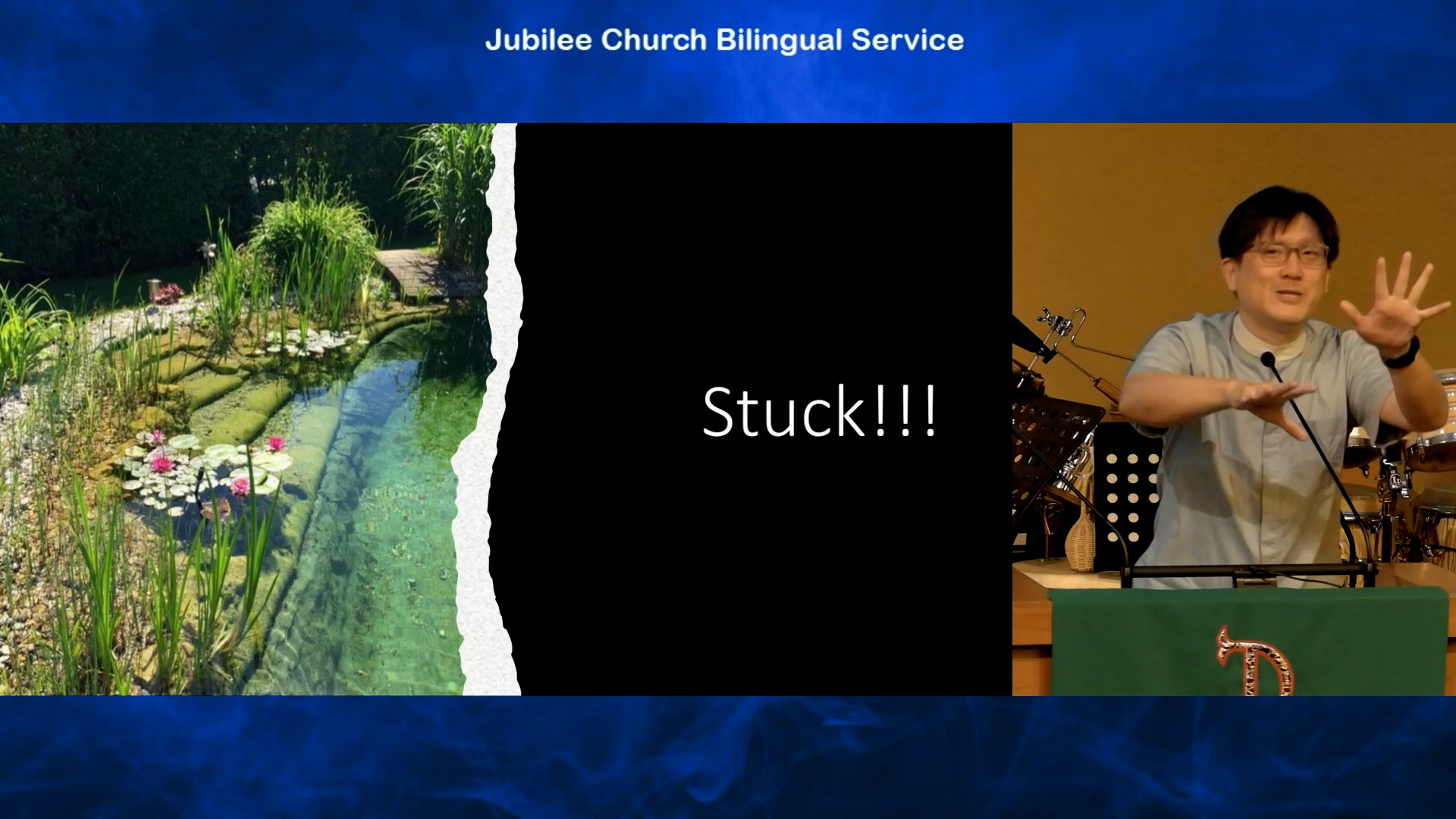
I was once at a waterpark. After a water ride, I tried to get out of the pool. The usual exit was crowded, so I decided to try a different way—just a few simple steps.
But the steps were super slimy. I stepped up and slipped. Tried again—no grip. Every attempt felt worse than the last. Soon I was on all fours, scrambling. Those few steps might as well have been a wall.
What struck me was this: Even though the exit was right there, I could not get out by myself.
That experience came rushing back when I read Psalm 40:
“He lifted me out of the slimy pit, out of the mud and mire; he set my feet on a rock and gave me a firm place to stand.”
The psalmist knew exactly what I felt: You’re just stuck.
The Universal Experience of the Pit
The slimy pit takes many forms. The slimy pit can be a metaphor for your personal difficulty. Perhaps when you’re trying to fix a tough situation. A broken relationship. A habit you thought you had under control. In today’s economic climate, it could be mounting debts or fruitless job hunting. You take one step forward—and slip back two. You make progress—and then lose it overnight. You start asking yourself, “What’s wrong with me?” “Why can’t I just get out?”
For some of us, the slimy pit might not be material but psychological. You may be trying to climb out of anxiety. You tell yourself to calm down. You try to be rational. Or maybe it is depression. You remind yourself that others have it worse. But the thoughts keep looping. Sleep and Peace don’t come easily. The more you try to control it, the more slippery it becomes.
But sometimes the pit isn’t even our personal problems. It can represent the macro-environment.
Parents, you may feel this deeply.
You love your children.
You try your best to guide them.
And yet you are raising them in a world shaped by social media algorithms, viral trends, and values that shift every few months.
You try to keep up.
You try to understand their world.
But it often feels like the ground is moving faster than you can adjust your footing.
Young people, you feel it too.
You hear constant talk about climate change, rising sea levels, extreme weather, and uncertain futures.
You didn’t cause this problem.
And yet you are expected to carry the weight of it.
It can feel like trying to walk forward while the floor beneath you is slowly melting away.
You may have heard of this term “climate fatigue”, it’s the exhaustion and helplessness of trying to climb out of this slimy pit of climate change.
In both cases, even if your personal life looks calm,
you may still feel helpless.
That’s what makes a slimy pit so frightening.
It’s about powerlessness.
I’ve talked about the slimy pit in terms of personal struggles and the macro environment. There is a third kind of pit Psalm 40 names for us.
I am referring to the spiritual dimension.
The psalmist says in verse 12:
“For evils have surrounded me beyond number;
my iniquities have overtaken me…
they are more than the hairs of my head;
my heart fails me.”
He is describing two forms of spiritual threats that often come together.
External Spiritual Threats: When Evil Forces Our Hand
Sometimes the spiritual threat comes from bad actors who force your hand.
You are pushed into:
- Political games of revenge
- Cycles of outrage and retaliation
- Us-versus-them thinking
- Justifying cruelty because “the other side started it”
The world tells you:
“If you don’t fight back, you’ll be crushed.”
“If you don’t retaliate, you’re weak.”
“If you don’t play the game, you’ll lose everything.”
And suddenly, without planning to,
you find yourself thinking thoughts you never wanted to think,
saying words you never wanted to say,
cheering for outcomes you once believed were wrong.
This is an external spiritual threat.
Internal Spiritual Threats: When Guilt Overtakes the Heart
But then comes the second line:
“My iniquities have overtaken me.”
This is internal. By this, I’m referring our sinful desires and our sense of guilt.
The anger you indulged.
The revenge you justified.
Now the enemy doesn’t need to accuse —
your own heart does it for him.
When you’re trying to escape guilt.
Something you said.
Something you did.
Something you failed to do.
You replay it again and again in your mind.
You promise yourself you’ll do better next time.
You try to make up for it.
You try to prove—to yourself, to others, maybe even to God—that you are not really that person.
But instead of feeling lighter, the weight feels heavier.
The harder you try to clean yourself up, the dirt just seems to spread.
That’s because guilt is its own kind of slimy pit.
The more you struggle, the deeper you sink.
And guilt does not simply remind you —
it overtakes you.
The Hebrew sense is being caught from behind.
Like running, only to realize you’re still in the pit.
The weight of guilt multiplies.
The psalmist says:
“They are more than the hairs of my head.”
That’s not exaggeration.
That’s suffocation.
And then the line that names what many of us are afraid to say aloud:
“My heart fails me.”
This is exhaustion.
You are tired of carrying both:
- the pressure of external evil
- the weight of internal guilt
This is the spiritual pit.
Why God Is the Rock
Thanks be to God, Psalm 40 says He sets our feet on a rock. God Himself becomes the solid ground we lack.
In the Psalms, “rock” points to covenant faithfulness. God is solid ground because His word has structural integrity—it holds weight. When God speaks, promises are established. His faithfulness does not give way under pressure. He bears the full weight of our fear, guilt, and failures without buckling.
That’s the quiet but powerful confession at this psalm’s heart: When everything else slips, God does not.
The Honest Rhythm of Faith
But here’s where Psalm 40 becomes uncomfortable. Most psalms fit neatly into one category—either cries for help or songs of praise. But Psalm 40 is thanksgiving that turns back into lament. It says: “God lifted me out… I am surrounded again.”
That’s deeply uncomfortable because we like spiritual stories that move in one direction: trouble → victory → happily ever after. But Psalm 40 tells the truth: Real life is not a straight line upward.
Being rescued once doesn’t mean you’ll never cry for help again. Faith is not a one-time rescue story. It’s a lifelong conversation with God through victories and setbacks, thanksgiving and lament—sometimes in the same season, sometimes the same week, sometimes even the same day.
Living Faithfully Through the Rhythm
Psalm 40 teaches us to live faithfully through life’s rhythm:
In the pit, we wait and resist vanities. Verse 1 opens with deceptively simple words: “I waited patiently for the LORD.” This isn’t passive resignation. The Hebrew suggests enduring hope—active trust that refuses to let circumstances rewrite God’s character. This is faith stretched over time.
When life is hard, we’re vulnerable to vanities—quick fixes, false securities, moral compromises that promise relief but deliver deeper entanglement. The psalm warns: “Blessed is the one who trusts in the LORD, who does not look to the proud, to those who turn aside to false gods.” Don’t let desperation decide your values. Don’t let pressure rewrite your faith. Waiting is not weakness. Waiting is faithfulness.
On the rock, we worship and dedicate our lives. Notice something important:
Worship here is never private-only.
God’s grace overflows into witness.
The psalmist sings —
and others see.
Others learn.
Others are drawn to trust.
We enjoy the rescue,
but sometimes we forget the testimony.
But the psalmist goes even deeper.
Verses 6–8 say something shocking:
“Sacrifice and offering you did not desire…
burnt offering and sin offering you have not required.
Then I said, ‘Here I am, I have come—
it is written about me in the scroll.
I desire to do your will, my God;
your law is within my heart.’”
God’s goal was never just religious performance.
His desire was a life aligned with His will.
In other words:
True worship is not just what we sing —
it is how we live.
Psalm 40 teaches us that seasons of blessing call for more than gratitude.
They call for dedication.
Not:
“Thank you, God, now I’ll live my life.”
But:
“Because of what you’ve done, my life belongs to you.”
So the second application is this:
When life goes up, worship deeply — and dedicate your life fully.
Sing your praise.
Tell your story.
But also ask:
“How does God’s grace shape my choices, my priorities, my obedience?”
From Individual Rescue to Community Grace
If we stopped here, Psalm 40 would already give us profound spirituality for life’s ups and downs. But the New Testament reveals something more.
The writer of Hebrews looks at Psalm 40 and makes a remarkable claim. When Christ came into the world, these words became His words: “Sacrifice and offering you did not desire… Here I am—I have come to do your will.” The psalm’s voice becomes the voice of Jesus Himself.
Jesus didn’t simply rescue us from a pit. He entered the pit of human existence and offered a fully obedient human life. Where the psalm says, “I waited… I cried… I was rescued… I offered myself,” Hebrews says: Jesus fulfilled this perfectly—once and for all.
But then Hebrews makes a startling move: “By that will, we have been made holy.” Christ’s obedience isn’t only our salvation—it’s our formation. Psalm 40 becomes the pattern of a people.
A Community Shaped by Grace
Hebrews insists God never wanted a community built on endless self-justification, constant performance, or proving who’s good enough. That’s sacrifice culture, and it creates fear, comparison, and exhaustion.
Instead, because Christ has offered Himself fully, we’re free to live differently. A Psalm 40-shaped community doesn’t pretend pits don’t exist. It knows we will fall, wait, be rescued, and need help again. Yet we come together not to perform, but to offer our lives in grateful obedience.
This is why Hebrews says: “Let us consider how to spur one another on toward love and good deeds.” Not pressure. Not shame. But encouragement rooted in grace.
We live in a world that is obsessed with outcomes but impatient with waiting.
A world that celebrates success but hides weakness.
Here’s the vision: A community where people are honest about the pit because our standing doesn’t depend on pretending strength. Where obedience flows from gratitude, not fear. We don’t obey to earn rescue — we obey because rescue has already been given. Where worship expresses itself in aligned lives. Where waiting is practiced together. Where witness flows naturally—not because we’re impressive, but because God is faithful.
This is why Hebrews says:
“Let us consider how to spur one another on toward love and good deeds.”
Not pressure.
Not shame.
But encouragement rooted in grace.
Conclusion: The Foundation That Holds
Some of you are in the pit. Some are on the rock. Most of us are somewhere between. But here’s what Psalm 40 fulfilled in Christ promises: God is with us.
You belong to a people shaped by Christ’s obedience, sustained by God’s faithfulness, and held together by grace. When everything else slips, God does not. When every surface fails, God remains. When we cannot stand, God stands beneath us.
That’s not just individual hope. That’s the foundation of a community that learns, again and again, how to wait, worship, and offer ourselves to God in every season of life.
When you can’t get out by yourself—and none of us can—God is the rock that holds.