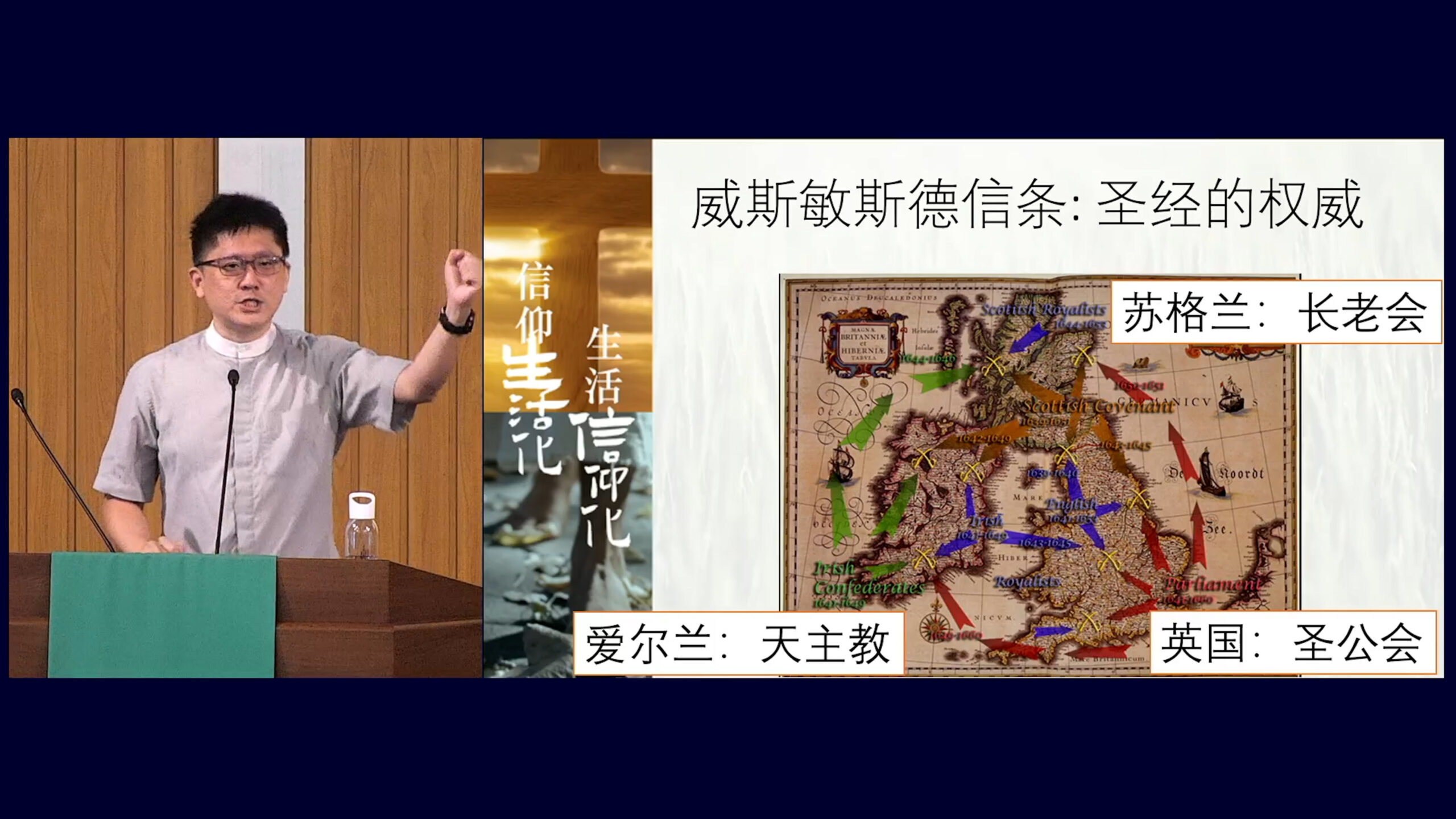
Last week, we started a new sermon series based on the Westminster
Confession of Faith. Today, we will discuss the first half of chapter 1: The
Authority of the Bible. Why is this topic placed right at the beginning of the
entire Confession? It has very much to do with the context of its drafting. So
today, my sermon will be structured in 3 parts. First, I will explain the
background of the Confession, then talk about the content of today’s
paragraph, and finally end with its implications for today.
The Westminster Confession of Faith (WCF), written between 1643 and 1647 by
the Westminster Assembly, was born in a climate of political uncertainty. This is
known in British history as the Wars of the Three Kingdoms 1 , which includes
England which is Anglican, Scotland which is Presbyterian, and Ireland which is
Catholic. In particular, England was in the middle of a civil war between those
who supported the royalty (called the Royalists), and those who wanted more
power to the English parliament (called the Parliamentarians). However, this
political conflict was also a religious one. The Royalists were made up largely of
Catholics and high church Anglicans. The Parliamentarians however were
Puritans, English Protestants who wished to reform the Church of England
(Anglican) further away from Roman Catholicism.
To win the war, the Parliamentarians needed the support of the Scots whom I
mentioned earlier were Presbyterians. They know that the Scots would likely be
supportive due to their similarity in theology. The Scots had earlier expelled the
bishops sent by the king when the king was trying to transform the Church of
Scotland to be more like the Church of England (Anglican). This event was
known as the Bishops’ Wars. 2 So, the goal of the Westminster Assembly, which
was a council of theologians and members of the English Parliament, was to
codify the doctrine of the Puritans, so that the Church of England can become
truly reformed like the Church of Scotland. In doing so, the puritan English
Parliament can then form an official alliance, both political and theological, with
the presbyterian Scots against the Royalists. By God’s grace, in three years, they
succeeded in drafting what is known today as the Westminster Confession of
Faith. It was then adopted by both the English and Scottish Parliaments, though
in history only the Scots continued with it when the English later reverted back
to high church Anglicanism. Nonetheless, we can say that thanks to the efforts
of all the English theologians at that time, Presbyterians all over the world now
have a Confession of Faith that articulated their official fundamental doctrines.
Having looked at the Confession’s origin, let’s now explore what it says about
the Bible’s authority. Based on this historical context of war against the king,
you can see why authority was the first topic that needs to be addressed in the
Confession. The root issue was as political as it was theological. The Anglicans
do believe in sola scriptura, which means that the Bible is the ultimate source of
truth and authority for faith and practice. But they interpret this doctrine with
the metaphor of a three-legged stool, scripture needs to be balanced with
church tradition and human reason. While Anglicans affirm Scripture’s primacy,
the Church of England’s structure historically involved the monarch in
governance, creating tensions between political authority and spiritual
authority. Today, the supreme governor of the Church of England is King
Charles III. 3 The Confession therefore needed to reform this doctrine to the
purest form of sola scriptura. There should be no earthly power that should
have a higher or even balancing authority than the Word of God, not the
church, and certainly not the king. We shall now read the first half of Chapter 1
and understand it before I analyse its meaning.
CHAPTER 1
Of the Holy Scripture
1. Although the light of nature, and the works of creation and providence, do
so far manifest the goodness, wisdom, and power of God, as to leave men
inexcusable; yet are they not sufficient to give that knowledge of God, and
of His will, which is necessary unto salvation; therefore it pleased the Lord,
at sundry times, and in divers manners, to reveal Himself, and to declare
that His will unto His church; and afterwards for the better preserving and
propagating of the truth, and for the more sure establishment and
comfort of the church against the corruption of the flesh, and the malice
of Satan and of the world, to commit the same wholly unto writing; which
maketh the holy Scripture to be most necessary; those former ways of
God’s revealing His will unto His people being now ceased.
Let me rephrase the 1 st section in youth friendly language: “We can learn some
things about God just by looking at nature—like how powerful, wise, and good
He is. But that’s not enough to truly know Him or understand how to be saved.
So, God chose to speak to people in different ways in the past to show them
who He is and what He wants. Later, He had everything written down in the
Bible so the truth wouldn’t get lost and we could stay strong in our faith. That’s
why the Bible is so important—because it’s how God speaks to us today.” At
the heart of the Confession is a bold claim: Scripture, not the Church, is the
supreme authority for faith and life. In short, the Bible is the true and only
revelation of God regarding his salvation.
2. Under the name of holy Scripture, or the Word of God written, are now
contained all the books of the Old and New Testament, which are these:
All which are given by inspiration of God, to be the rule of faith and life.
3. The books commonly called Apocrypha, not being of divine inspiration, are
no part of the Canon of Scripture; and therefore are of no authority in the
church of God, nor to be any otherwise approved, or made use of, than
other human writings.
A natural question arises: how did we get the Bible we have today? Did
someone simply declare which books “made the cut”? The 2 nd and 3 rd section of
the Confession is regarding the canonicity of the Bible. Only the books you have
in the Bible are considered Canon, which means the standard. The rest are not
divinely inspired, and hence they cannot be part of the Canon. But some might
argue, since it is the Church that determines the Canon, then the Church should
have authority over the Bible. So let me clarify: the Church did not create the
canon—it merely recognized it. The canon was not imposed by ecclesiastical
authority but discovered by the witness of the Spirit in the life of the
community. This is crucial. The books of Scripture were embraced because they
had power to transformed lives in the early church. The Church did play a role
in discerning canon, but this was not arbitrary—it was guided by the Spirit and
shaped by living faithfully over the first few centuries.
4. The authority of the holy Scripture, for which it ought to be believed and
obeyed, dependeth not upon the testimony of any man or church, but
wholly upon God (who is truth itself), the Author thereof; and therefore it
is to be received, because it is the Word of God.
Section 4 is where we come to the crux of the matter on authority. Scripture is
not authoritative because the Church says so, but because God speaks through
it. Calvin puts it this way: “We owe to the Scripture the same reverence which
we owe to God, because it has proceeded from Him alone.” This is not a three-
legged stool. Scripture is not a collection of ancient writings the church has
decided to treat as sacred. It is divine self-disclosure. It is God speaking. The
authority of Scripture is not an abstract proposition but a personal encounter.
We meet Christ in the Word.
Hebrews 1: In the past God spoke to our ancestors through the prophets at
many times and in various ways, 2 but in these last days he has spoken to us by
his Son, whom he appointed heir of all things, and through whom also he made
the universe. 3 The Son is the radiance of God’s glory and the exact
representation of his being, sustaining all things by his powerful word. After he
had provided purification for sins, he sat down at the right hand of the Majesty
in heaven.
“What makes Christianity unique is not that it appeals to a hidden wisdom that
cannot be fully encompassed in human understanding but that it insists that this
wisdom became incarnate in history-in a particular individual and at a particular
time and place. This means that the claims of faith are open to historical
investigation, though they cannot be finally validated by such investigation, for
it is not simply the events in sacred history but the action of God in these events
that constitutes the supreme content of Christian faith.” 4
In Faith Seeking Understanding, Migliore describes the authority of Scripture
not as a static or isolated concept, but as something best understood through a
dynamic, relational model. He uses the image of concentric circles to explain
how different forms of the Word of God relate to one another:
1. Jesus Christ is the innermost circle — the incarnate Word of God.
2. Scripture is the next circle — the written witness to Jesus Christ.
3. Preaching and proclamation form the outer circle — the Word of God as it
is proclaimed in the Church today.
This model helps us see that the authority of the Bible is derived from its role as
a faithful witness to the living Word, Jesus Christ. Scripture has authority
because it points us to Christ, not simply because it is a sacred text in itself.
Imagine a gallery of portraits, all claiming to be of the same person. Some look
close; others are clearly fakes. But when the true portraits are gathered—those
painted by people who really knew Him—they form a recognizable image.
That’s how the canon functions: many voices, one face—Jesus Christ. Calvin
also emphasizes the internal testimony of the Holy Spirit. The Spirit opens our
hearts to see that these writings are not merely human, but divine. They aligned
with apostolic teaching and centered on Christ. The same Spirit who inspired
the text now illuminates the reader. The authority of the Bible is rooted in
Christ—and made alive by the Spirit.
Let me sum up my points so far before I move on to their implications for today.
1. The Westminster Confession of Faith was written to consolidate the belief
of the English Puritans to align themselves with the Scottish Presbyterians
against the Royalists.
2. The Confession began with the authority of the Bible, so that neither the
Church nor any other earthly powers can claim to dominate the truth of
God’s salvation.
3. The authority of the Bible lies in its ability to be a witness towards Jesus
Christ who is the ultimate revelation of God. God’s action through Jesus
Christ is God speaking directly to us.
The Church, as the outer ring of revelation, derives its authority from Jesus
Christ revealed in Scripture. Yet this derived authority carries great
responsibility. How the Church interprets the Bible deeply impacts believers and
those within their reach.
Picture Scripture as a lamp (Psalm 119:105). In harmful hands, it becomes a
blinding flashlight—used to interrogate and control. But in Christ-like hands, it
gently lights the path, guiding others toward truth with grace.
Let’s explore how this authority has been used—and misused—through history.
A classic example is slavery. It was long defended with distorted readings of
Scripture. But abolitionists like William Wilberforce and Sojourner Truth
reclaimed the Bible’s call for justice and human dignity. Wilberforce, shaped by
his evangelical faith, fought for decades in Parliament to abolish slavery,
inspired by the liberating Word that “proclaims liberty to the captives” (Luke
4:18). Later, Dr. Martin Luther King Jr. boldly drew on Scripture—Exodus, the
prophets, the Sermon on the Mount—to preach justice and nonviolence. His call
to “let justice roll down like waters” (Amos 5:24) transformed Scripture into a
summons for action.
In science, Galileo’s support for heliocentrism challenged the Church’s
authority. Branded a heretic, he was silenced and confined. Yet we now
understand that Scripture doesn’t teach astronomy—it calls us to humility and
wonder. Truth—whether biblical or scientific—liberates and leads us to
worship.
Also, in creation care, Genesis 1:28 was once misread to justify domination of
the earth. This fueled environmental harm and injustice. But Scripture calls us
not to exploit, but to steward. Today, many churches are reclaiming this
role—partnering with scientists, planting trees, and standing up for those
harmed by climate change. This is creation care as worship, a witness to the
liberating authority of God’s Word.
Another example from the Bible itself reminds us how easily its authority can be
misused. In Mark 10:1–12, the Pharisees point to Moses’ law about divorce. But
Jesus exposes how they had twisted it. What was meant to protect women from
abandonment had been used to justify sending them away. A law intended for
mercy had been turned into a tool for exploitation.
This is an important warning for us today. The authority of the Bible is a sacred
trust. It is meant to liberate, not to oppress. Yet too often, people have used it
to justify cruelty or to trap others in pain. We must be wary of doing the same,
especially in sensitive areas like marriage and divorce.
Precisely because Scripture is authoritative, we must handle it with great care.
We must always ask: “What does God’s heart reveal here? What does this teach
us about grace, justice, and life?” True obedience to the Bible means
interpreting it wisely and faithfully, in a way that reflects the character of Jesus
Himself. So how do we ensure that the Church handles the authority of the
Bible wisely, not as a form of oppression to others, but as a source of salvation
as it is intended?
Let’s imagine Scripture as a compass. A compass doesn’t argue. It simply points
north. Whether we like it or not, whether we feel close to God or far from Him,
the compass is constant. So too is Scripture. We don’t get to reinvent God in our
image. The Word shapes us—not the other way around. Are you reading
Scripture to be proved right—or to be made right? This means we read the Bible
not just for facts but for transformation. It’s not a rulebook or a relic. It’s a living
conversation. In this case, Scripture should always point towards Christ.
And if we see Christ or enable others to experience Christ in our use of the
Bible, then we are using the compass correctly, and not abusively from our
selfish desires. Scripture’s authority is not to enslave but to liberate. It’s not
about controlling people—it’s about setting us free to love God and neighbor.
When we submit to Scripture, we’re not shrinking—we’re expanding into the
life God intended. That’s why we don’t read Leviticus the same way we read
the Sermon on the Mount. That’s why we ask: Does this align with the character
of Christ? Does this show us more of His grace, truth, and justice? When
reading Scripture, always ask: How does this point me to Christ? We submit to
the Bible not because it's a perfect book—but because it leads us to a perfect
Savior.
The Bible is like a stained-glass window, even—revealing light and color and
beauty we couldn’t see on our own. When the light of Christ shines through
Scripture, it transforms ordinary words into holy truth. If Scripture is God's
Word through the Son, made alive by the Spirit, then the only proper response
is to listen—and obey.
Before opening the Bible this week, pause and pray: ‘Jesus, speak through these
words, and help me follow.’
We read with humility, asking: What is God saying here—not just to
people long ago, but to me?
We wrestle with hard passages, trusting that the Spirit will lead us deeper
into Christ.
We submit, not to a book, but to the living God who speaks through it.
Standing before a great stained-glass window. From outside, it looks dull. But
from the inside, with the light streaming through, it glows with color and
beauty. Scripture is that window—and the Spirit is the light.
So what is the authority of the Bible?
It is the voice of God—confirmed by the Spirit, not the vote of the Church.
It bears witness to Christ—the living Word who is the center of our faith.
It speaks into our lives afresh today—shaping us through the Spirit.
It calls us into community—to discern, interpret, and obey together.
It trains us in righteousness—not just in right thinking, but in right living.
The authority of Scripture is not meant to control us, but to free us—to become
the people God is making us to be.
Imagine you're in a crowded train station—announcements blare, people talk,
phones ring. But then you put on noise-canceling headphones and suddenly,
you can hear a voice clearly speaking to you.
That’s what the Spirit does when we read Scripture. It doesn’t change the
text—it tunes your heart to hear God’s voice in the noise of life.
So let us return to the Word with awe, with humility, and with hope.
Let us pray, with the psalmist, “Open my eyes, that I may behold wondrous
things out of your law.” (Psalm 119:18)
And let us say together, “Speak, Lord, for your servant is listening.”