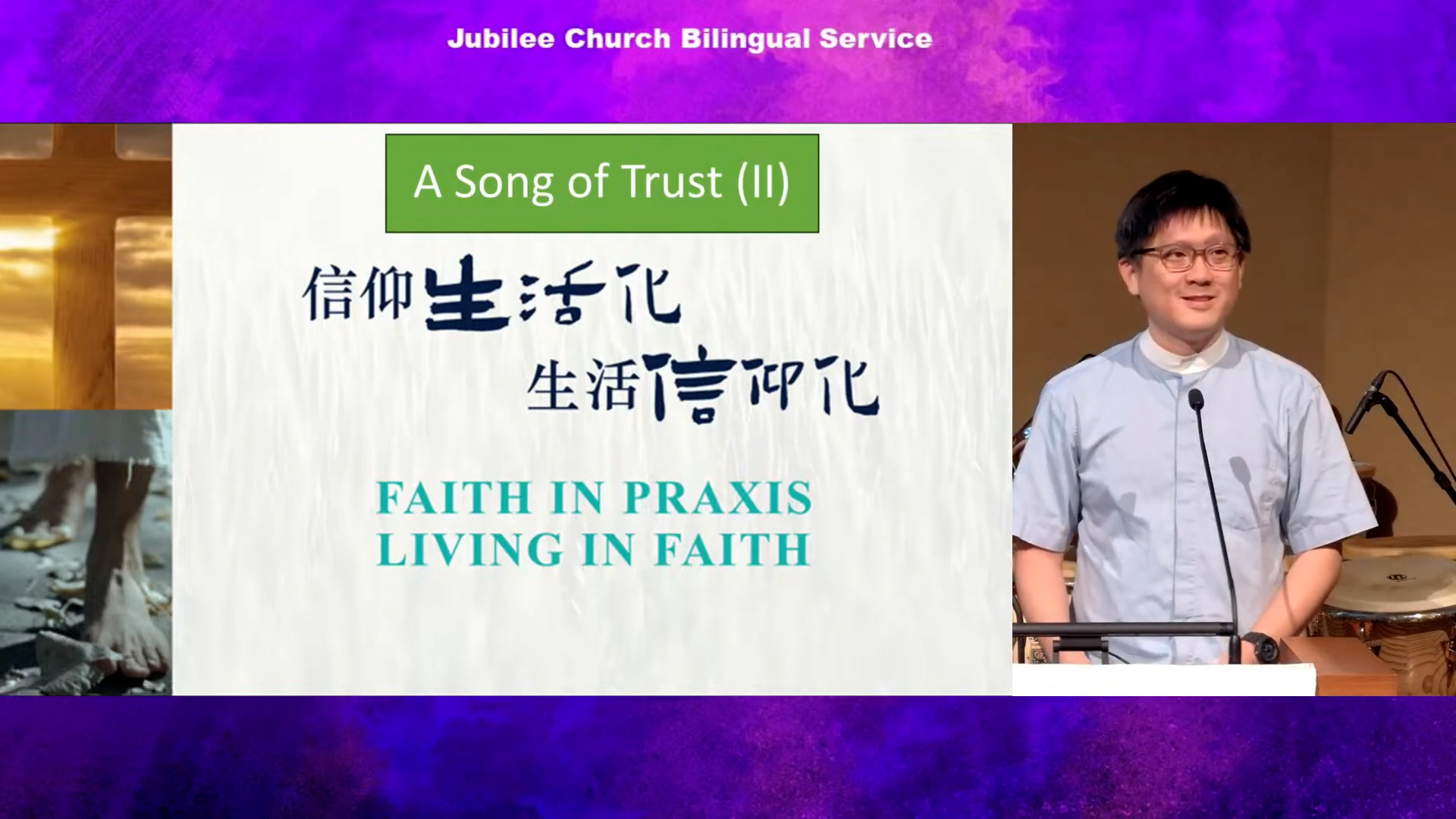
Psalm 23: 1 The Lord is my shepherd, I lack nothing.
2 He makes me lie down in green pastures,
he leads me beside quiet waters,
3 he refreshes my soul.
He guides me along the right paths
for his name’s sake.
4 Even though I walk
through the darkest valley,
I will fear no evil,
for you are with me;
your rod and your staff,
they comfort me.
5 You prepare a table before me
in the presence of my enemies.
You anoint my head with oil;
my cup overflows.
6 Surely your goodness and love will follow me
all the days of my life,
and I will dwell in the house of the Lord
forever.
In March, I preached on Psalm 63 which I introduced as one of the rare Songs of
Trust. Today, we are preaching on Psalm 23, which is yet another Song of Trust;
but unlike Psalm 63, Psalm 23 is immensely well known, perhaps the favourite
psalm of many Christians. I used Psalm 23 as the message in more than half of
the wake and funeral services I had conducted. It is a psalm that brings comfort
to those who are grieving, and assurances to those who feel troubled. So, I
thought it might be meaningful to reflect on Psalm 23 in the same way today. I
imagine that if King David could write his own funeral sermon, perhaps Psalm 23
would be it. David, the shepherd boy turned king, reflects on his journey with
the Lord—not with sentimentality, but with seasoned wisdom at the end of a
life marked by both fierce battles and painful failures. If he is to write a funeral
sermon for himself based on Psalm 23, I imagine it might be something like this:
“Dear family and friends, thanks for attending my funeral. I have written my
funeral sermon in advance, because I want to give a testimony of God in my life
to all of you. I have titled it: The Lord is my Shepherd.
Whenever I face the trials and tribulations of life, I am not afraid. The Lord is
my shepherd. 4 Even though I walk through the darkest valley, I will fear no evil,
for my shepherd is with me. He has two great instruments in his hands: the rod
on one hand and the staff on the other. 1 They comfort me. The rod symbolizes
divine justice—God’s judgment upon my enemies and protection from any
external threats. 2 The staff represents divine discipline—God’s correction and
mercy that guides my soul back when it wanders. 3 In this remembrance of my
life, walk with me through these two dimensions of God's care.
Part 1: The Rod – Protection from Enemies, the God Who Fights for Me
Many of you have lived in the palace for all your life, but you might remember
that I was a shepherd in my younger days. I walked the rocky paths of
Bethlehem with a few sheep under my care. The sheep had no idea how much
danger they were in. There were wolves in the ravines, lions behind the rocks.
In the world of shepherding, the rod was not a gentle instrument. It was a
weapon—a club used to drive off predators and beat back human threats. I
may be famous for my slingshot, but it is always better to scare off potential
dangers with a big stick.
And indeed, I had faced many opponents in my life. From the wild dogs and
bears of my shepherding days to Goliath on the battlefield, and later, Saul,
Philistines, and sadly even my dear Absalom. Yet through it all, I was protected
by God’s rod of justice upon them. It was God's way of saying, “You will not
touch My anointed.”
Let me put it simply—God’s rod is what He uses to protect me when I can’t
protect myself. Just like a shepherd uses a rod to fight off wolves or anything
threatening the sheep, God used His rod to shield me from danger. When Saul
chased after me, when enemies rose against me, or when lies surrounded
me—God was there. He saw what I couldn’t see, and He stepped in.
But it’s not just about fighting people. That rod is also a reminder that God
doesn’t turn a blind eye to evil. He’s not passive. He’s not indifferent. He’s a God
of justice. And when something’s wrong—He deals with it. That gave me peace.
Not because life was easy, but because I knew I wasn’t alone. That rod told me:
God sees. God knows. And yes, God will act.
It is like God preparing a table before me in the presence of my enemies. God is
letting everybody know he has my back. God laid out a feast of restoration, and
my enemies were made to watch. By anointing me, he is telling everyone I am
the one he has chosen to favour, and by showering me with overflowing
blessings, everybody knows that when they deal with me, they are dealing with
God, my shepherd with a big stick. I was thinking of those moments when God
didn’t just deliver me—He honored me. Right in front of those who wanted me
gone, He showed them that I was His.
Part 2: The Staff – God Guiding Me Through What’s Inside
Now let’s talk about the other side—the part I don’t always like to remember.
You see, the biggest dangers in my life didn’t always come from outside. A lot of
them came from me.
I made some terrible mistakes. I took what wasn’t mine. I betrayed good
people. I ignored my responsibilities. And I paid dearly for it—so did those I
loved.
But even then, God didn’t let go of me. He restores my soul. Again and again.
And that’s where His staff came in.
In shepherding, the staff isn’t for beating enemies. It’s for the sheep. It’s the
hook that pulls them back from the edge. It’s the gentle nudge that keeps them
on the right path. In the worst case scenario, it is for lifting fallen sheep from
pits. The staff symbolized care and correction. And that’s what God did for me.
He didn’t overlook my sin. He sent Nathan the prophet to call me out. He let me
feel the full weight of what I’d done. But even in that pain, I could feel His
mercy. God’s staff was not soft, but it was merciful. His correction stung—but it
healed. He didn’t throw me away. He corrected me—but He stayed close.
His correction wasn’t rejection—it was proof that I still mattered to Him.
That staff reminded me that no matter how far I strayed, I was still His. Still in
the flock. Still loved.
I want to say something more about God’s guidance. Back when I watched over
sheep, I learned something about those “quiet waters.” In our land, the water
sources weren’t always safe. A stream could suddenly become a flood,
especially in those dry riverbeds—wadis, we called them. A sheep drinking
peacefully could be swept away in an instant. So, I had to be careful where I led
them.
That’s how God was with me. He didn’t just correct me when I was wrong—He
guided me before I even knew I was in danger. He brought me to places where I
could truly rest, where my soul could breathe. And when I needed direction, He
led me in the right paths—not just for my sake, but “for His name’s sake.” His
reputation as a good Shepherd was on the line, and He never failed.
I can look back now and see moments when His staff pulled me back from the
dangers of sin, and return to the safety of God’s righteousness:
When I fled Jerusalem, barefoot and weeping, I still sensed His presence.
When I repented, He didn’t take away all the consequences—but He didn’t
take away His Spirit either.
When I was older and slower, I still saw His mercy walking with me.
That staff reminded me that no matter how far I strayed, I was still His. Still in
the flock. Still loved.
Conclusion: A Shepherd Who Was Always Shepherded
My life was complicated. I messed up. I had victories. I had regrets. But when I
put it all together—what I see most clearly is the Shepherd who never left me.
I see the rod—how He protected me from things that would’ve destroyed me. I
see the staff—how He brought me back when I was about to destroy myself.
And at the end of it all, I don’t speak with doubt. I speak with confidence:
“Surely goodness and mercy shall follow me all the days of my life, and I will
dwell in the house of the Lord forever.”
Not maybe. Not hopefully. Surely.
When I was strong, He was my strength. When I failed, He was my mercy. When
I wandered, He found me. When I fought giants, He steadied my hand. The
words "goodness and mercy" speak to God's covenant faithfulness, His loving-
kindness that pursued me all the days of my life. This longing to dwell in the
house of the Lord is not just a desire for earthly sanctuary but a hope for eternal
fellowship with God. I want you to know that is where I am now. And now, at
the end of my days as I am writing this, I say it again—not as a hope, but as a
testimony: The Lord is my shepherd; I shall not want.
That’s the peace I want you to know, too. If you’re grieving today, let me tell
you, even in your pain, your shepherd’s preparing something beautiful. He still
walks with you—even in the valley.
His rod and His staff? They’re still in His hands. And in those hands, they bring
comfort.
Amen.”
So, this is what I imagine a self-written funeral sermon by King David would
sound like if it is based on psalm 23. Today, we delve once more into the
comforting embrace of Psalm 23, seeking to understand the profound care of
our Good Shepherd through the powerful symbols of His rod and His staff. I
would like to conclude by reflecting on the words of Jesus from the gospel
reading of the lectionary.
John 10: 27 My sheep listen to my voice; I know them, and they follow me. 28 I
give them eternal life, and they shall never perish; no one will snatch them out
of my hand. 29 My Father, who has given them to me, is greater than all; no one
can snatch them out of my Father’s hand. 30 I and the Father are one.”
Now, as we close, let us return to where we are today—standing not just with
the memory of David’s words, but with the living voice of Jesus. Today’s Gospel
reading from John 10:22–30 reminds us of what David pointed toward all along:
the Good Shepherd who lays down His life for the sheep.
Psalm 23 was David’s song—but in Jesus, it becomes our promise.
The rod? Still in His hand. He protects. He defends. In Paul’s words from Romans
8: No enemy—seen or unseen—can separate us from His love.
The staff? Still in His grasp. He calls us by name. He leads us. He guides us—not
just in life, but through death and into life everlasting.
If you’re wondering what to hold onto today, hold onto this: You are not alone.
You are not forgotten. You are not beyond His reach.
His sheep hear His voice—and they follow Him. And wherever you are today, if
you are listening, if you are following, then rest in this promise: “I give them
eternal life, and they shall never perish.”
Not maybe. Not hopefully. Surely.
The Shepherd is still speaking. Let us listen. Let us follow. And let us live with the
same confidence that David had—now fulfilled in Jesus Christ our Lord.