Psalm 63: 1 You, God, are my God,
earnestly I seek you;
I thirst for you,
my whole being longs for you,
in a dry and parched land
where there is no water.
2 I have seen you in the sanctuary
and beheld your power and your glory.
3 Because your love is better than life,
my lips will glorify you.
4 I will praise you as long as I live,
and in your name I will lift up my hands.
5 I will be fully satisfied as with the richest of foods;
with singing lips my mouth will praise you.
6 On my bed I remember you;
I think of you through the watches of the night.
7 Because you are my help,
I sing in the shadow of your wings.
8 I cling to you;
your right hand upholds me.
9 Those who want to kill me will be destroyed;
they will go down to the depths of the earth.
10 They will be given over to the sword
and become food for jackals.
11 But the king will rejoice in God;
all who swear by God will glory in him,
while the mouths of liars will be silenced.
Today, I will focus my sermon on the psalm reading of the lectionary: Psalm 63.
This psalm is about a psalmist who was in trouble because of lies. We know this
because the psalm ends with the confidence that "the mouths of liars will be
silenced." Have you ever been the victim of a lie? How did it make you feel?
Although we do not know the exact content of the lies that smeared the
psalmist, we can imagine and feel the pain. We have all been hurt by lies before.
When we face deception or injustice, will we trust in God or take matters into
our own hands?
Our psalm today shows how the psalmist responded by trusting in God despite
being caught in a web of lies. Lies are a cheap and convenient weapon. You only
need to twist the truth slightly, and you can easily start something false but
believable. But just because it is simple doesn’t mean it is any less deadly. The
initial lie spreads through gossip and rumors, and soon, the victim struggles just
to undo a scandal that began with a few words.
A recent case in Taiwan illustrates how destructive lies can be. Last month, a
celebrity in Taiwan was falsely accused of using improper connections to
advance her career. The rumors spread fast, harming her reputation. Though
the truth later emerged, not everyone is so fortunate—many suffer in silence,
their reputations ruined by mere words.
The psalmist described these liars as “ 9 Those who want to kill me.” There are
two ways to interpret this. First, metaphorically, as character assassination. Just
like my earlier example, even if there was no physical harm, the victim is “killed”
in the eyes of society. She is no longer seen for who she truly is but instead
falsely portrayed as a seductress and home-wrecker. Character assassination is
a terrifying form of harm because it destroys a person’s true identity and
replaces it with a false one. For the youths, this may remind you of a school
rumor, a misunderstood student, or a viral TikTok controversy that led to
cyberbullying. We have all heard of cases where false accusations drove people
into depression or even suicide.
The second way to interpret this verse is literally. If the psalmist is King David,
we know of at least two people, Saul and Absalom, who wanted him dead. Of
the two, Absalom is the likely antagonist in Psalm 63 because he usurped the
throne through lies about David. For four years, he deceived others, claiming
David was an unjust king who didn’t care for them, promising that if he were
king, he would bring justice. He then used the scandal against David to start an
uprising, forcing David to flee from his own son.
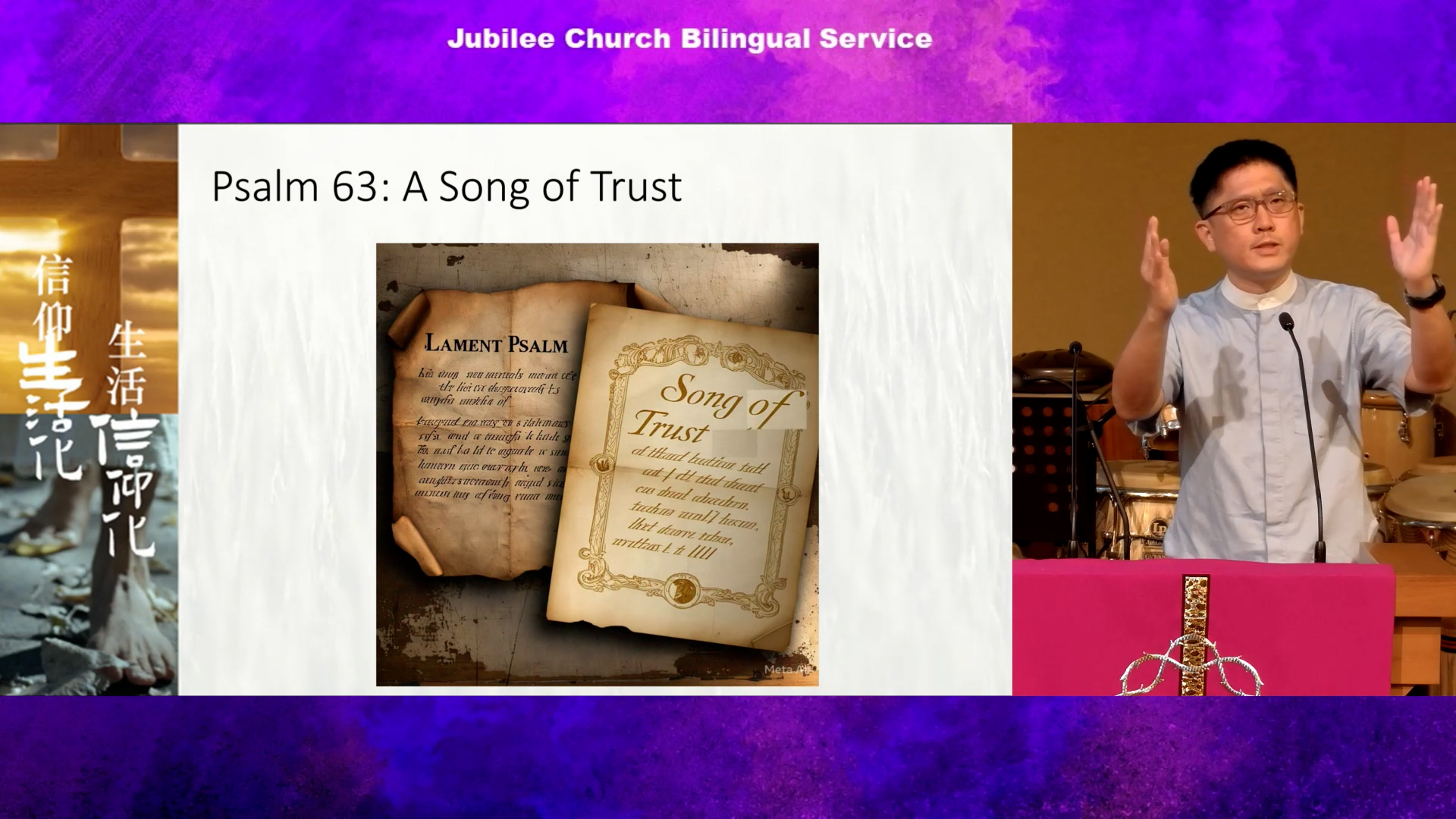
At this point, you might assume this is a typical lament psalm. The psalmist is in
trouble, so he cries out, describes his suffering, asks for help, and then
expresses trust and thanksgiving. However, this psalm is unique. It is not a
lament psalm. Prayers for help are the most common type of petition in the
Bible. We at Jubilee also bring our requests to God in worship, cell groups, and
personal prayers. Understandably, more than 50 psalms are laments. But Psalm
63 lacks an explicit plea for help, so it is classified differently.
Psalm 63 is a song of trust. 1 While lament psalms include expressions of trust,
songs of trust are unique because trust is the dominant theme. These psalms
are rare—only about ten in total. It is hard to be confident in the midst of
trouble, yet Psalm 63 shows that unwavering faith is possible even before
deliverance comes.
Psalm 63 paints a picture of a man in the wilderness, facing hardship and
uncertainty, yet responding with deep trust in God. David was on the run,
betrayed, and in danger. Yet, instead of lamenting or waiting until deliverance
to give thanks, he expressed unwavering confidence in God. He did not let false
accusations or betrayal shake his faith. Though lies spread like wildfire,
distorting reality and damaging reputations, David refused to let deception
define him. Instead, he anchored his identity in God’s truth. This psalm teaches
us to trust God wholeheartedly—not just when life is smooth but even in the
midst of trials.
Therefore, I believe Psalm 63 can guide us when we face false accusations,
misunderstandings, or gossip that shake our sense of security. How do we move
from letting fear and resentment take over to offering a prayer of trust like
David? Today, I will focus on the psalmist’s thought process—how he composed
such a remarkable song of trust.
The reason why David has so much trust and confidence in God lies in 2 keys
words in Psalm 63: “because” in verse 3 and 7.
3 Because your love is better than life,
my lips will glorify you.
7 Because you are my help,
I sing in the shadow of your wings.
These two “because” spells out the two reasons why David can find the
assurance he needs in his prayers and worship, and why his encounter with God
is so good that he can spend the entire night just thinking about it. 6 On my bed
I remember you; I think of you through the watches of the night.
The first “because” refers to the love of God, sometimes translated as
steadfastness or loving-kindness. The word is Khesed in the original Hebrew
because it is love based on the covenant of God. 2 We have shared this before in
multiple sermons so I won’t repeat it in detail. 3 My main point about Khesed
love is that David just has to remember who God is and his divine promises and
his commitment to his word, and David immediately knows God can be trusted.
The second “because” refers to the protective wings of God. This is a metaphor
that comes from the behavior of how many bird parents protect their young. It
is as if there a divine hiding place called “the shadow of God’s wings”, a
metaphor repeated five other times in the Psalms (17:8; 36:7; 57:1; 61:4; 91:4).
I can imagine as David says, “ 8 I cling to you; your right hand upholds me.” He
finds security in God’s promises.
These are the two things that David thinks about to find the assurance he
needs: God’s khesed love and God’s protective wings.
But David didn’t just hold these truths in his mind—he actively lived them out.
His trust in God was not a passive feeling but a daily practice shaped by his
habits of worship and thanksgiving. We don’t just need to learn how he thinks,
we must also learn what he does. David didn’t wait until trouble came to seek
God—he had already built a habit of trusting worship, which is why he could
remain confident even in difficulty.
Psalm 63: 1 You, God, are my God, earnestly I seek you; I thirst for you, my whole
being longs for you, in a dry and parched land where there is no water. The
word “seek” might have led us to think that David felt God was absent in that
moment, and so David had to look for him like how a traveller in a desert looks
for an oasis. If that is the case, then Psalm 63 would indeed sound like a typical
lament psalm.
But the word “seek” is in the Hebrew yiqtol verb form. Yiqtol verbs can be
translated into the present tense or future tense. But yiqtol verbs can also be
used for ongoing or habitual action. So when David says, ‘I seek you,’ it’s not a
one-time search. It means, ‘I am seeking You again, just as I always do.’ No
wonder God said that David was a man after His own heart (1 Sam 13:14). In
fact, much of Psalm 63 is written using the Hebrew yiqtol verb form. I believe
we should apply a similar understanding towards a lot of the yiqtol verbs
translated as future tense in Psalm 63: l I will praise (v.4,5), I will sing (v.7), I will
rejoice (v.11). Those yiqtol verbs translated as future tense doesn’t mean that
David will only do his thanksgiving after his troubles are over. Since they are
yiqtol verbs, it could also mean that these verses about thanksgiving can also be
understood also a habitual action for David both in good times and bad;
whether it is past, present, or future.
So, this is what David does, habitual seeking and habitual thanksgiving. And
when he is in his daily worship with God, he thinks about God’s khesed love and
his protective wings. No wonder David described himself as being satisfied by
God as like having eaten delicious food. It is like the frequent visit to a favourite
restaurant. If you know that if you go there, it is always good, won’t you
develop a craving just thinking about it? Won’t you go there with confidence,
trusting that your needs will definitely be satiated there? Of course. This is why
David can write his song of trust in the midst of his troubles. He is routinely and
in this case, already satisfied by the assurance he found in his worship.
Brothers, let’s follow David’s example in how he thinks and what he does. One
Presbyterian pastor responded to Psalm 63 in this way. 4 “Do I desire God? Do I
hunger and thirst for God? Do I enjoy the sort of relationship with God that fills
me with love and praise and satisfaction? Do you? Honestly? I read Psalm 63
and I feel guilty, inferior, spiritually weak, because I don’t desire God as David
did, at least not all the time, and certainly not with the same kind of intensity. I
wonder what’s wrong with me.” Brother and sisters, do you also want to
encounter God personally in worship? I wish for this level of spiritual yearning
as well. 5 What about you? How often do you think about God? What do you
think about when you pray? If we build the same habits as David, our trust in
God will grow—even in the midst of troubles.
We began by reflecting on how lies and character assassination can destroy
reputations and cause deep pain. David himself faced this when his enemies
spread falsehoods about him, seeking to undermine his rule and even take his
life. Yet, instead of responding with fear or retaliation, he placed his trust in
God. In Psalm 63, we see that his confidence was rooted in two key truths:
God’s steadfast love (khesed) and His protective care. Because David had built a
habit of seeking and worshiping God daily, he remained spiritually satisfied and
secure, no matter the circumstances. His unwavering trust serves as a model for
us today.
I want to end with a biblical story based on the Old Testament reading of the
lectionary:
Isaiah 55: “Come, all you who are thirsty,
come to the waters;
and you who have no money,
come, buy and eat!
Come, buy wine and milk
without money and without cost.
2 Why spend money on what is not bread,
and your labor on what does not satisfy?
Listen, listen to me, and eat what is good,
and you will delight in the richest of fare.
3 Give ear and come to me;
listen, that you may live.
I will make an everlasting covenant with you,
my faithful love promised to David.
Isaiah 55 echoes this same call to trust. The Israelites were exiled in Babylon,
but God reminded them that Babylon’s power and security were temporary.
God was offering something eternal—a covenant rooted in His steadfast love. 6
It is an invitation to eat and drink, and be satisfied daily in God. David chose to
trust, not because his situation had changed, but because he had confidence in
God’s character. He clung to God’s love and faithfulness, finding security under
the “shadow of His wings.”
So let us learn from David. Trust is not just about waiting for God to act—it’s
about knowing He is faithful even when we cannot see the outcome. It’s about
holding on to His love, believing that His promises stand firm. And as Isaiah 55:3
invites us: "Give ear and come to me; listen, that you may live." May we build
our lives on that trust, finding in God our ultimate security and satisfaction.
Amen.