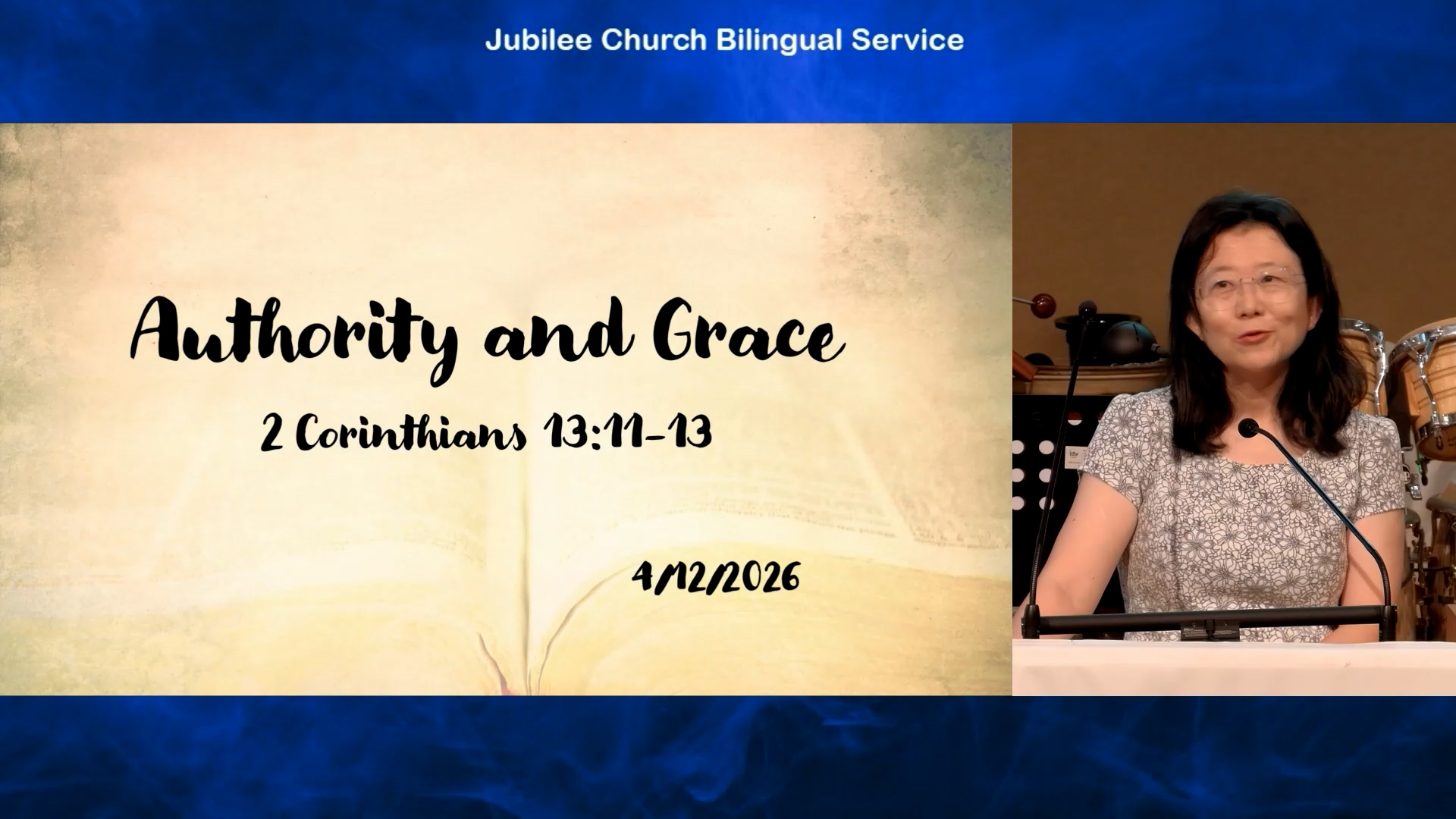
In February, I preached over 1Corinthians chapter 1, reminding and calling all of us to return to the essence of the gospel, to worship, to serve, and to live accordingly. Today the church assigned these passages to me, and I’d like to continue that sermon with the very last 3 verses of 2Corinthians.
Let me read them out.
11 Finally, brothers and sisters, farewell. Be restored; listen to my appeal; agree with one another; live in peace; and the God of love and peace will be with you.
12 Greet one another with a holy kiss. All the saints greet you.
13 The grace of the Lord Jesus Christ, the love of God, and the communion of the Holy Spirit be with all of you.
At first, these 3 verses may seem cliché. Restoration, unity, peace and God’s presence—these are words we often hear in church. And the last sentence is the benediction which we all know very well. So many times, at the end of worship, the chairperson raises both hands and blesses us with these words.
But when we read the lines in light of the whole story behind this letter, and when we look at them more carefully and feel them with our hearts, we begin to see that they are not just some common Christian terms. Not at all! Paul’s final exhortation and blessing are indeed meaningful and powerful.
- Paul and the church in Corinth
In the last sermon, we learnt that Paul and his co-workers left Corinth, and heard that many problems had come up in the church. The believers did not really understand the gospel. They were still thinking like the Roman society around them. They cared about honor and status. They admired the rich. They followed gifted leaders, and this led to division.
There were arguments about food, worship, and serving. There was sexual sin. The whole church was in a mess. So,Paul wrote them a letter—what we now call First Corinthians. Trying to bring them back to the heart of the gospel. But it did not work out. Instead, it faced strong resistance from the church.
Brothers and sisters, Paul was the first pastor of this church. He and his co-workers started from zero. They preached the gospel, led people to Christ, and worked hard to build up the church. Now the church had gone astray, and they even turned against him. therefore, Paul decided to go back to Corinth himself, thinking that speaking to them face to face would make a difference.
2 I already gave you a warning when I was with you the second time. (2 Cor 13:2a)
But it did NOT. Instead, he was attacked, and his authority was challenged “His letters are weighty and strong, but in person he is unimpressive, and his speech amounts to nothing.”
Paul had no choice but to leave. He returned to Ephesus deeply hurt.
Now, I invite you to go into Paul’s world. Think about this… A cell leader notices that a married brother may be close to an affair. He often goes out alone with a female colleague. The leader wants to stop things from getting worse, so he gently speaks to him. But the brother refuses to listen. He was irritated, and even makes up stories to attack the cell leader.
Another example. A Sunday school teacher sees that some children don’t behave. They use 4-letter words and bully others. So the teacher talks to the parents. But the parents criticized her, saying, “You are not loving enough. You cannot accept each child’s uniqueness.”
Imagine, you were that cell leader, or that Sunday school teacher。。。
Now, can you feel Paul?
Ok, Paul still could not let go of this church. He could not let go of these brothers and sisters. Finally, he wrote another letter, hoping that the gospel of Jesus Christ would not be trampled any more, and the church would not fall into even greater confusion.
He wrote with tears; he spoke from the bottom of his heart. He tried very hard to clear up their misunderstandings and respond to their attacks. He shared his own life story, to show the power of the gospel— a power that looks weak, but is truly strong.
- Paul’s Defence and Clarification
He made 3 points:
No 1, a Christian must be measured only by Christ—by His weakness and His strength.
Some impressive people had come to the Corinthian church. They called themselves “super apostles.” They questioned Paul’s apostleship and said he did not show the marks of a true apostle. Paul responds very sharply: (read verses)
He did not compare himself with the so-called super apostles in terms of wealth, status, rhetoric skills, or amazing spiritual experiences. Brothers and sisters, what Paul emphasizes is his suffering. He speaks of being looked down on. He speaks of the places where he seems weak and like a loser. What he boasts about is the suffering he has gone through for the gospel.
He also boasts about God’s refusal to recover his health. When there is great pain in his body, he appealed to God three time. But God chose not to remove it. (12:7–10).
Paul also talks about spiritual experiences. He had received very special and mysterious visions, maybe more extraordinary than any believer in his time. But he chose not to say much about them (12:1–6).
Underlying this bitter irony is a clear and firm theological claim. In the faith of Jesus Christ, the way we measure weakness and strength is not the way of those “super apostles.” In 13:3-4, he speaks of Christ’s crucifixion in weakness, and resurrected life in power.
His 2nd point: Self-examination before judgement of others
The believers in Corinth were constantly evaluating Paul and his co-workers in many areas. So Paul turns it back on them and says, “Examine yourselves. Test yourselves.”
No. 3, Paul would rather he himself fails if the believers are strong.
Paul’s deepest desire is this: that the Corinthian believers will pass the test. Even if he himself seems to fail, even if he and his co-workers appear weak, as long as the believers are strong, he will be truly glad and satisfied.
- For the Gospel: Defending Apostolic Authority
Brothers and sisters, from all these, do you see what really matters to Paul? His mind is only on the gospel. He desires what God desires — that every believer would receive and enjoy the life from God, a full and flourishing life.
At this point, let me take a short detour. Some of us may wonder: we often preach from Paul’s letters and take him as an example, does that mean pastors are always selfless, always thinking only about the gospel and the church? I must admit, there are indeed very ugly cases in this world. Just this Monday, The Straits Times reported a case about a pastor who repeatedly abused a young girl[1].
And you may also ask: is the relationship between pastors and the church always tense? Of course not. In many churches, the relationship is healthy. For example, Jubilee Church. Our church has always shown great care, support, and understanding toward the pastoral staff. Even though I have only been in full-time ministry for four years, I am confident about this. you accepted me as your pastor, and you bear with my English, till today.
And now, as a Synod preacher on leave and a member of Jubilee Church, your love and support are still there. Many of you have been asking about my studies. Let me take this chance to update you. I am finishing my 2nd semester of MTh program in TTC, working on a project in Christian Education, a very important domain of church ministry. By God’s grace, I hope to finish the thesis by next year May.
Alright, let us come back to Paul.
Paul really wants to mend his relationship with the Corinthian church. He wants them to accept his authority again and recognize him as an apostle of Jesus Christ. But authority is not his goal, not his point.
His authority serves the gospel of Jesus Christ. It is there so that the gospel he preaches and lives out will be heard, will take root in their hearts, and will bear fruit in their lives.
In other words, his authority can make his message very clear: the believers no longer belong to themselves. They cannot just live however they want. Their lives, and their relationships with one another, are built on what God has done—on His work in Jesus Christ. They belong to Christ. And their life together must reflect the One they belong to—the One and only God!
- Grounded in God’s Work in Christ
In a very practical way, what believers are called to do is this: live in peace with one another, and love one another.
“Brothers and sisters, farewell. Be restored; listen to my appeal; agree with one another; live in peace. And the God of love and peace will be with you.” (2 Cor 13:11)
Now we know all the conflict in the Corinthian church, and all the tension between them and Paul, these — “live in peace” , “love one another” —are not casual words. Paul does not say this lightly.
He has said so much. He has given so much. It is as if he has opened his heart to them. And in the end, this is his appeal: because of what Jesus Christ has done, do not stay astray. Do not keep fighting over leaders. Do not keep dividing the church over status and wealth.
You were bought by the precious blood of Christ. So lay down all these barriers. Live in peace with one another.
Now, living in peace does not mean there will be no conflict, no disagreement. Even in a small family, a husband and wife from different backgrounds can have many conflicts. How much more in a big family like the church?
Conflict is not the problem. Different opinions are not the problem. The key is how we face them, and how we deal with them.
Paul set us a wonderful example. And it is Jesus’ example that he follows. Christ, as the son of God, is willing to give himself up, for the sake of reconciliation between God and man.
Brothers and sisters, living in peace and loving one another does not mean we compromise our principles. It does not mean we stop caring about right and wrong. In times of conflict, we seek God. We return to the gospel. And in the spirit of the gospel, we look for the best way forward. Truth and love go together. Justice and mutual acceptance must both be kept.
- the Alpha and Omega of the church—the triune God
After saying all this, Paul ends with a blessing in the name of the Father, the Son, and the Holy Spirit.
Among all ending blessings in his letters, this is the only place where Paul clearly names all three—the three persons of the triune God:
“The grace of the Lord Jesus Christ, and the love of God, and the fellowship of the Holy Spirit be with you all.” (2 Cor 13:13)
Some Bible scholars say the situation in Corinth was so serious that Paul had to appeal to the triune God. Systematic theologians often use this verse as support for the doctrine of the Trinity. Others study how grace is linked to Christ, love to the Father, and fellowship to the Holy Spirit.
To be honest, we don’t know the exact reason. In fact, none of these is Paul’s focus.
If we follow the flow of the whole letter, and Paul’s line of thought, we can see this: in the end, Paul blesses the church with God’s gifts — the gifts of the Father, the Son, and the Holy Spirit. That is, grace, love, and fellowship.
This final blessing is not just a formality. He really means it. The church needs rigorous teaching. It needs faithful preaching. It also needs believers who hold on to the truth and live it out. But in the end, the One who builds the church is God. The One who carries the church forward is God. The Alpha and Omega of the church are God, our triune God!
The church must depend on God’s gifts, God’s work, and God’s sustaining power.
B/S, the history of the Church is a history shaped by God.
Even more, the history of humanity is a history shaped by God.
Let me share two stories.
One is what happened globally 500 some years ago.
The other is a story of a small local church.
In the 15th and 16th centuries in Europe, ordinary believers became more and more serious and passionate about faith. They wanted to be involved. At the same time, the church had long held great power and lived in complacency, and it became more and more corrupt. Church offices were bought and sold. Authority was abused. Indulgences were promoted. Doctrine was distorted. Little by little, the foundation of the Western church began to shake.
All these led to the Reformation in the 16th century. And at the same time, within the Catholic Church, a new force was rising—the Society of Jesus, The Jesuit, begun by St. Ignatius.
The rise of the Jesuits and the Reformation went hand in hand. Both started in simple and unexpected ways. Yet both changed and impacted the church profoundly. In different ways, faith was renewed, church was transformed, and more were blessed.
The Reformation brought the doctrine back to the gospel. Bible was translated into common languages, so ordinary people could read God’s Word themselves. It called people to trust in grace, and to see salvation as God’s gift, not human effort. It reshaped church life, calling believers to live out their faith in daily life.
The Jesuits, on the other hand, became a strong force for renewal within the Catholic Church. They were devoted to mission, education, and spiritual formation. They founded schools, trained leaders, and brought the gospel to many parts of the world. Their discipline, learning, and passion reformed the church from within.
This movie, the silence, is the story of Jesuit missionaries who suffered greatly as they brought the gospel to Japan.
All these are God’s work—carried out with His perfect grace and wisdom.
Despite the corruption in the global church, God brought his people back to Himself. Renewal sprang up from within.
Now, the story of the local church?
A pastor once went to preach at a church he knew well. The passage was Psalm 133, which is known for promoting brotherly love. As he preached, he had no idea what was going on in that church. He simply shared from the text.
After the service, a church leader, came up to him and asked nervously, “Pastor, how did you know there was conflict in our church?”
The pastor was completely innocent. He didn’t know anything. But since he was a trusted friend of the church, and the church leadership already took the matter seriously, they invited him to step in.
Later, he did sense a prompting from the Spirit when looking into the matter closely. And after lots of talks, listening, and even confrontations, the divided parts were reconciled, the church was restored.
Brothers and sisters, there are many stories like this — big and small, here and there.
People make mistakes. We all have our flaws. Churches can go through troubles. Even pastors can fall. But God never fails. He cares for His church, He guides His church, He restores His church!
The One who builds the church is our God. He is the One Paul leans on. He is the One Paul entrusts the Corinthian church to. And He is the One we trust.
So let us respond faithfully to His saving work, in the power of the risen Christ. And let us walk day by day with our Heavenly Father, in the Holy Spirit.
May the blessings from God be with you all. Amen!