Introduction
One author describes Lent as a double journey. It is a journey into the mystery of God — into the mystery of His Son who died for our sins. At the same time, it is a journey “into the depths of our humanity.”[i]
This is the journey Lent invites us to take. During this season, believers are called to look more closely at ourselves — at our longings and intentions, our values and our responses. Lent is not only about what Christ has done; it is also about who we are and who we are becoming.
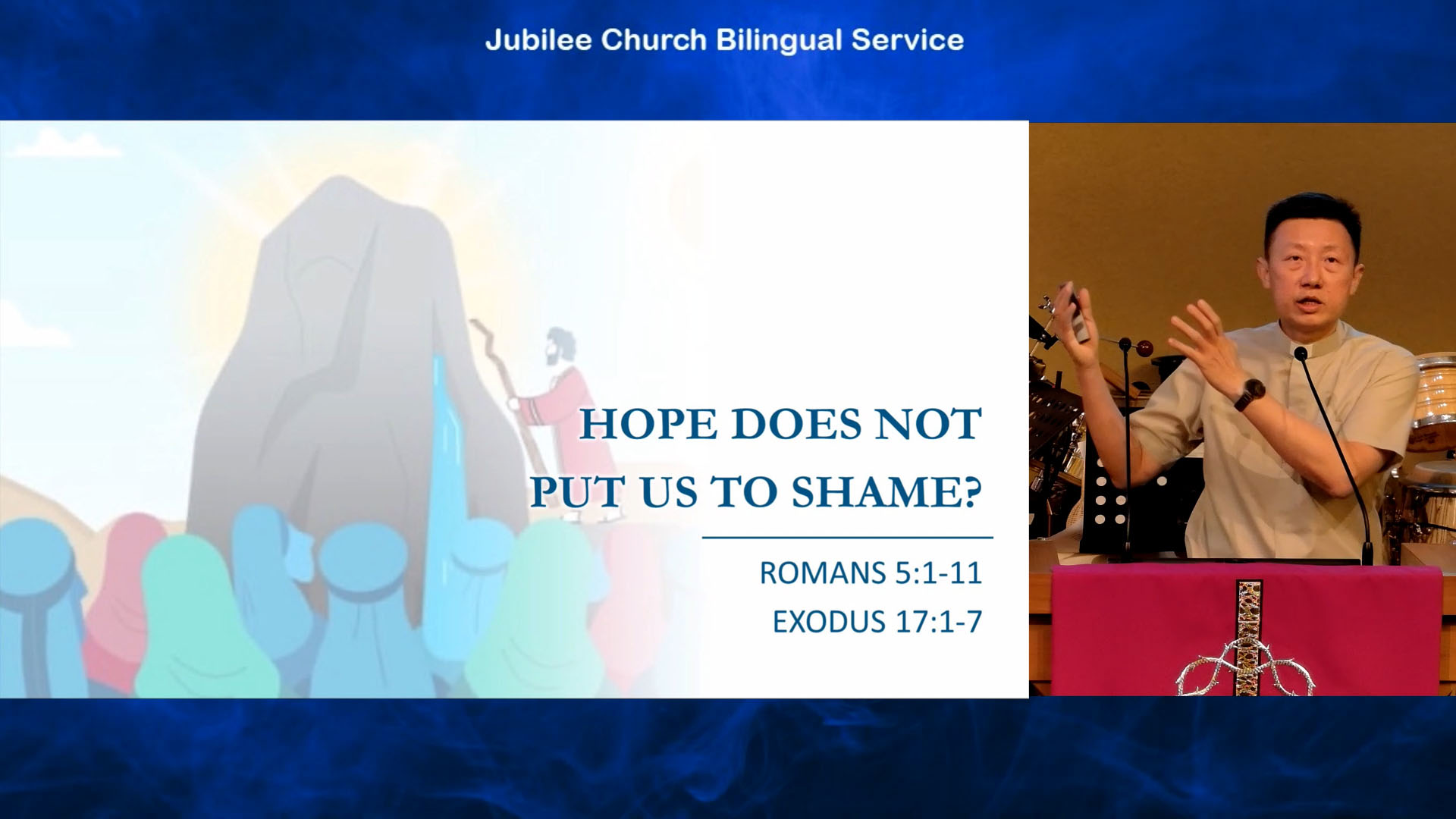
The readings this morning invite us to do exactly that. In the first reading, we are shown a moment when Israel’s true heart is revealed (Ex 17:1-7).
- The reading recounts what happened when the Israelites, on their journey to the Promised Land, could not find any drinking water.
This was a serious situation. We all know how essential water is for survival. And in this case, we are not speaking of one or two individuals, but an entire community — a vast company of travellers: children, the elderly, families, and their livestock. Every life depended on water. Without it, they would not survive for long.
Faced with that reality, the people panicked. And honestly, most of us would probably have done the same. Under the pressure of thirst and the threat of death, they began to react. They quarrelled with Moses. And they tested the Lord.
It appears that the Israelites had quickly forgotten that the Lord was their help. Not long before this, they had already faced two crises involving water. At the Red Sea, they were trapped between Pharaoh’s army and the waters. The Lord opened a way for them, and they passed through safely. Soon after that, at Marah, the water they found was bitter and undrinkable — and the Lord made it sweet.
In both instances, God intervened. In both instances, He proved Himself faithful. Yet they had not learned to trust Him.
But what happens at Rephidim is actually something even worse — something we might miss unless we look more closely at the text.
The people quarrelled with Moses, who was more than just a leader. He was the one through whom God performed mighty works and delivered His instructions. As a prophet, Moses stood as God’s representative before the people.
To quarrel with Moses, then, was to quarrel with God Himself.
And the word translated “quarrelled” is a Hebrew verb with legal overtones — a word used to describe bringing a charge against someone, even taking them to court. The author of Exodus wants us to picture what is happening: this was not simply an emotional outburst, but an accusation — what they did was tantamount to putting God on trial.
The second description — that they “tested the Lord” — is no less serious. To test the Lord does not mean that the Israelites were innocently seeking proof that God was faithful. Nor was it because they had not seen enough of His power to trust Him.
They had, in fact, already witnessed God’s mighty acts — at the Red Sea and at Marah. So they knew that God was able to provide water when there was none.
The real problem is that instead of trusting Him, they demanded that He act. Rather than showing humble dependence, their posture was one of challenge — an attempt to force God’s hand, demanding that He prove Himself once again. This is most likely what their question really meant: “Is the Lord among us or not?” (v.7)
If He is — and He is the Lord — prove it. The issue was not their thirst, but their unwillingness to trust God.
That is why this story speaks so directly to us during the season of Lent. Lent invites us to look honestly at our own hearts — including how we respond when life becomes difficult.
The story at Rephidim is not only about Israel’s past. It also reveals something about the human condition — our tendency to value immediate relief over trusting God, to want to command God rather than follow His commands. Scripture has a name for this tendency: hardness of heart.
The psalm appointed for today underscores this same human tendency and warns us not to fall into it. Verses 7 and 8 of Psalm 95 say, “Today, if you hear his voice, do not harden your hearts, as at Meribah, as on the day at Massah in the wilderness.”
The story in Exodus and the warning in the psalm both reveal something we recognise in our own lives — the struggle within us — the constant oscillation between obedience and resistance, between trusting God and doubting Him.
What, then, should we expect from God as we struggle with this constant oscillation of the heart?
One possibility is that God chastises and punishes us for our disbelief. We can find many stories in the Bible where God responds in this way.
Another possibility is that God shows grace—reaching out to help us, forgiving us in our moments of weakness. We find many examples of that in Scripture as well.
But sometimes God responds in ways that go beyond what we would expect, even beyond what we can imagine. And in the story from Exodus, we see one such surprising response.
After Moses cried out to God because of the hostile reaction from the people, the story continues:
“And the Lord said to Moses, ‘Pass on before the people, taking with you some of the elders of Israel, and take in your hand the staff with which you struck the Nile, and go. Behold, I will stand before you there on the rock at Horeb, and you shall strike the rock, and water shall come out of it, and the people will drink.’ And Moses did so, in the sight of the elders of Israel.” (vv.5-6)
At first glance, nothing here seems particularly surprising. But let’s look again.
We said earlier that what Israel did at Massah and Meribah was, in effect, to put God on trial. They demanded proof: “Is the Lord among us or not?” In other words, they summoned God to answer their accusation.
And what did God do?
In a surprising way, God went along with their demand. He attended the trial — as the defendant.
Why does God say He will stand “on” the rock at Horeb rather than beside it? In the imagery of a courtroom, God places Himself where the accused would stand — as though He were taking the defendant’s place. And why is everything done “in the sight of the elders of Israel”? Because they serve as witnesses — even, metaphorically speaking, as judges — in this strange court case.
In this moment, God allows human beings to summon him to trial. That is the startling part of this story.
And what is the outcome? God proves them wrong. Yet instead of punishment, He provides water. In this moment, God answers human hostility with grace — surprising grace.
The people drink, their lives are sustained, and they continue their journey. Yet the deeper problem remains. The oscillation between obedience and resistance does not end there — not in Israel’s story, and not in ours.
That leads to a question we should ask ourselves this Lent.
If our hearts are so often caught in this oscillation — between trust and doubt, obedience and resistance — what hope do we have?
II.
The answer the New Testament gives is this: our hope does not rest on us, but on God.
And this is exactly what the second reading from Romans 5 reminds us. Paul tells us what God has done through Jesus Christ.
God — the one offended by human sin — acted first to make peace with us. Through Christ, we are reconciled to Him and have access to the very grace in which we stand.
And this changes everything. We are now able to boast in the hope of sharing God’s glory. We can even boast in our sufferings. And above all, we boast in God Himself. We boast because He has done what we could never do, giving His beloved Son for us and restoring the relationship we had broken.
But the question remains.
What does it mean to say that our hope rests in God, especially as we struggle with that constant oscillation of the heart — between trusting and doubting, obedience and resistance?
III.
A short reflection on the portion about boasting in suffering might shed some light on the question. Let’s read the verses again, “And not only that, but we also boast in our afflictions, knowing that affliction produces endurance, and endurance produces character, and character produces hope, and hope does not put us to shame, because God’s love has been poured into our hearts through the Holy Spirit that has been given to us.” (Rom 5:3-5)
Some commentators say that the spiritual growth described in these verses can indeed happen—but only under a basic condition. The person going through suffering must respond in the right way. They face their difficulties with prayerful confidence, continue rejoicing in God, or respond in other faithful ways.
That sounds reasonable. In fact, it matches our common experience. If we were using this passage to encourage someone who is going through a hard time, wouldn’t we say something similar? I think we would. We would tell the person not to give up, to keep praying, and to keep trusting in God.
But someone has pointed out that Paul never actually says this in the letter. He does not add a condition like, “if we respond properly.” Instead, Paul simply states it: suffering produces endurance, endurance produces character, and character produces hope.
So that raises a question for us: why does Paul leave out that condition?
Either Paul is extremely optimistic about everything—like Uncle Ivan—or perhaps, at this point, he is being a little simplistic in his thinking.
But the answer must be neither.
I think the point Paul is making is exactly what we have already mentioned: our hope does not rest on us, but on God. In Romans 8, he puts it this way: “Those whom he justified he also glorified” (Rom 8:30).
What does these loaded words mean? Simply, it is God who declares us righteous. We did not become righteous in God’s eyes by our own efforts. And those whom God declares righteous—he himself will also bring to glory. He is the one who will see to it that they are filled with godliness and, ultimately, with glory.
How will that happen?
When will that be? Paul does not tell us.
He only wants us to know this: the God who can bring forth water where there was none, the God who brought the entire creation into being—this God can surely do this as well.
We are people who constantly oscillate between obeying and resisting God. That is what we see when we look honestly at ourselves. And often we do not even know how to be otherwise.
But in Romans 5, Paul directs our gaze away from ourselves and toward God—the one who gives us hope, and the one who will train us to hope more steadfastly.
So what does it mean to say that our hope rests in God? It means knowing that what he declares will come to pass. And when it does, it will not be because of us, but because of him.
Paul can speak so confidently because he believes that the process of spiritual growth does not ultimately depend on the steadiness of our hearts, but on the faithfulness of God. The suffering that produces endurance, the endurance that produces character, and the character that produces hope—all of this is grounded in God’s work, not ours.
I want to say this one more time: It is God who declares us righteous, God who carries us toward glory. Even when we waver, even when we struggle, hope endures—not by our strength, but by God’s. With this, we see the answer to the question posed in the title: hope does not put us to shame, because it rests securely in God.
IV.
So what is our role, since God is the one who helps us hope in Him? One author suggests picturing hope not just as a desire — like wishing that there will be no more pain or tears when we reach heaven — but as a muscle that needs exercise. Just like a muscle, hope weakens if we don’t use it. The more we exercise it, the stronger and more resilient it becomes. Seen this way, hope is by definition active—it involves participation, commitment, and even risking.
Risking—why? The same author suggests picturing daily life as a dance with Jesus. In dancing, partners sense each other’s movements and they flow together. And when it’s time for a challenging move—like a lift or a flip—dancers take a risk, trusting their partner to support them through the stunt. That’s how active — and participative — hope should be. As the author puts it:
“…hope is not the patient, waiting hope of the final inheritance, but the daily, energetic hope of a relationship dance with Jesus Christ—prayers whispered throughout the day, little risks of faith that anticipate the Spirit’s work, simple trust that believes God will place steady ground under each next step.”[ii]
We mentioned at the start that Lent is “a journey into the depths of our humanity.” To hope is to go even deeper into that journey. And that can feel risky, because we may not know how to face what we find there.
But Paul’s teaching on hope reminds us: no matter how deep, how dark, or how tangled our situation may be, those whom God has justified he will also glorify. Trusting that promise, we keep stepping forward. We keep trusting the Lord. And we keep dancing.