Introduction
Every event brings with it certain outcomes and results.
We organize birthday parties for our loved ones in the hope that the celebration will lead to the birthday babies feeling loved and celebrated.
Churches hold evangelistic events in the hope that more people will come to know Christ.
Whether what we hope for comes to pass or not, there will still be an outcome, for every event brings with it its own results and consequences.
At this very time, the Iran conflict is ongoing. It has already resulted in higher fuel prices, people reconsidering their holidays, and hawkers and other businesses experiencing reduced earnings. Not to mention other anticipated effects, such as higher electricity tariffs in Singapore when rates are adjusted in July, potential job losses, and an increase in scams as people look for alternative sources of income.
Event; effects.
The same logic applies to events in nature. Rain—run or get drenched.
Here’s a recent example: on April 6, a group of hikers were ascending a mountain on Indonesia’s Halmahera Island when an active volcano suddenly erupted. The hikers just metres away from a billow of smoke and volcanic ash.
Event; effect; and we also add: response.
The local guide responded by instructing the hikers to do something counterintuitive—he told them to run uphill instead of descending. In fact, he urged them to move upward quickly. He later explained that his decision was based on years of experience: descending could have placed the hikers directly in the path of the ash flow if the wind changed direction.[i]
Event; effect; response.
I am sure we all know the answer to this question—what is the greatest event in the Christian faith? The Resurrection. Event; effect; response.
It is no different when it comes to the historical events proclaimed in Scripture.
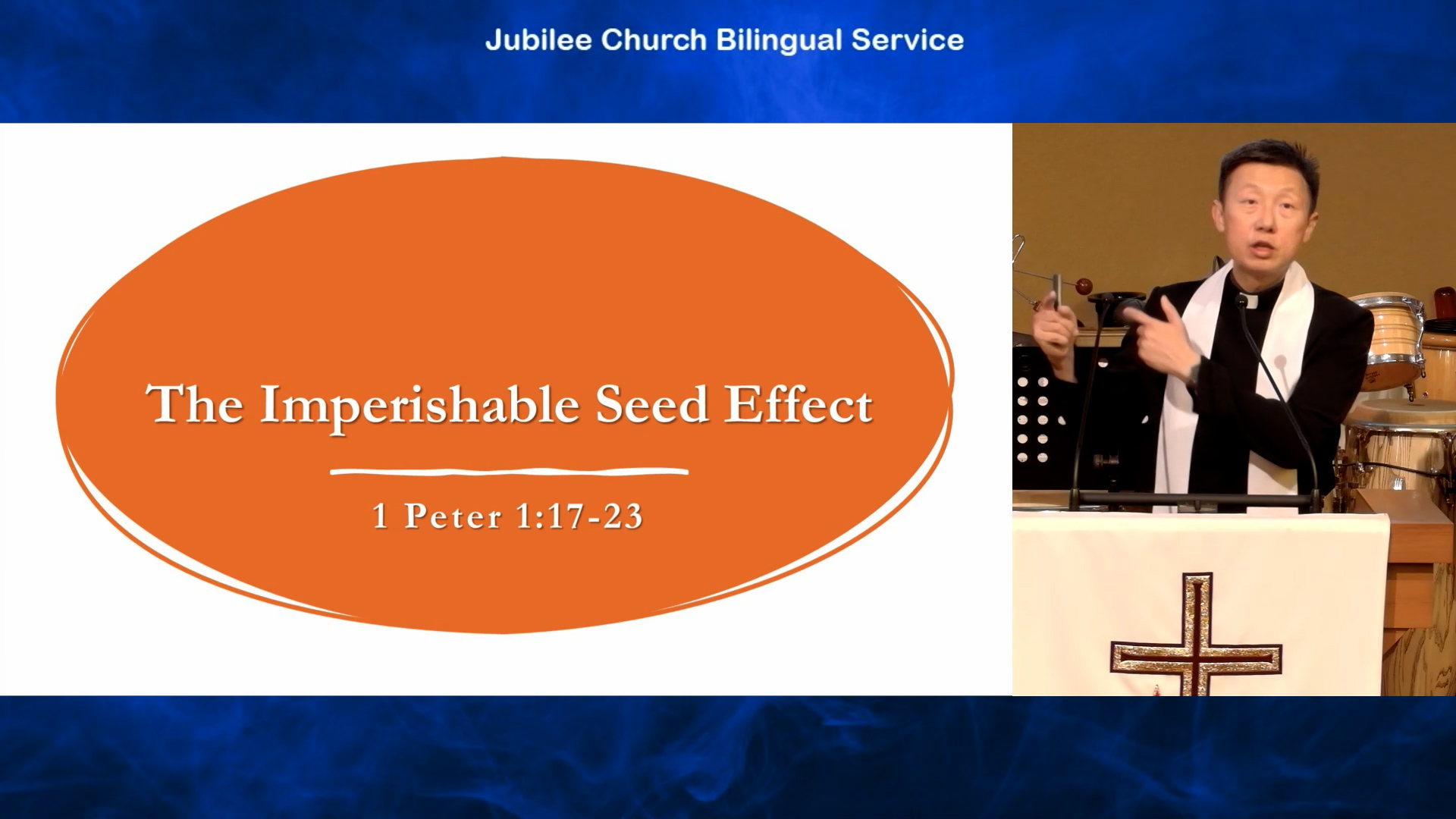
Today is the 5th Sunday of Easter. Easter Day celebration is over and done with—rehearsals and presentations are all completed in faith and love—and we have since moved on with life. More biblically put, we are continuing as God’s people in the Easter season. Easter, at its core, is the event of the Resurrection. Today, based on 1 Peter, we want to reflect on the effect and the response.
I.
The effect is most clearly expressed in 1 Peter 1:3: “Blessed be the God and Father of our Lord Jesus Christ! According to his great mercy, he has caused us to be born again to a living hope through the resurrection of Jesus Christ from the dead.”
Although the resurrection happened so long ago, believers today know and are certain of their hope because God has spoken through His Word. And God’s Word is living and abiding—that means it continues to convict and remain active, as Peter says. He aptly calls it the imperishable seed.
Friend, God’s Word—the Bible in your hands and on your phones—is the imperishable seed. And we know this: when seed is merely held in human hands, no life comes forth. Seed must be sown into good soil.
Allow me to digress a little. I don’t have green fingers, but I have tried my hands at potted plants and know, at least in principle, that even good soil requires care. From time to time, we need to replenish nutrients, aerate the soil, and allow oxygen to reach the roots.
Likewise, those who are born of the imperishable seed are already good soil. Brothers and sisters in Christ, you and I are that good soil.
But it is still worth asking: how are we tending to this soil?
Rather than asking whether we should, perhaps the better question is how. For believers, this begins with a heart of gratitude and humility—a heart ready to let God, and His people, speak truth in love into our lives. That is what good soil does.
So, whether alone before God or with a trusted fellow believer, let’s do so this week by taking time to ask: is my soil in good condition? Reflect on the past weeks, or how you have lived since the start of 2026. Ask ourselves. whether we habitually and instinctively think and act according to God’s Word—the imperishable seed.
And ask God to renew and refresh the soil He has already made good, doing so with humility and anticipation.
With that in mind, we return to Peter’s letter. What does he call God’s people—those who have been born of this imperishable seed—to do?
II.
In today’s passage, we focus on two of Peter’s exhortations that call for a response on our part.
The first exhortation is found in verse 17: “And if you call on him as Father who judges impartially according to each one’s deeds, conduct yourselves with fear throughout the time of your exile.”
Here we see an effect of the resurrection: we now call on God as Father, and yet He is also the One who judges impartially. And so Peter calls us to live before Him with fear.
As we consider Peter’s exhortation to fear God, it is helpful to first remind ourselves who were Peter’s audience, and what does Peter mean when he describes God this way?
Peter’s readers were Christians scattered across various Roman provinces because of persecution. For these Christians, For these Christians, their situation would have felt like a new beginning, as they learned to live in a foreign land. For some, it would have been especially difficult.
Yet instead of offering only words of comfort and encouragement, Peter calls them to fear God. Why? His reason is tied to who Christians—the good soil—actually are. It is a matter of identity.
I would like to share a quote that may help us think more deeply about the Christian identity, especially in relation to life in the wider world outside the faith community. The quote is rather long, but I believe it is worth our attention, so bear with me.
Christians do not come into their social world from outside seeking either to accommodate to their new home (like second generation immigrants would), shape it in the image of the one they have left behold (like colonizers would), or establish a little haven in the strange new world reminiscent of the old (as resident aliens would). They are not outsiders who either seek to become insiders or maintain strenuously the status of outsiders. Christians are the insiders who have diverted from their culture by being born again. They are by definition those who are not what they used to be, those who do not live like they used to live. Christian difference is therefore not an insertion of something new into the old from outside, but a bursting out of the new precisely within the proper space of the old.[ii]
In short, Christians are defined by their new, born again identity, and their actions are its expression.
Hence, whether scattered or not, and wherever they may be, believers fear God. Period.
However, when God is described as an impartial judge, He can easily be misunderstood as cold and harsh, as though we must get everything right all the time or else stand condemned, and obedience becomes something dreadful rather than joyful.
Such misunderstanding fades when we look not only at this verse, but also at other parts of the letter. We saw earlier in 1:3 that God has great mercy. And in verse 21, we see that He vindicated Jesus and approved His work, so that we might have faith and a true hope. These verses make clear that God is not distant but loving.
So to fear God is not to be terrified of Him, but to have a reverent fear toward a God who is perfectly impartial and yet perfectly loving.
What does it look like—or feel like—to fear God in daily life?
Imagine driving, or one of the other activities on the screen. A good driver does not drive well only because he knows the traffic rules and how to operate a vehicle, but also because he has a healthy sense of caution. He knows that an accident can happen at any moment, so he drives carefully.
Or think of professional skiers. They fly down slopes at high speed and seem to take difficult corners with ease. Yet they never stop being careful to maintain their balance—because without it, they would end up in the trees instead of reaching the finish line.
The kind of fear Peter is calling us to looks something like this: not a fear that makes us doubt God’s goodness, but a careful, reverent awareness that keeps us from becoming careless or doing something foolish, while still trusting fully in His goodness. And we should fear God, because all people—including believers—will one day stand before the Judge.
I hope this brief elaboration has made Peter’s first exhortation clearer and helped us respond to it more consistently in daily life.
III.
The second exhortation is to love one another earnestly. Peter’s emphasis, as we look more closely at verses 22 to 23, is on why believers not only should—but in fact will—do so.
Because, if we follow Peter’s logic of new birth, when a person is born again of imperishable seed, God’s eternal nature—that is, His character and ways—is, in a sense, generated in that person. God is holy and loving, and so too are those who are born again, though not yet perfectly. So even now, God’s people begin to reflect His character.
What is truly remarkable here is this: to say that these new ways are generated means that we are not merely influenced, encouraged, or motivated by the Bible or by other believers to act in certain ways. It means that something that was not there before, is now caused, produced—brought into existence. And so, believers not only should—but in fact will—love one another earnestly.
This has come about for us because Jesus paid a price. As one writer puts it, He “pays the concrete price of the gift of Himself… [and] he buys for this price a reformation of our wills, a change of our hearts.” [iii]
The church reminds us that we have been redeemed at a great cost. Peter tells us that Jesus gave His life so that we might be able to love.
And this love is characterized by integrity, benevolence, transparency, and sincerity—not hypocrisy or two-faced. Do we see this kind of love in the church? Yes, but perhaps not always. And in some corners of the church, such love is painfully lacking. When it comes to love, there is still room for growth.
Let me close with this: dear “good soil”—all of us who have been born again in Christ. The price has been paid so that we might live out the effect of the imperishable seed: to live in reverent fear of God and to love one another earnestly.
We are busy city dwellers. Whether you are working or studying, managing a home, or caring for family members, life is often demanding.
But Peter calls us to understand who we are before God, so that we may live as who we are in the world: redeemed people, called to live before Him in reverent fear, and sent into the world to bless and to love.
So the reminder this morning is simple: let us keep our soil receptive, so that we may be continually shaped by our Lord and bear the fruit of His life in us.